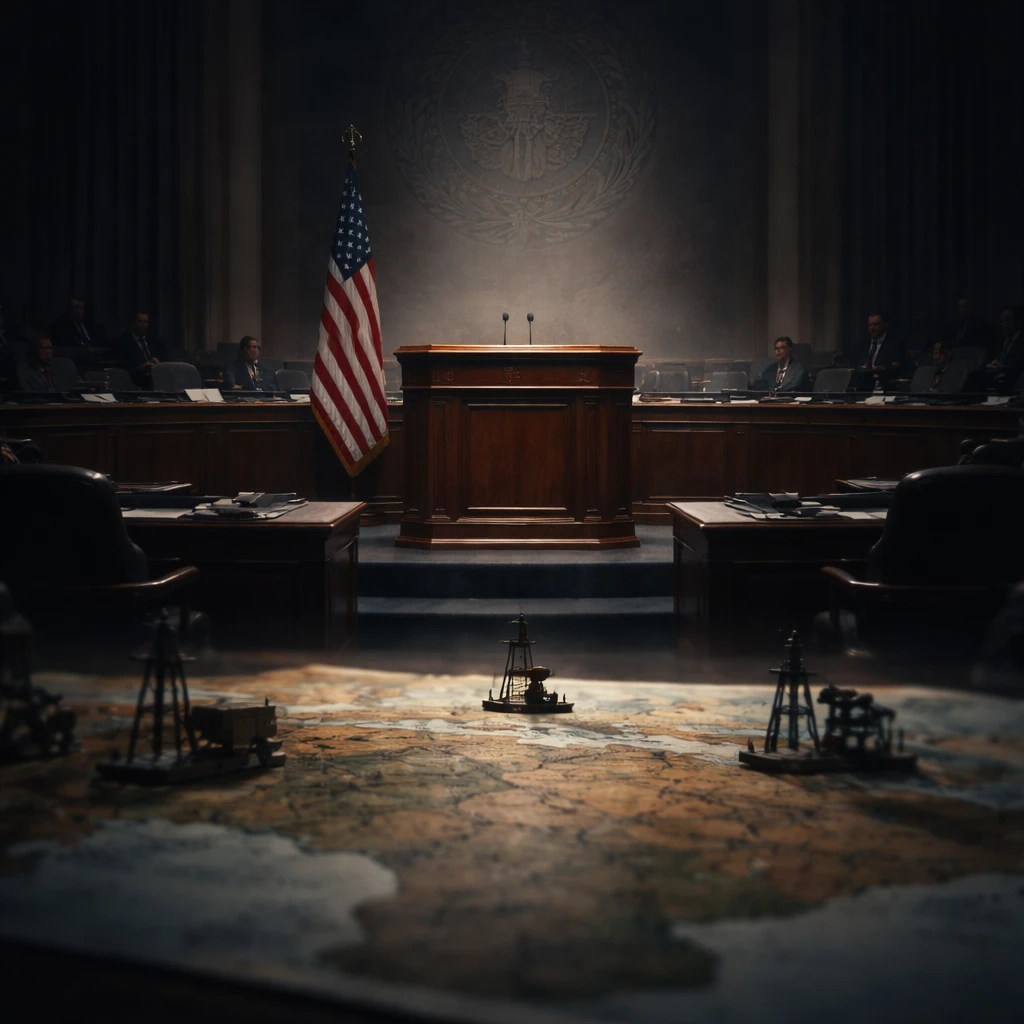
In a significant move reflecting growing congressional resistance, the United States Senate voted narrowly to restrict President Donald Trump's capacity to launch new military engagements related to Venezuela. The measure, passed on Thursday with a 52-47 vote, emphasizes legislative oversight of warfare and pushes back against the President's plans regarding the South American nation.
The Senate's resolution, spearheaded by Senator Tim Kaine, a Democrat from Virginia, and supported by Republican Senator Rand Paul of Kentucky, seeks to prohibit further hostile actions against Venezuela unless specifically authorized by Congress. This bipartisan effort saw five Republicans joining all Democrats in favor of the resolution, marking a notable departure from uniform Republican support for the President on foreign military actions.
This War Powers resolution, having cleared the Senate, is set to proceed to a final vote in that chamber before moving to the House of Representatives, which remains under Republican control. The path ahead for the resolution is uncertain, as it faces considerable obstacles, including a likely veto from President Trump, underscoring the contentious debate over executive military authority.
Expressing strong disapproval of the Senate dissenters, President Trump criticized the Republicans who voted against him. He asserted that these senators should feel ashamed for siding with Democrats in attempts to diminish his capacity to defend the United States and engage in military action as he sees fit.
Amidst these legislative tensions, President Trump shared insights into his vision for America's role in Venezuela during a recent interview. He indicated that US involvement in the country's affairs, particularly its oil resources, could endure for an extended timeframe, suggesting an oversight period lasting years. When asked about the duration, the President responded that "only time will tell" but anticipated it would be "much longer."
Furthermore, Trump expressed intentions to facilitate rebuilding efforts in Venezuela in a manner that would be "very profitable," implying economic considerations as a component of the US strategy for the oil-rich nation.
These comments come on the heels of a special operations raid conducted on January 3 in Caracas, resulting in the detention of Venezuelan President Nicolás Maduro and his wife, Cilia Flores. The detained president faces federal charges in the United States, including narco-terrorism and conspiracy to import cocaine, charges which he has denied. Maduro maintains that he remains Venezuela's legitimate leader despite his detention on US soil.
Venezuela's vast oil reserves underscore the strategic importance of the country. Data from the U.S. Energy Information Administration identifies Venezuela as holder of the world's largest proven oil reserves, estimated at approximately 303 billion barrels. This volume accounts for nearly 17 percent of global oil reserves. Nonetheless, decades marked by mismanagement and the impact of international sanctions have severely diminished Venezuela's oil output, reducing it to roughly one percent of global supply.
The country also faces a profound humanitarian crisis, with economic collapse and political instability driving more than 7.9 million Venezuelans to flee. This mass displacement ranks among the largest migration crises on record, highlighting the severe challenges confronting the region.
Following Maduro’s capture, interim authorities in Venezuela took measures that included releasing several journalists and activists, describing these actions as steps toward seeking peace. However, rights organizations report that numerous political prisoners remain detained, indicating ongoing concerns regarding human rights and political freedom within the country.
As the US government navigates its complex role in Venezuela, balancing military, economic, and humanitarian factors amid legislative scrutiny, the situation remains fluid and fraught with uncertainty. The Senate’s move to assert control over war powers reflects broader debates over appropriate channels for authorizing military engagement, while the President’s expressed long-term interest in overseeing Venezuela’s reconstruction adds further complexity to the evolving scenario.