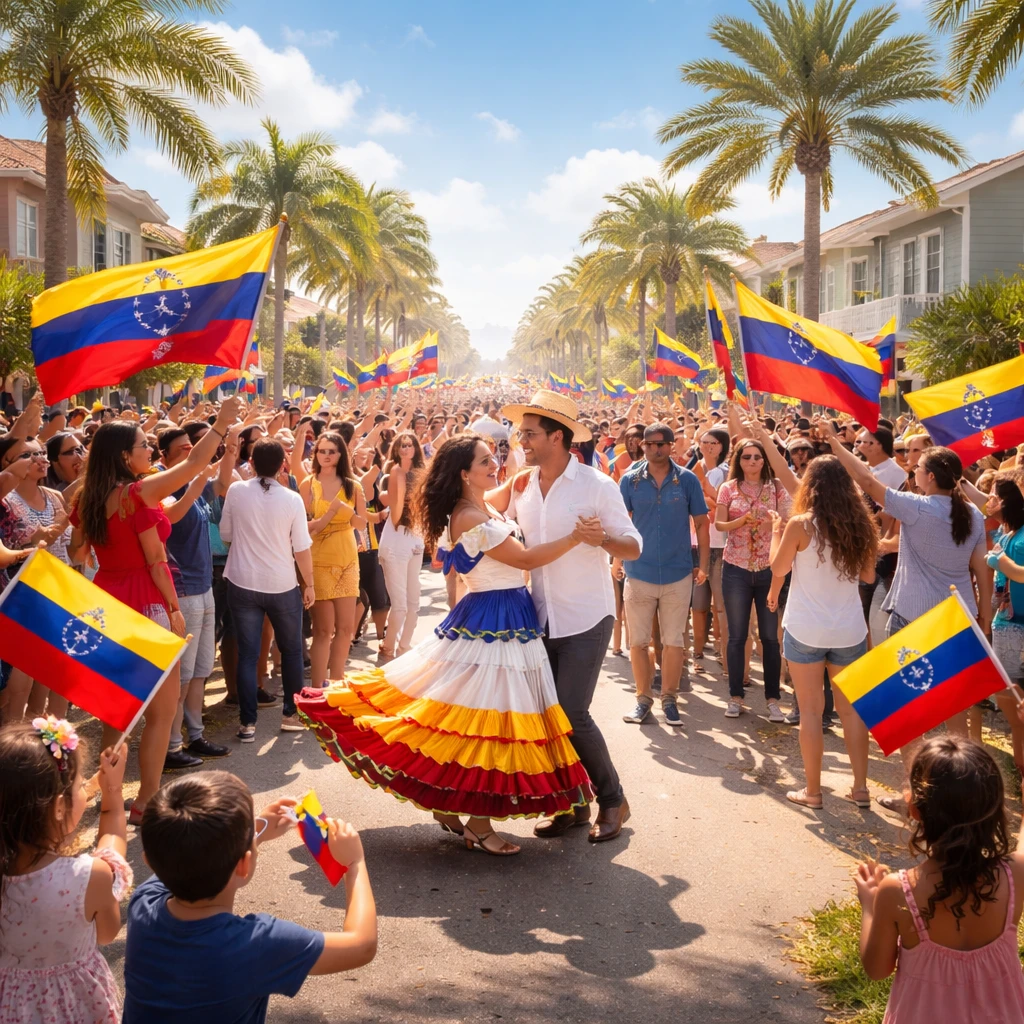
In the suburban city of Doral, Florida, home to a large Venezuelan community, residents reacted with visible and vocal excitement upon confirmation that Nicolas Maduro, Venezuela’s sitting president, had been apprehended by United States military forces. The event unfolded early on a Saturday morning and was marked by impromptu street celebrations featuring music, dancing, and widespread honking from vehicles, underscoring the deep connection the local diaspora maintains with their home country’s political dynamics.
The celebrations gathered momentum around El Arepazo, a well-known Venezuelan arepa eatery within the city, which became a central meeting point for residents eager to share in the momentous occasion. The gathering underscored not only communal solidarity but also the intensity of sentiments sparked by the political developments in Venezuela.
Many participants in the celebrations have been closely monitoring the ongoing political tension in Venezuela, especially in recent months during an escalated period of pressure exerted on Maduro’s government by the prior U.S. administration. The community's outlook combines relief and cautious optimism yet includes a degree of apprehension concerning future developments now that Maduro has been removed from power via extraterritorial military action. Questions persist about the trajectory Venezuela’s political landscape will take following the ousting of its leader.
The international response to the capture of Maduro has been notably varied and often sharply divided. In the United States, Senator Bernie Sanders of Vermont openly criticized the military operation, challenging both its conformity with international legal standards and the constitutional authority claimed by the Trump administration to conduct an armed action against a foreign sovereign nation. This reflects ongoing debates within U.S. political spheres regarding executive power and the scope of military intervention abroad.
On the global stage, leaders from allied western democracies such as France and the United Kingdom issued statements supporting the removal of Maduro's regime, framing the action within the context of promoting political change in Venezuela. Conversely, major powers including China and Russia issued objections to the U.S. incursion, emphasizing concerns over sovereignty violations and the implications such unilateral actions might have on international norms and geopolitical stability.
Amidst a complex geopolitical landscape and the local community’s earnest response in Florida, the aftermath of Maduro’s capture presents multiple layers of uncertainty. While the immediate public response in Doral highlights a profound desire for change and the significance of diaspora voices in American cities, the broader consequences for Venezuela’s future governance and international relations remain unsettled and closely watched.