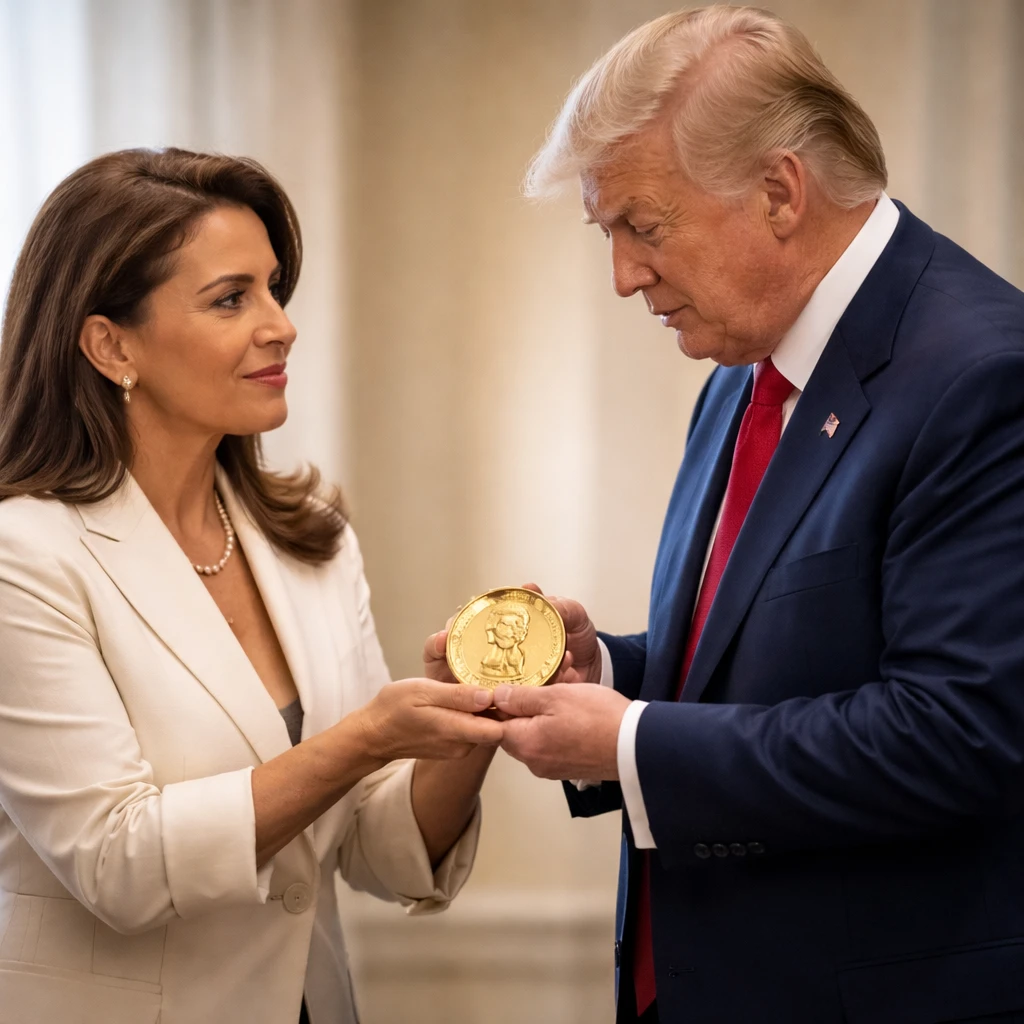
In a notable political moment at the White House on Thursday, María Corina Machado, a leading opposition figure from Venezuela, handed President Donald Trump the Nobel Peace Prize medal she had received. The event, conducted in the presence of U.S. officials, demonstrates Machado's ongoing attempt to shape American perspectives on Venezuela's political future.
Following the luncheon, President Trump expressed his appreciation via his social media platform, Truth Social, describing the presentation as "a wonderful gesture of mutual respect." He acknowledged Machado's honor, stating, "Maria presented me with her Nobel Peace Prize for the work I have done." Trump’s remarks conveyed a symbolic recognition of his efforts related to Venezuela.
Machado characterized their meeting as "excellent," highlighting that the gift was meant to acknowledge what she views as Trump's dedication to securing freedom for the Venezuelan people. According to a White House official, Trump plans to retain the medal, suggesting the gesture holds ongoing personal and political significance.
This exchange arrives amid a backdrop of discussions regarding Venezuela's leadership following recent U.S. actions targeting President Nicolás Maduro. Earlier this month, Maduro was captured in a U.S. operation described as a "snatch-and-grab," intensifying focus on potential political shifts in Venezuela. Despite some proposals advocating for Machado to assume Venezuela's leadership in the changing environment, Trump publicly dismissed such suggestions.
Trump's interest in the Nobel Peace Prize has been longstanding, as he pursued the accolade before Machado was awarded it last year. He voiced dissatisfaction when not selected, tying his aspirations for the prize to various diplomatic initiatives, including cease-fire deals and his assertive policy stance on Caracas.
It is important to note that, according to the regulations of the Norwegian Nobel Institute, the Peace Prize cannot be revoked, transferred, or shared. This clarification was reiterated in light of discussions about the possibility of sharing the award between Trump and Machado. Although Machado presented the accompanying gold medal to Trump during their meeting, she retains ownership of the Nobel title itself.
When questioned about whether he desired to receive Machado’s Nobel Prize, Trump responded, "No, I didn't say that. She won the Nobel Peace Prize," underscoring the distinction between his ambitions and Machado’s official award.
The luncheon marked the first in-person meeting between Machado and Trump, lasting a little over an hour. Subsequent to this gathering, Machado engaged with more than a dozen U.S. senators from both major political parties. Reports indicate that she has generally encountered warmer support within the Senate than from members close to Trump, reflecting varying degrees of receptiveness among political stakeholders.
Machado, who escaped Venezuela via a covert sea route in December, is striving to amplify her influence with U.S. policymakers amidst competing interests within Venezuela, including those of interim President Delcy Rodríguez. The Venezuelan opposition, along with allied countries across Latin America, hopes that Maduro’s removal will pave the way for authentic democratic elections. Nevertheless, analysts remain cautious, acknowledging that a true democratic revival in Venezuela remains uncertain.
In summation, Machado’s presentation of her Nobel Peace Prize medal to Trump is a symbolic but politically charged act, emphasizing her efforts to align with influential U.S. figures as she seeks a meaningful role during Venezuela's potential transition. The interaction reflects complex dynamics involving recognition, diplomacy, and competing visions for Venezuela’s future governance.