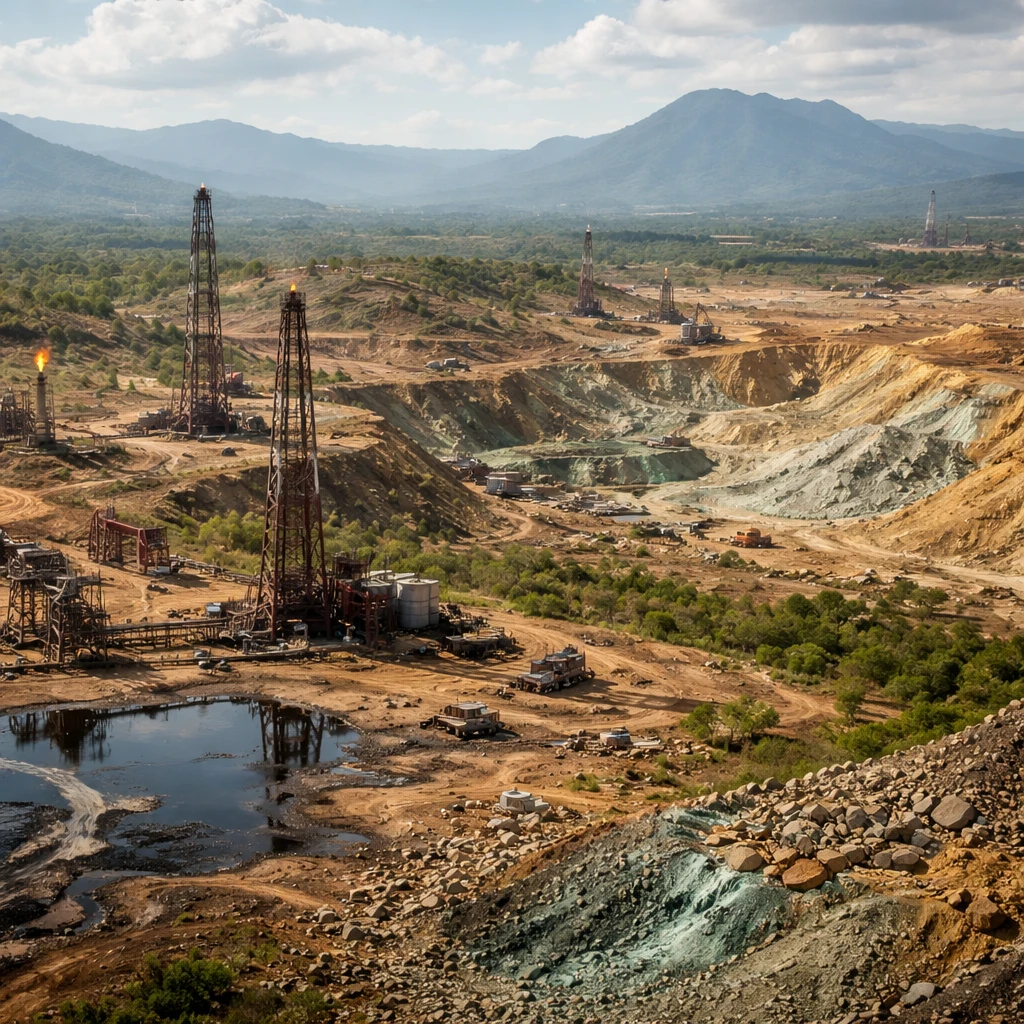

The recent announcement that US firms may gain access to Venezuela’s vast oil reserves has placed the country’s energy resources squarely in Washington’s strategic outlook. Beyond petroleum, Venezuela is believed to harbor significant deposits of minerals, metals, and potentially rare earth elements—materials indispensable to a range of industries from national defense to high technology. However, experts caution that extracting these resources and integrating them into secure, reliable supply chains poses complex challenges that extend beyond those encountered in the oil sector.
According to Reed Blakemore, director of research at the Atlantic Council Global Energy Center, the US administration recognizes the broader value of Venezuela’s natural resources beyond oil. Yet, the conditions for exploiting these mineral resources—such as geological data scarcity, security concerns, and economic feasibility—render the situation substantially more complicated. Blakemore notes, “If we’re talking about the conditions under which we are able to exploit those mineral resources and bring them to market, it’s a much more challenging story, and even, frankly, more challenging than the oil story.”
Security risks in the mining regions further complicate extraction efforts. Many areas, particularly within Venezuela’s Orinoco Mining Arc, are frequented by guerrilla soldiers and armed groups involved in illegal gold mining activities, elevating operational risks and hindering legitimate mining enterprises. Additionally, rare earths mining, which is energy-intensive and environmentally taxing, presents environmental concerns that must be considered when assessing the viability of resource development.
Even if US companies were able to initiate mining operations for rare earth elements in Venezuela, the process of bringing these materials to the market entails more than extraction. The refinement phase is critical and poses an additional challenge. Today, China dominates the global refining of rare earth elements, accounting for over 90% of processing capacity as of 2024 according to the International Energy Agency. This dominance stems from decades of Chinese government subsidies, industry expansion, and relatively lax environmental regulations.
The strategic value of rare earths has escalated in US-China relations, with export controls imposed by Beijing during trade disputes underscoring Washington’s concerns over the reliability of supply chains. Joel Dodge, director of industrial policy and economic security at the Vanderbilt Policy Accelerator, emphasizes that the geopolitical and industrial advantage China maintains in rare earths processing “cannot be overcome overnight.”
The US Geological Survey (USGS) identifies 60 critical minerals essential to economic and national security. Among these are commodities such as aluminum, cobalt, copper, lead, and nickel, along with 15 rare earth elements like cerium, dysprosium, neodymium, and samarium. These rare earth elements encompass 17 metallic elements crucial for consumer electronics—including phones and batteries—as well as defense technologies like lasers, fighter jets, and missile systems.
Despite the term “rare earths,” these elements are relatively abundant in the Earth’s crust. The principal challenge lies in industrial extraction and refinement, processes that are technically complex and capital intensive. This reality has driven US policymakers in recent years to focus on reducing dependency on foreign imports of critical minerals through initiatives supporting domestic mining and processing. However, the timeline to develop these projects can extend over several years or even decades.
Venezuela does not appear among the USGS-listed countries with known rare earth element reserves, a reflection in part of limited data availability resulting from over 25 years of governance under former President Hugo Chávez and current President Nicolás Maduro, which has constrained accurate geological assessment. Nevertheless, experts recognize that the country likely holds deposits of certain critical minerals. These include coltan—a source of tantalum and niobium—and bauxite, which may contain aluminum and gallium, all of which are categorized as critical minerals by USGS.
In 2009, Hugo Chávez publicly highlighted Venezuela’s mining potential, referring to coltan as “blue gold” and announcing the discovery of significant reserves. More recently, in 2016, President Maduro designated the Orinoco Mining Arc to promote mineral exploration and production. Yet this designated zone has struggled with illegal mining and associated organized crime activities.
BloombergNEF metals and mining analyst Sung Choi summarizes the situation: “While the country sits on large deposits of mineral resources, it is crippled by a combination of poor geological data, low-skilled labor, organized crime, lack of investments and a volatile policy environment.” Choi assesses that despite Venezuela’s geological potential, it is unlikely to make a meaningful contribution to the critical minerals sector for at least the next decade.