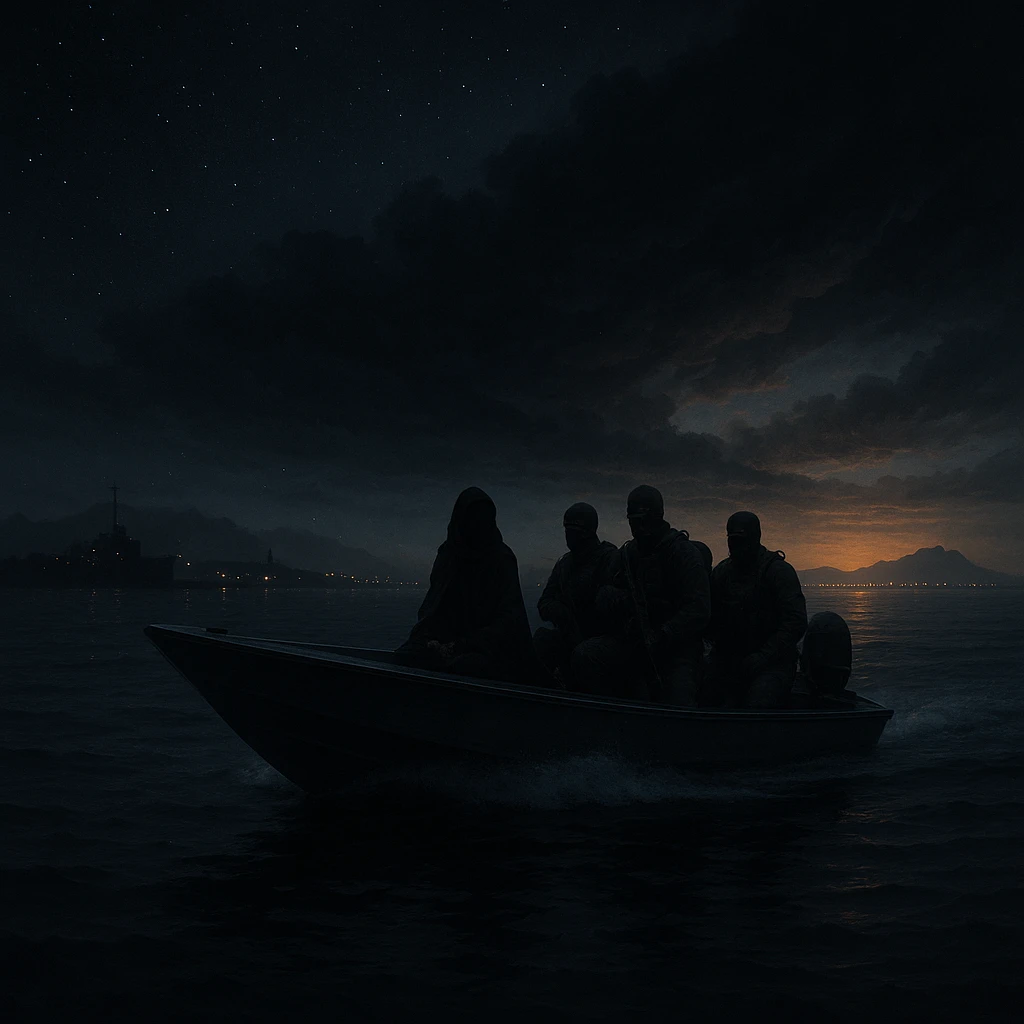

In an extraordinary episode blending elements of international politics and clandestine operations, María Corina Machado, Venezuela's newly minted Nobel Peace Prize winner, was extracted from her homeland in a daring maritime operation masterminded by a team of U.S. Special Forces veterans.
Machado's journey to the Nobel ceremony in Oslo was far from routine. For over a year, she lived covertly, hidden away after leading an opposition movement that, according to validated election results overseen by international observers, decisively defeated incumbent Nicolás Maduro. Despite these results, Maduro refused to relinquish power, launching a widespread crackdown on opposition figures including Machado.
Ensuring her safe passage out of Venezuela fell to Bryan Stern, a former U.S. Special Forces soldier and founder of the Grey Bull Rescue Foundation, comprised of military veterans experienced in high-risk extraction missions worldwide. While his group had orchestrated numerous rescues, Stern acknowledged the unique difficulties presented by this operation, termed "Operation Golden Dynamite"—a nod to Alfred Nobel, the Peace Prize's namesake and dynamite inventor.
"She's the second most popular person in the Western Hemisphere after Maduro," Stern said, emphasizing the operation’s complexity due to her high profile. This notoriety increased the challenges of maneuvering her out undetected through a hostile environment tightly controlled by Maduro's government.
With only a week to devise an effective strategy, the team evaluated options. Overland escape was quickly deemed unfeasible due to extensive checkpoints where recognition and apprehension were inevitable. Consequently, a maritime route was chosen to evade surveillance and government forces.
However, this option carried its own hazards. The U.S. military had recently escalated operations along Venezuela's coast, destroying nearly two dozen suspected narcotics smuggling vessels and eliminating at least 87 individuals. Aware of these activities, Stern coordinated with U.S. officials to operate safely within this sensitive theater.
To minimize risks, Stern rejected the use of a large, fast boat typically employed by narcotics traffickers—which are targeted by military patrols. Instead, the team selected a less conspicuous craft capable of blending into regional maritime traffic, reducing the chance of interception.
Despite careful planning, the rendezvous in the Caribbean Sea hit a snag when Machado’s arranged vessel failed to arrive as scheduled. Adaptability was crucial in the face of uncertainty; Stern’s team altered their plan and traveled directly to locate her craft instead.
Amid pitch-black conditions and turbulent seas with 10-foot waves battering both vessels, tensions peaked. Each crew remained on edge, wary of the possibility that the other could be hostile agents or affiliated with cartels. Stern described the encounter as "scary stuff," highlighting the dangers of nocturnal sea navigation under such circumstances.
At last, the crews identified each other audibly, with Machado’s voice clarifying the identity and allaying fears. Once she was safely aboard, conditions improved, and a subsequent smooth passage to a Caribbean island—widely reported though not confirmed as Curaçao—ushered Machado out of immediate danger.
A private aircraft was positioned on the island to transport her from there to Oslo, where she would receive international recognition for her efforts under immense personal risk.
Throughout the extraction, Machado displayed remarkable resilience. Stern remarked on her toughness compared to even seasoned military veterans. While the team grappled with cold, hunger, and wet conditions, Machado remained steadfast without complaint, earning Stern’s admiration and confirming the robustness behind her moniker, "Iron Lady." He described her as "gnarly" and "pretty awesome," underscoring the extraordinary nature of her persona and endurance.
This operation sheds light on the extreme measures required to safeguard political leaders opposing authoritarian regimes. It also exemplifies the role military veterans play in protecting democratic principles abroad, often operating in challenging, high-stakes environments far from home.