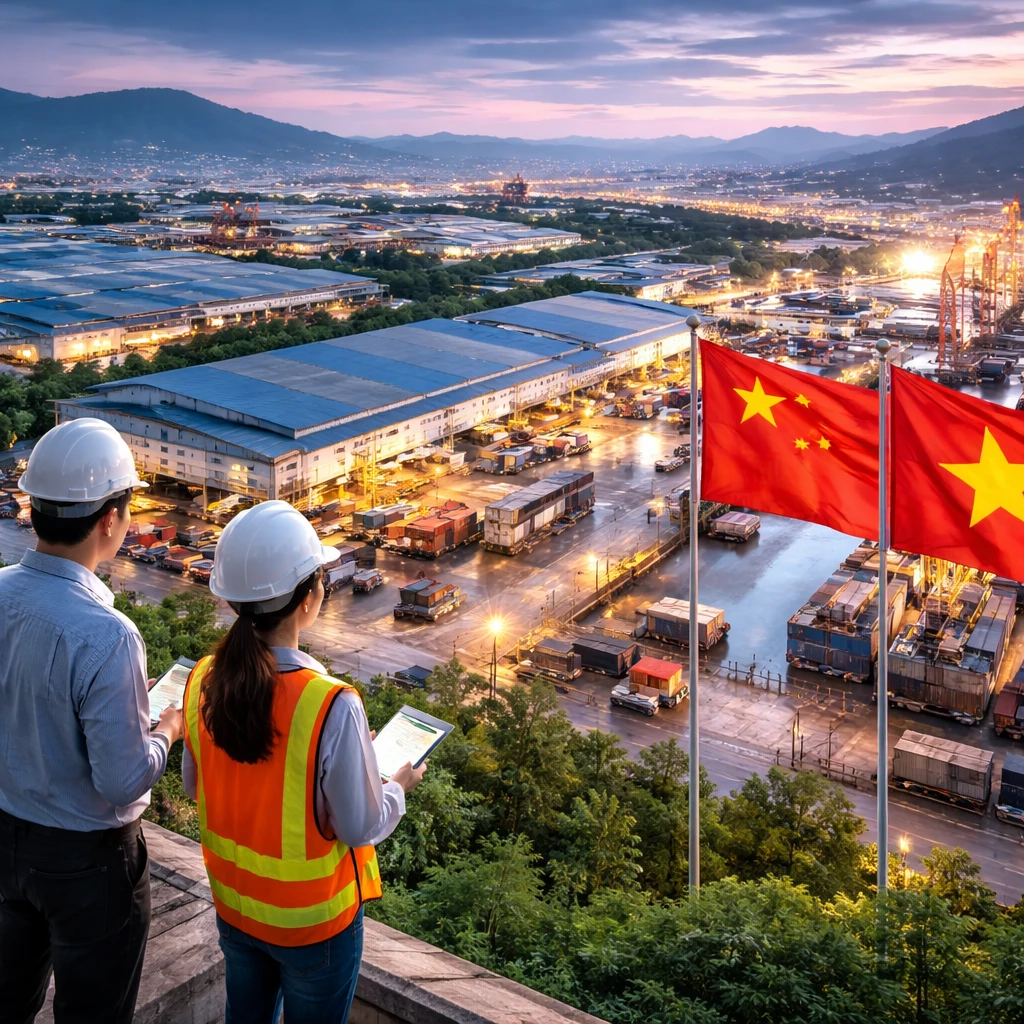

The city of Bac Ninh in northern Vietnam exemplifies the country's profound economic transformation. Previously famed for its rice paddies and the age-old Quan Ho folk songs, Bac Ninh has morphed into one of Vietnam’s foremost industrial zones. This metamorphosis reflects expansive foreign investment bolstered by the tariff tensions initiated by former U.S. President Donald Trump, which accelerated manufacturers relocating operations from China to Vietnam.
This trend supplements earlier waves of Japanese and South Korean investment, establishing Vietnam as a prominent global manufacturing center. Yet, the nation’s accelerated industrialization faces obstacles such as escalating labor costs, inadequate local infrastructure, and labor shortfalls. Concurrently, robust competition from Indonesia and the Philippines intensifies the challenge for Vietnam to sustain its industrial growth.
Within Bac Ninh, the shift is apparent. Chinese and Korean culinary establishments are common, and business signages frequently display Chinese language, indicating the influence of increased Chinese commercial activity. Following normalized diplomatic relations since the 1990s, Chinese companies have significantly increased their investment in Bac Ninh, drawn by its developing electronics supply chain, available workforce, and favorable local government policies. Chinese-speaking facilitators help navigate administrative procedures and logistics, easing this influx.
Vietnam, however, remains a substantially smaller economy than China, whose GDP eclipses it by a factor of 40. To remain competitive and absorb rising foreign investment, the Vietnamese government has prioritized infrastructural development, including constructing a new highway to the Chinese border that trims travel time by over an hour. Additionally, a railway connecting Hanoi to Haiphong’s port and onward to the border town of Lao Cai is underway, enhancing trade logistics.
On December 19, 2025, Bac Ninh initiated the expansion of an industrial zone focused on advanced manufacturing sectors such as electronics, pharmaceuticals, and clean energy. This development forms part of Vietnam’s coordinated national strategy that saw the launch of 234 major projects valued at over $129 billion preceding an important National Party Congress. This congress will determine Vietnam’s future political leadership and economic strategies.
The growing Chinese presence is striking; downtown Bac Ninh hosts stores named after Alibaba’s flagship online marketplace, Tmall, while Chinese-Vietnamese language institutes serve the educational needs of both communities. However, as Chinese firms seek the most favorable labor conditions and resources, the “China plus one” strategy encounters rising expenses. Labor costs have increased by 10% to 15% since the beginning of 2024, and efforts to attract workers have included wage premiums, signing bonuses, and commuter subsidies.
Despite the relocation of manufacturers from tech hubs such as Shenzhen to Vietnam, domestic challenges persist. Vietnam still depends heavily on Chinese technology, equipment, and expertise, leveraging China’s optimized manufacturing ecosystem developed through decades of government backing and substantial investment. Experts acknowledge that replicating China’s manufacturing scale and efficiency in Vietnam is not achievable overnight.
U.S.-based logistics firms note Vietnam’s limitations relative to China in infrastructure and logistics capabilities. In response, companies often undertake elaborate recruitment initiatives in manufacturing centers like Bac Ninh to mitigate workforce shortages. Workers are enticed with additional benefits to counterbalance the competitive employment market.
Vietnam has emerged as one of the significant beneficiaries of trade friction between the U.S. and China, with the U.S. remaining its largest export destination. The country posted a trade surplus of $123.5 billion with the U.S. in 2024, ranking third globally behind China and Mexico. Although threatened at one point with tariffs up to 46%, Vietnam ultimately faced a 20% tariff rate after negotiations, and the two countries continue efforts to maintain this tariff level. Vietnam has reciprocated by providing preferential access to U.S. products.
The trade truce agreed between the U.S. and China in October 2025, reducing tariffs on Chinese exports to an average of approximately 47%, eased some trade tensions but did not halt the relocation of manufacturing factories away from China. Companies now adopt a more diversified approach, spreading production across several Southeast Asian nations. While Vietnam offers only a modest 10% cost increase due to manufacturing inefficiencies versus China, smaller firms face challenges in financing and equipping new facilities in the region.
Vietnam’s cumulative foreign direct investment reached over $28.5 billion by September 2025, up 15% year-on-year, signaling strong international confidence. Nevertheless, scrutiny of Vietnam’s role as a transshipment hub for tariff avoidance prompts caution among some manufacturers, who diversify operations to other countries such as India. Competitors like Indonesia and the Philippines capitalize on their respective regulatory advantages and incentives to attract manufacturing projects, with the Philippines extending private land leasing rights for up to 99 years to foreign investors.
Looking ahead, Vietnam aspires to be a “tiger economy” by 2045, emulating models like South Korea and Taiwan. This transformation involves moving beyond low-cost assembly toward producing high-value goods including electronics and clean energy components. The government incentivizes upgrades with tax reductions on imported machinery and discounted industrial land rents. Currently, automated technology usage remains limited to about 10% of production lines, reflecting significant potential for modernization.
Vietnam’s strategies also include expanding export markets to regions beyond the U.S., targeting areas like the Middle East, Latin America, Africa, and India. State trade offices play an active role in market intelligence and product promotion, supporting these diversification efforts. Despite the optimistic projections, rising production costs and intensified competition from regional peers will test Vietnam’s capacity to sustain its economic trajectory and the growth of industrial centers such as Bac Ninh.
In December 2025, Vietnam’s Prime Minister Pham Minh Chinh underscored the nation’s ambition, urging the country to “reach far into the ocean, delve deep underground and soar high into space,” highlighting the strategic imperative to continue advancing economically and technologically.