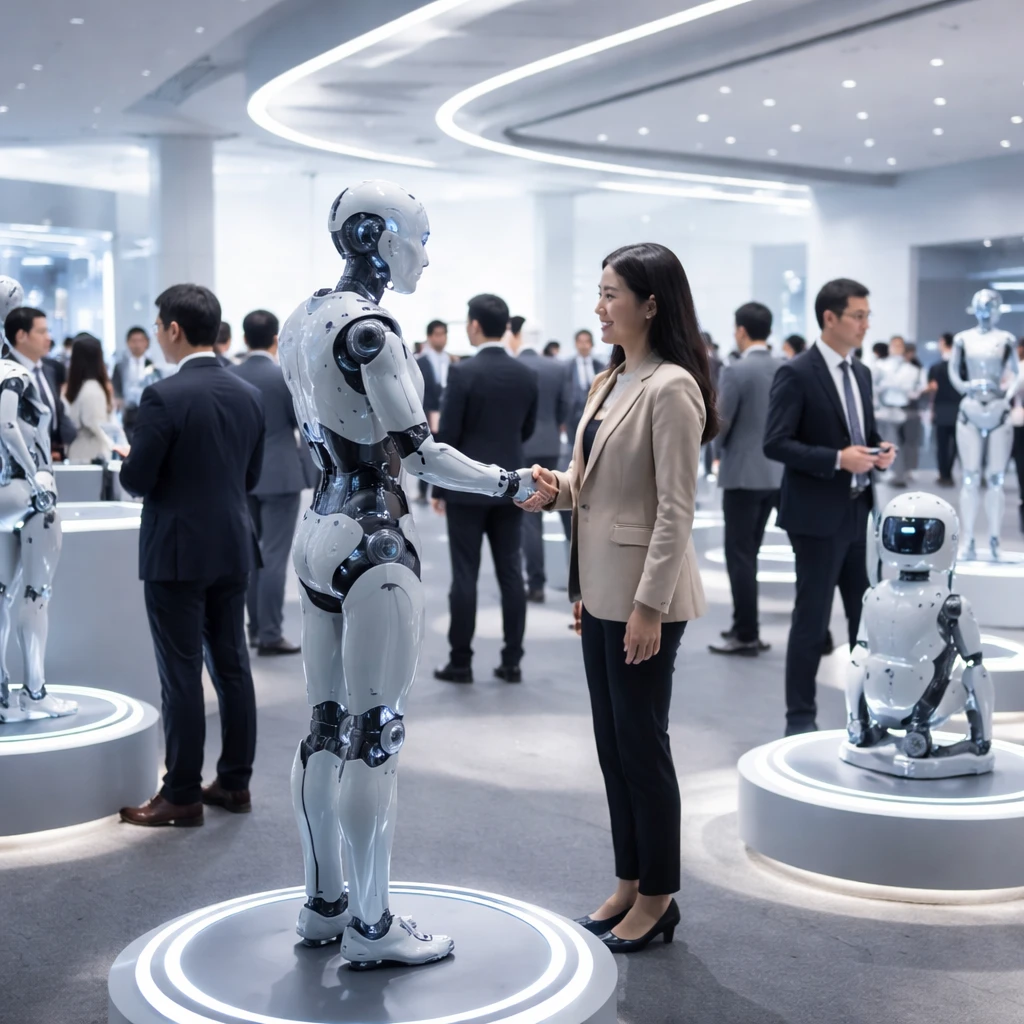

Las Vegas recently hosted the annual Consumer Electronics Show (CES), where the atmosphere buzzed with excitement over innovative artificial intelligence (AI) technologies. Visitors encountered a diverse lineup of robots navigating the convention floor, including towering humanoid models that engaged the audience with movements like head turns and waves, as well as smaller, quadruped robots roaming nearby. Such displays highlighted the event’s dual nature as both a spectacle and a hub for emerging technologies.
CES has long been a venue where companies unveil new gadgets, concepts, and advancements, attracting global attendees eager to witness breakthroughs in consumer electronics and other tech sectors. While some products remain aspirational or prohibitively priced, the event offered valuable insight into the strategic priorities of industry leaders such as Nvidia, Intel, Amazon, and Samsung, especially as AI continued to dominate discussions and demonstrations.
Throughout the show, AI applications permeated various exhibits, extending from the factory floor to the home. Demonstrations ranged from humanoid robots designed to assist with manufacturing and logistics to refrigerators equipped with voice activation capabilities, as well as next-generation semiconductor chips intended to underpin these intelligent systems.
The vibrant CES environment, particularly on the Las Vegas Strip, presented a setting relatively insulated from pervasive skepticism about AI's economic trajectory. When queried about the prospect of an AI investment bubble—where capital influx might significantly surpass practical demand—several executives acknowledged the concern but emphasized that their businesses remained focused on developing and delivering tangible AI value.
Panos Panay, Amazon’s chief of devices and services, stated, “We’re in the earliest stage of what’s possible. So when I hear we’re in a bubble, I’m like… this isn’t a fad. It's not going to pass.” His remarks underscore a prevailing view among some leaders that AI represents a fundamental, lasting technological advancement rather than a fleeting trend.
Nonetheless, the financial appetite accelerating AI infrastructure development is significant. According to data from S&P Global, technology corporations are expected to spend more than $61 billion on data center investments in 2025, fueling concerns that these expenditures may outstrip immediate market requirements. This trend is projected to intensify, with Goldman Sachs estimating AI firms' capital expenditures may exceed $500 billion this year alone.
Research from MacroStrategy Partnership highlighted the scale of this phenomenon, estimating last year that the AI investment bubble is seventeen times larger than the dot-com bubble of the early internet era. Much of this inflation stems from the necessity of data centers optimized to handle AI's computational demands, which current mobile devices cannot efficiently support due to their high power consumption.
Nvidia, widely recognized as a leading player in AI hardware, announced during CES that it plans to release the next iteration of its AI computing platform in the year's second half. This platform is critical for powering data centers that run complex AI models and underpins much of the industry's infrastructure growth.
Executives from chip manufacturers Intel and Qualcomm addressed bubble worries by emphasizing their companies' initiatives to improve on-device AI processing capabilities, reducing reliance on cloud-based computation and potentially mitigating risks tied to massive data center expansion.
Qualcomm, with its primary business in smartphone chipsets, has started to venture into data center technologies, albeit this area remains a minor component of its overall operations. Chief Financial Officer and Chief Operating Officer Akash Palkhiwala commented, “As far as we’re concerned, where we operate is not where the bubble conversation exists.” This suggests Qualcomm views its market niche as somewhat insulated from broader AI investment excesses.
Intel's client computing group leader Jim Johnson remarked that the company focuses on enhancing products important to end consumers, such as chips that improve laptop AI performance, rather than committing extensively to high-stakes investments whose returns are uncertain.
Samsung's executive vice president and head of digital appliances, CK Kim, refrained from labeling the current state as a bubble but underscored the company’s focus on whether AI provides meaningful consumer value, indicating a pragmatic approach centered on product utility rather than speculative investment cycles.
A particularly prominent segment of the show was dedicated to humanoid robotics, featuring companies like Nvidia, Intel, Hyundai, and Qualcomm introducing new technologies to enable human-shaped machines. Boston Dynamics, owned in majority by Hyundai, in collaboration with Google’s DeepMind AI group, revealed their Atlas robot designed for industrial tasks such as order fulfillment. Deployment is planned both within Google DeepMind and Hyundai's Robotics Metaplant Applications center in the near future, with broader commercial adoption expected in early 2027.
Aya Durbin, heading product strategy for humanoid applications at Boston Dynamics, indicated that such investments allow exploration across diverse use cases ranging from industrial environments to retail and even home settings.
Beyond robotics, exhibitors sought to capture the next major consumer technology wave following the smartphone era, positioning AI as central to this pursuit. Various companies introduced discreet listening devices capable of audio recording, including AI-integrated jewelry by startup Nirva, Pebble's Index 01 ring, and Amazon’s wristband originating from its acquisition of Bee.
These voice-activated gadgets offer hands-free convenience and also allow the collection of user data intended to generate insights about individual lifestyles, though this raises potential privacy concerns that remain to be addressed.
Overall, industry leaders expressed consensus that AI is becoming an integral facet of daily life and technological progress. Pete Erickson, CEO of Modev—a company specializing in tech events and education—acknowledged the existence of a bubble in the sector but affirmed AI's permanence. “I don’t think it’s going anywhere,” he remarked, reflecting the general optimism despite caution over investment dynamics.
In summary, CES presented a vivid tableau of AI’s pervasive influence, demonstrating robust corporate commitment and innovation amid complex financial and market considerations. The unfolding AI landscape continues to blend ambition, technological promise, and economic challenges as the sector navigates its rapid evolution.