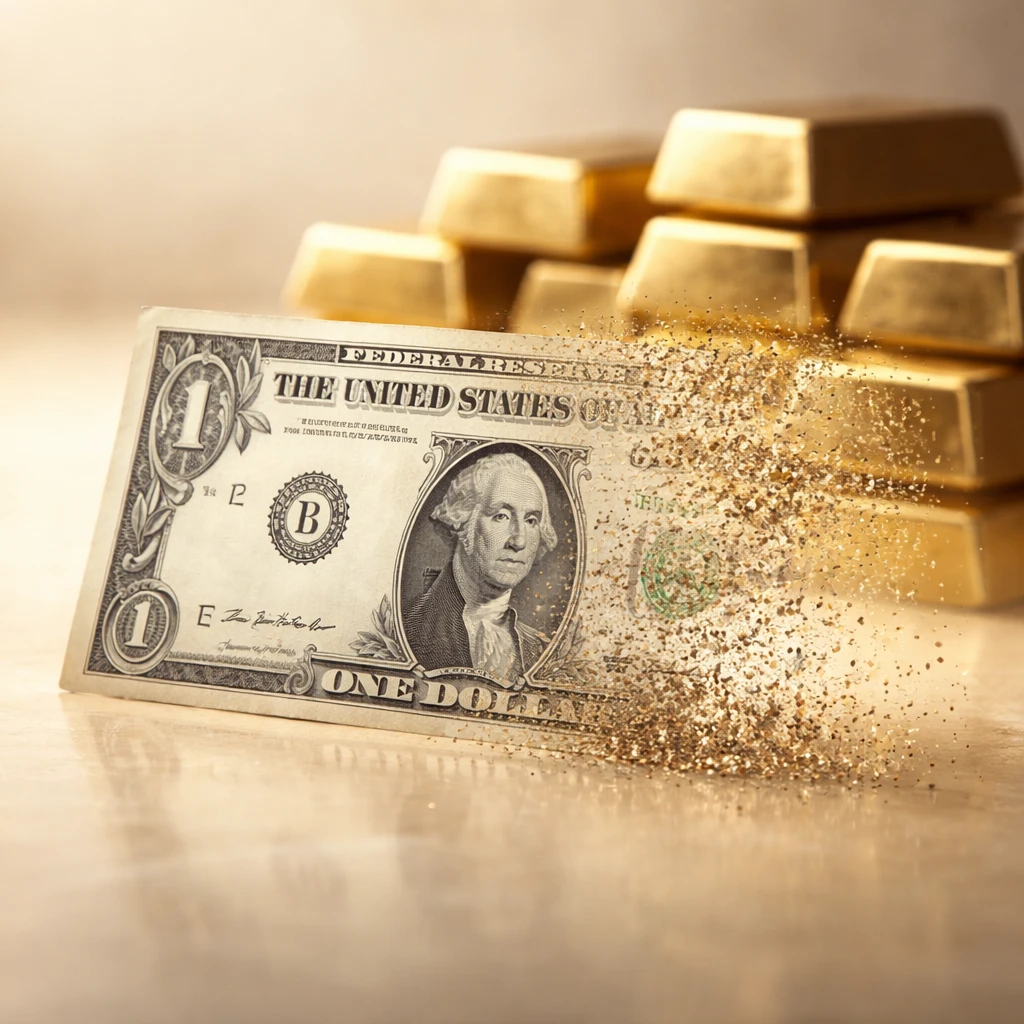

On Sunday, Anthony Scaramucci, who served as the former White House communications director and is a seasoned investor, provided an in-depth assessment of inflation's role in diminishing the American dollar's value and its broader consequences on national economic perception. Through his commentary on social media platform X and accompanying video message, he conveyed serious concerns over the weakening dollar and its subtle effects on personal wealth measurement among U.S. citizens.
Scaramucci asserted that inflation has not merely caused straightforward depreciation of the currency but has operated more insidiously by effectively "quietly robbing you." He quantified this phenomenon by estimating that the U.S. dollar has lost nearly 28 percent of its value over the last five years due to inflationary pressures. This persistent decline, he argued, has warped the benchmarks Americans rely on to evaluate financial progress, leading to a widespread misconception that many have grown richer when, in hard terms, they have not.
He highlighted that this distortion facilitates political evasion of accountability since the rising price levels inflate nominal wealth figures without corresponding increases in real buying power. According to Scaramucci, "People confuse bigger numbers with more wealth," underscoring how inflation inflates nominal metrics while obscuring actual economic conditions.
To concretely illustrate these points, Scaramucci invoked a comparative framework utilizing gold as a consistent standard of value. He recounted that his parents purchased a house in 1962 for approximately $16,000. At that time, gold was priced near $35 an ounce, making the home’s value equivalent to roughly 457 ounces of gold.
Fast forward to today, the same home is valued at about $750,000, whereas gold currently trades near $3,300 per ounce. This equates to around 227 ounces of gold. This comparison starkly reveals that despite nominal price increases appearing substantial, when measured against a consistent store of value like gold, the house’s relative worth has actually declined, reflecting diminished real value in terms of purchasing power.
Scaramucci summarized the effect concisely: "You're not richer. The currency is weaker." He emphasized that $1 million dollars today does not carry the same purchasing power as it did in previous decades, thus cautioning against complacency or misinterpretation of inflated dollar figures as genuine wealth.
These observations arrive amid recent fluctuations in the U.S. dollar index, a metric which gauges the dollar’s strength against a basket of six major global currencies. As of the article's writing, the index stood at 99.15, experiencing a modest daily decline of 0.24 percent. Although the index posted a slight gain within the current month, it remains down roughly 9 percent compared to its position one year prior. Notably, the index reached a peak near 113 during 2022, signaling a significant retreat in the dollar’s valuation since that high-water mark.
Scaramucci’s analysis underscores broader economic dynamics affecting both personal finances and macroeconomic frameworks. Inflation's persistent erosion of purchasing power, combined with nominal price increases, complicates the public’s ability to accurately assess economic wellbeing. The disconnect between nominal values and real value as measured against stable benchmarks, such as gold, poses challenges for individuals and policymakers alike in managing expectations and economic policies.
Key Points:
- The U.S. dollar has lost approximately 28% of its value over the past five years due to sustained inflation, according to Scaramucci.
- Inflation generates an illusion of increased wealth by inflating nominal wealth figures without commensurate increases in real purchasing power.
- Comparing real estate prices to gold over time reveals that many nominal gains in asset values may not reflect actual increases in real economic value.
- The U.S. dollar index has declined about 9 percent over the past year, indicating weakening against a basket of major currencies despite recent modest monthly gains.
Risks and Uncertainties:
- Continued inflation may further obscure true wealth levels, complicating financial planning and economic policymaking.
- Political reluctance to address inflationary effects might delay corrective measures, prolonging erosion of consumer purchasing power.
- The disparity between nominal and real values risks fostering misinformed economic expectations among consumers and investors.
- Fluctuations in the dollar index could impact international trade dynamics and investment decisions sensitive to currency strength.
Disclosure: This article is based on public statements and observable market data. It reflects the author's analysis without offering specific investment advice.