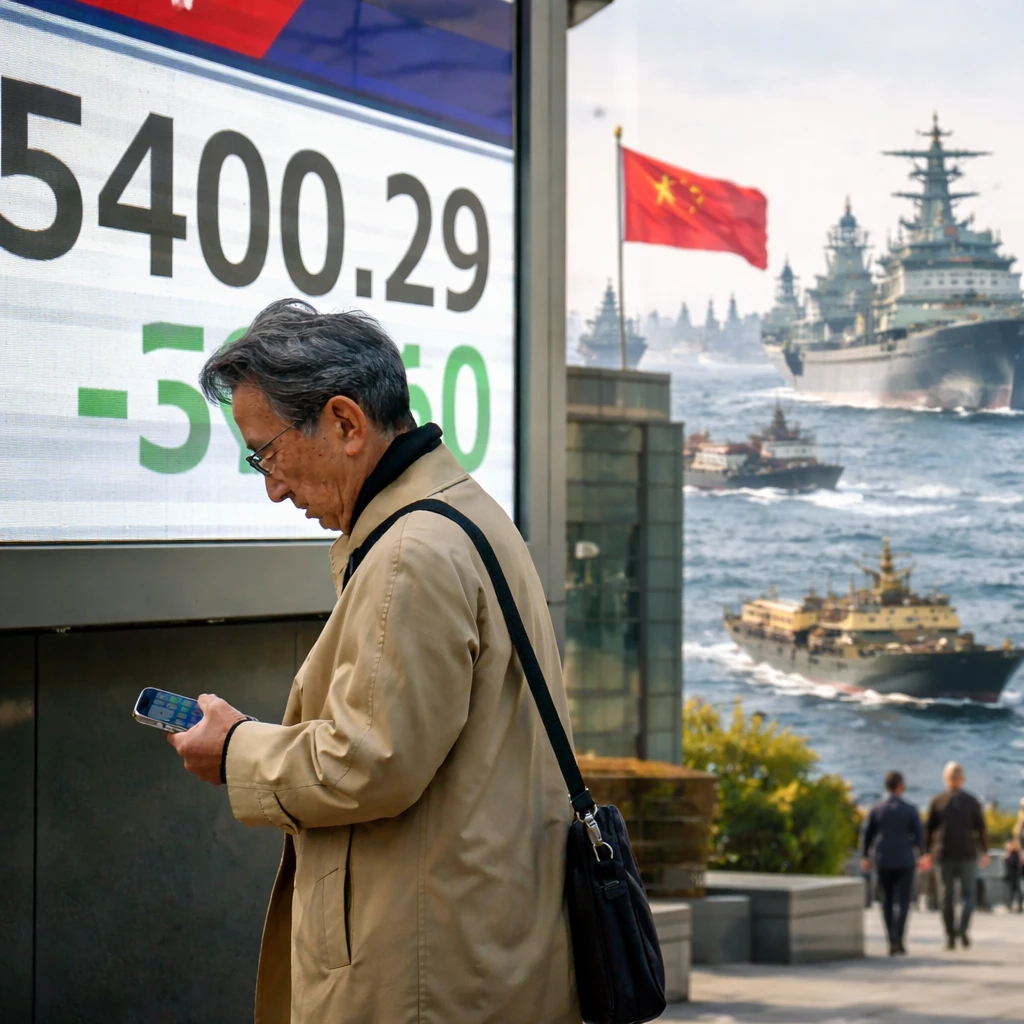

Markets across Asia encountered predominantly downward pressure during a trading session characterized by light volume due to regional holidays. This subdued activity coincided with China’s announcement of military drills conducted in proximity to Taiwan, an island whose sovereignty is contested by Beijing. Despite heightened tensions from these maneuvers, Taiwan’s stock market demonstrated resilience, advancing moderately.
China’s People's Liberation Army reported that the exercises aimed to send a message opposing what it described as separatist activities and outside intervention, a statement that did not explicitly mention the U.S. or Japan despite ongoing geopolitical sensitivities involving these countries. Taiwan responded by elevating its military alert status, labeling Beijing as a significant disruptor of regional peace.
The backdrop to these military drills was recent friction arising from U.S. arms sales to Taiwan, alongside comments from Japan’s Prime Minister Sanae Takaichi suggesting possible Japanese defense participation should China take assertive action on the island. However, China’s official remarks refrained from direct reference to Japan or the United States in this context.
Within regional equity markets, Taiwan's Taiex index registered a gain of 0.9%, reflecting investor confidence despite military activities nearby. Conversely, Hong Kong’s Hang Seng index retreated by 0.7% after failing to sustain earlier advances, closing at 25,637.69. Mainland China’s Shanghai Composite index held steady, remaining virtually unchanged at 3,965.28.
In other Asian equity movements, Tokyo’s Nikkei 225 declined by 0.4% to 50,526.92 amid cautious trading. South Korea’s Kospi index climbed 2.2% to 4,220.56, approaching its all-time high set in early November. This rise was significantly bolstered by a 6.8% surge in SK Hynix shares, attributed to the removal of an investment warning following regulatory reassessment. Samsung Electronics also contributed positively with a 2.1% increase.
Australian markets expressed weakness as the S&P/ASX 200 index slipped 0.4% to 8,725.70, reflective of the general cautious tone observable across the region.
Turning to commodities, precious metals experienced retracements following recent upward trends. Gold prices declined by 1.3%, settling at $4,494 per troy ounce, while silver dropped 2.4% to $75.30. These metals had risen recently amid supply constraints and investor demand for safe-haven assets beyond traditional stocks and bonds. Earlier gold prices were also lifted by concerns related to past U.S. government shutdowns and expectations of forthcoming Federal Reserve interest rate reductions, which typically weaken the dollar and enhance gold’s appeal.
Silver’s price has been influenced by additional factors, notably changes in China’s export policy. As the world’s largest refiner of silver, processing approximately two-thirds of global supplies, China recently transitioned from an export quota system to an export licensing regime effective January 1. Industry experts emphasize that this adjustment significantly tightens supply availability, impacting downstream industrial users rapidly.
In U.S. markets, equities reopened following the Christmas holiday with minimal shifts: the S&P 500 and Dow Jones Industrial Average both declined by less than 0.1%, while the Nasdaq Composite also edged lower by 0.1%. Year-to-date, the S&P 500 has increased nearly 18%, supported by policy changes under the current administration and optimism surrounding artificial intelligence prospects. The market environment remained subdued due to institutional investors largely pausing activity for the year-end period.
Commodity prices for crude oil exhibited a modest rebound. U.S. benchmark crude futures rose by 68 cents to close at $57.42 per barrel, and Brent crude oil advanced 66 cents to $60.90 per barrel. These gains followed prior declines observed the previous Friday, when U.S. crude and Brent crude dropped by 2.8% and 2.6%, respectively.
Currency markets displayed minor adjustments with the U.S. dollar retreating slightly against the Japanese yen from 156.56 yen to 156.23 yen, while the euro inched higher against the dollar, climbing from $1.1770 to $1.1777.