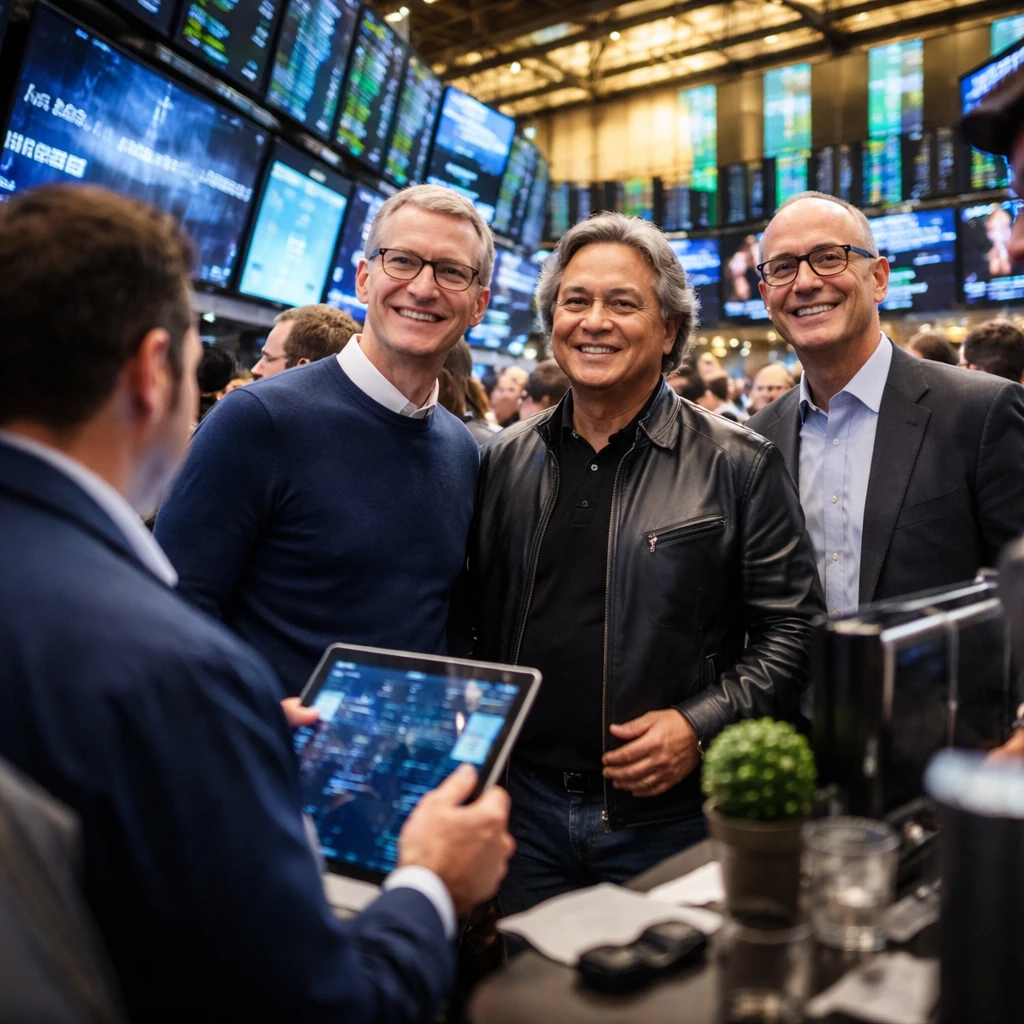

Wall Street saw elevated trading activity on Tuesday as technology companies led a widespread rally that propelled key market indices to new records early in 2026. This surge in technology shares echoed patterns observed throughout the previous year, where the sector frequently catalyzed market highs.
The benchmark S&P 500 index climbed 42.77 points, or 0.6%, reaching 6,944.82, marking a new record on only the third trading day of the year. The Dow Jones Industrial Average increased by 484.90 points, or 1%, closing at 49,462.08 and posting records for the second consecutive day. The Nasdaq composite advanced 151.35 points, or 0.6%, to end at 23,547.17.
Performance was broadly positive across sectors with healthcare, retail, and industrial companies gaining alongside technology. Approximately 75% of stocks within the S&P 500 index finished higher, reflecting a broad-based upward momentum. Smaller companies outperformed larger peers, as the Russell 2000 surged 1.4%, nearing its December peak.
Technology continued to dominate gains. Amazon, straddling both retail and technology industries and ranked among the most valuable corporations globally, posted a 3.4% rise which helped offset other losses including a 1.8% dip in Apple’s shares. Micron Technology also contributed significantly with a 10% jump, while Microsoft shares gained 1.2%. Nvidia, often a key determinant of market direction, fluctuated intra-day but ultimately dropped 0.5%.
The standout performer of the day was Sandisk, which soared 27.6%, marking the largest single-stock gain. Since spinning off from Western Digital last February, Sandisk's stock has appreciated over 800%, driven by increased demand for data storage technologies linked to advances in artificial intelligence (AI). Western Digital itself rose 16.8% buoyed by this trend. The spotlight on AI-related technologies is intensifying ahead of this week’s Consumer Electronics Show (CES) in Las Vegas, an important industry event for showcasing innovation.
Investors are closely monitoring how AI developments influenced market advances in 2025 and remain attentive to corporate updates that could clarify the implications of sizable AI investments moving forward.
Turning to commodities, U.S. benchmark crude oil prices declined 2% to $57.13 per barrel, retreating from earlier sharp increases triggered by a recent U.S. military operation targeting Venezuelan President Nicolás Maduro. International crude prices (Brent) similarly dropped 1.7%, landing at $60.70 per barrel.
In the bond market, Treasury yields edged higher. The 10-year Treasury yield inched up to 4.16% from 4.15%, while the 2-year Treasury yield, more sensitive to Federal Reserve policy expectations, increased to 3.46% from 3.45% late Monday.
Precious metals gained amid geopolitical concerns; gold climbed 1% and silver jumped 5.7%. These metals often attract investors seeking safe haven assets during economic uncertainty and ongoing global tensions.
European equity markets similarly advanced, paralleled by optimism in U.S. markets.
Looking ahead, market participants are preparing for several crucial U.S. economic reports due this week, including job openings for November, weekly unemployment claims, and the December employment situation. These reports will provide insight into labor market dynamics as 2025 drew to a close and help forecast economic momentum for 2026.
Additional data slated for release includes the Institute for Supply Management’s services sector update and the University of Michigan’s consumer sentiment index, both scheduled later in the week. Given the services sector’s predominance within the U.S. economy and recent volatility in consumer confidence amid inflationary pressures and economic uncertainty, these reports are considered particularly significant.
The Federal Reserve will closely analyze this economic data in advance of its policy meeting in late January. The central bank lowered its benchmark interest rate three times in late 2025 in response to a softening labor market, aiming to support economic activity by reducing borrowing costs. However, lowering rates carries the risk of reigniting inflation, which remains persistently above the Fed’s 2% target, potentially jeopardizing economic stability.
Wall Street currently anticipates the Fed to maintain interest rates at their current levels during the upcoming January meeting, balancing inflation concerns against the need for ongoing economic support.