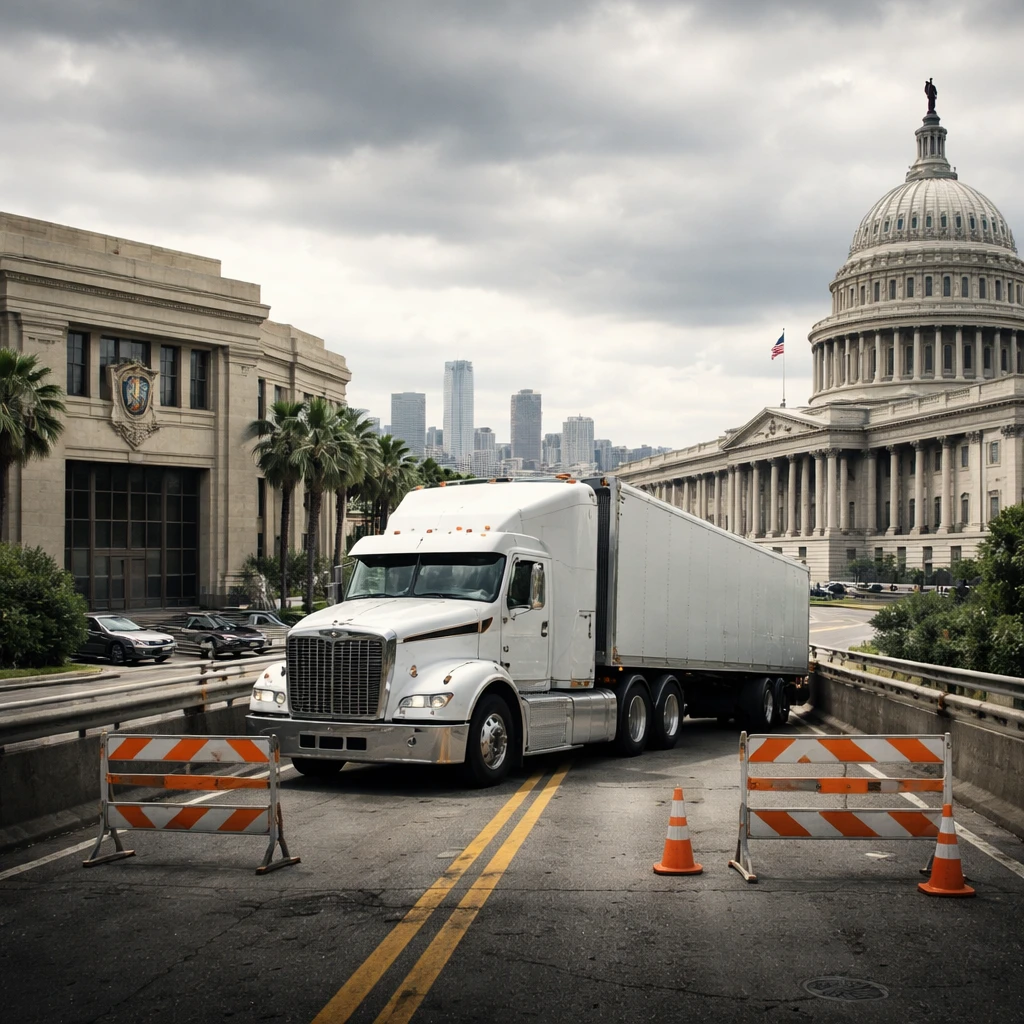

In recent developments within California's transportation sector, a clash has emerged between federal and state authorities concerning the cancellation of certain commercial driver's licenses (CDLs). This dispute centers on licenses that were allegedly issued in violation of established procedures, involving unvetted foreign drivers.
Sean Duffy, the United States Transportation Secretary, took to the social media platform X to contest statements made by California Governor Gavin Newsom and the state Department of Motor Vehicles. The controversy began when reports surfaced indicating that the DMV intended to extend the deadline for cancelling these CDLs beyond the original cutoff date.
Duffy emphatically rejected these reports, asserting that the deadline to revoke these illegally issued licenses remains set for January 5, 2026. He criticized Governor Newsom's administration, accusing the state representatives of misinformation and underscoring that no federal extension permitting such extensions has been authorized. In his statement, Duffy emphasized the potential safety risks posed by allowing unvetted drivers to continue operating commercial vehicles.
Moreover, the Transportation Secretary issued a stern warning regarding federal financial support, stating that failure to adhere to the January 5 deadline could result in the loss of approximately $160 million in federal transportation funding. This threat heightens the stakes in an ongoing dispute that reflects broader tensions between federal oversight and state autonomy in transportation policy.
The controversy gained public attention through a Fox26 News article published on the day of Duffy's social media post. The article reported that approximately 17,000 CDL holders in California were facing license cancellations as part of the enforcement action. Notably, it indicated that due to a class-action lawsuit filed by rights groups, the deadline for cancellations was being extended from January 5, 2026, to March 6, 2026.
However, these claims were decisively countered by Duffy, whose position is that no such extension has been sanctioned and that the original deadline must be enforced. This disagreement highlights the legal and administrative complexities surrounding the licensing of commercial drivers in California.
This is not the first confrontation between Secretary Duffy and Governor Newsom. Previously, Duffy warned of the possibility of withholding the same substantial federal funding allocation from California, eliciting public criticism from Governor Newsom and signaling a strained dynamic between the two officials.
Expanding beyond California, Secretary Duffy has engaged in similar disputes with other state leaders over the issuance of CDLs to undocumented individuals. Earlier in the same month, Duffy publicly criticized Minnesota Governor Tim Walz and threatened to withdraw over $30 million in federal funds from that state on comparable grounds.
The genesis of this controversy traces back to a tragic incident involving an undocumented foreign truck driver, Harjinder Singh, who made an illegal U-turn on a Florida highway resulting in three fatalities. Singh had been licensed in California under the contested policies regarding CDL issuance, intensifying scrutiny and calls for regulatory compliance.
In a separate but related matter, Secretary Duffy recently applauded a California court ruling that dismissed a lawsuit challenging the Trump administration's decision to rescind $4 billion in federal funding for California’s high-speed rail project between Los Angeles and San Francisco. Despite this federal withdrawal, Governor Newsom asserted that progress continues on the rail project, highlighting that track-laying operations are underway and emphasizing that the project has successfully passed regular financial audits.
The escalating exchange between federal and state transportation officials underscores the significant policy and financial implications these licensing issues carry. The ongoing debate impacts not only regulatory frameworks but also the safety of transportation networks and the allocation of substantial federal aid.
Stakeholders and observers await further developments as the January 5, 2026, deadline approaches, with California under increasing pressure to resolve the outstanding issues concerning CDL cancellations and to comply with federal mandates to safeguard continued funding.