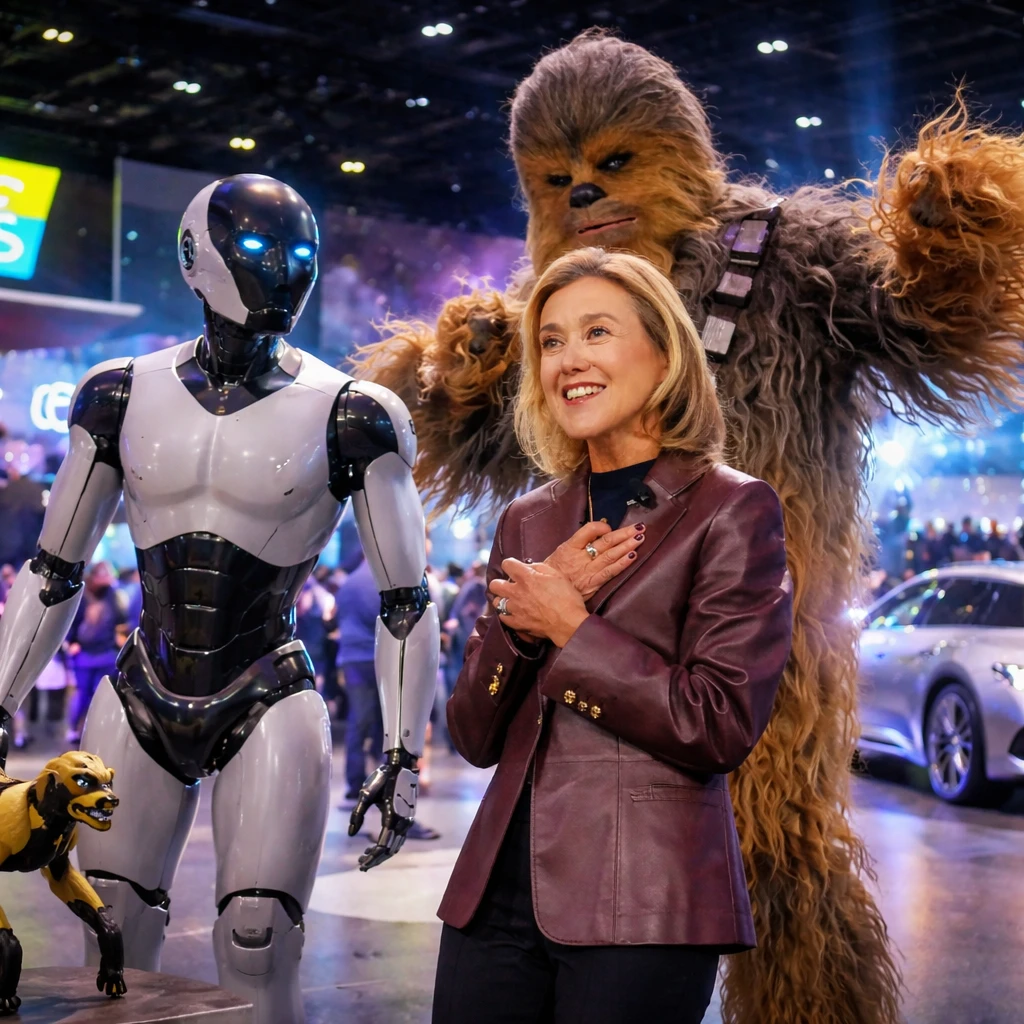

CES 2026 opened with a strong emphasis on artificial intelligence, as leading semiconductor companies and technology firms revealed advancements designed to shape the coming year’s product landscape. While Nvidia, AMD, and Intel each presented notable announcements concerning AI and chip technology, audience attention was notably captivated by visual spectacles intertwined with cultural icons.
Nvidia’s Physical AI and Autonomous Models
Nvidia CEO Jensen Huang detailed the company’s latest concept of "physical AI," which involves training AI systems within simulated environments using computer-generated synthetic data. These models are then embodied in real-world machines after mastering their designated tasks. Highlighting their approach, Huang introduced Cosmos, an AI foundation model built on extensive datasets capable of simulating environments that adhere to real-world physical laws. Complementing this, Nvidia announced Alpamayo, an AI model tailored specifically for autonomous driving applications. Huang also confirmed that Nvidia’s next-generation AI superchip, named Vera Rubin, is now in full production. Reinforcing its position, Nvidia revealed a strategic partnership with Siemens, signaling the company’s intent to maintain its leadership amid rising competition in the AI sector. Yet, beyond these technical revelations, the presentation was distinguished by Huang inviting two small, chirping robots on stage, capturing enthusiastic audience interest with their endearing charm.
AMD and Intel’s AI Chip Innovations
AMD’s CEO Lisa Su unveiled a fresh lineup of the Ryzen AI processors, aiming to deepen the company’s penetration into AI-driven personal computers. For the gaming segment, AMD introduced the Ryzen 7 9850X3D, designed to boost gaming performance. Intel, meanwhile, showcased its new AI-focused laptop chip, Panther Lake (part of the Intel Core Ultra Series 3), and announced intentions to launch a platform targeting the expanding handheld video gaming market.
Historically a dominant force in silicon-based processor manufacturing, Intel has encountered challenges transitioning through shifts in mobile computing and AI prominence, leading to a competitive setback relative to Nvidia’s rise. Recently, the U.S. government, through initiatives from the previous administration, acquired a 10% equity stake in Intel to bolster domestic manufacturing and technological development.
Advances in Autonomous and Robotic Technologies
Reflecting the burgeoning autonomous vehicle market, Uber unveiled its latest robotaxi concept, developed in collaboration with Lucid Motors and Nuro. This vehicle features an Uber-curated interior experience and integrates an array of sensors providing 360-degree environmental awareness. Its external design includes a subtle roof "halo" with LED lighting capable of displaying riders’ initials, enhancing identification and ride tracking. Inside, passengers can customize environmental settings and access real-time visualizations of the vehicle’s perception and planned navigation. Autonomous road testing initiated in San Francisco last month under Nuro’s leadership, marking progress toward a planned commercial launch within the current year.
In robotics, LG introduced a humanoid robot prototype intended for household tasks such as folding laundry and delivering food. As one of the larger technology companies committing to consumer service robots, LG plans to demonstrate the robot’s capabilities extensively during CES.
Meanwhile, Hyundai-owned Boston Dynamics publicly presented its humanoid robot Atlas, marking its CES debut. This robot is heading towards deployment in automotive assembly, with production slated for implementation in Hyundai’s electric vehicle factory in Georgia by 2028. This move signifies Hyundai’s investment in automating manufacturing processes and advances competition among companies focusing on humanoid robotic technologies.
Interactive Entertainment and Consumer Products
Entertainment and lifestyle innovations featured prominently as well. Lego launched its Smart Play platform incorporating sensor-embedded bricks that respond with lights and sounds when combined, enabling interactive play experiences. Supported by a new partnership with the Star Wars franchise, the system allows users to stage sensory-rich space battles and lightsaber duels, appealing specifically to Star Wars enthusiasts.
Adding to the novelty, Lollipop Star introduced a musical candy that utilizes bone conduction technology to transmit songs directly to consumers’ auditory senses while eating, with tracks from popular artists accessible through the confection. These lollipops will be available for purchase online post-CES.
Partnerships Enhancing Consumer Experience
Delta Air Lines announced a multi-year agreement as the official airline of Las Vegas’s Sphere venue, promising exclusive experiences including the Delta SKY360° Club lounge and access benefits for frequent flyers attending events. This partnership integrates Delta branding within Sphere’s prominent exterior LED display and will continue to roll out additional SkyMiles member privileges throughout 2026 and beyond.