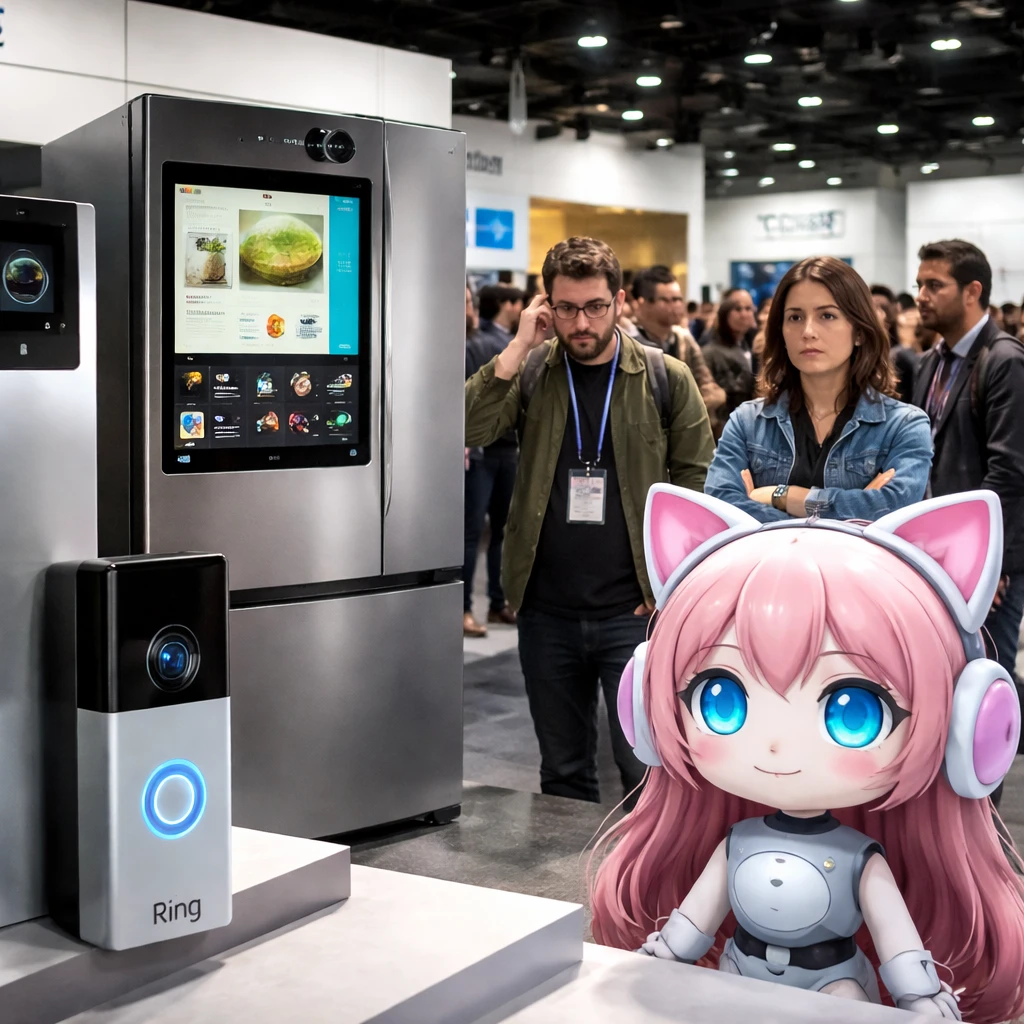

Artificial intelligence continued to dominate the stage at this year’s Consumer Electronics Show (CES), displaying its expanding role across a broad spectrum of devices. However, the annual “Worst in Show” contest, which spotlighted products deemed invasive, wasteful, or poorly designed, revealed growing skepticism about indiscriminate AI application. The contest's results, announced Thursday by a panel of consumer rights and privacy advocates, underscored the pitfalls of over-engineering and insufficient regard for user privacy.
At the forefront was Samsung’s “Bespoke AI Family Hub” refrigerator, which earned the dubious title of overall “Worst in Show.” This smart appliance allows users to verbally command the fridge—such as opening or closing its door—and uses computer vision to monitor food supplies, even suggesting replacements through targeted advertising.
During demonstrations at CES in Las Vegas, ambient noise often interfered with voice recognition, undermining the fridge’s core functionality of food preservation. Gay Gordon-Byrne from the Digital Right to Repair Coalition remarked via a video statement that the product introduced unnecessary complexity and reliability issues into what traditionally has been a straightforward appliance. She emphasized that the added AI features substantially increased operational difficulties, noting that the system’s computer vision components and advertising functions could detract from the fridge’s primary purpose.
Samsung responded by highlighting the difference between exhibition environments and typical home settings, asserting that their AI technology was designed to simplify home management and enhance convenience. The company also stressed that security and privacy form foundational elements of the AI experience incorporated into the fridge.
The “Worst in Show” judges, independent of CES and its organizing bodies, base their assessments on the severity of a product’s flaws, potential impact at scale, and regression compared to earlier versions or similar technologies. Representing organizations such as Consumer Reports, the Electronic Frontier Foundation, and right-to-repair advocates like iFixit, the panel aims to spotlight concerning technological trends and encourage improvements. Elizabeth Chamberlain, iFixit’s director of sustainability, described the awards as a constructive call to action rather than targeted shaming, emphasizing that the issues highlighted often reflect broader industry patterns rather than isolated product failings.
Privacy concerns were prominent, with Amazon’s Ring doorbell system receiving the “Worst in Show” for privacy. New Ring features include an “AI Unusual Event Alert” designed to detect unexpected occurrences, such as unfamiliar individuals or wildlife like coyotes. The system utilizes facial recognition technology and supports deployment of mobile surveillance towers in public areas. Furthermore, an app store intended for Ring devices raises worries about potentially invasive third-party applications. Cindy Cohn, executive director of the Electronic Frontier Foundation, criticized the product for reinforcing misconceptions that enhanced surveillance inherently enhances safety. Amazon did not provide an immediate comment.
Adding to privacy apprehensions, the “People’s Choice” of worst products was accorded to Ami, an AI-powered virtual companion developed by the Chinese company Lepro, which primarily markets lighting solutions. Ami manifests as a female avatar on a curved screen and aims to offer “always-on” empathetic interaction for remote workers facing isolation. It monitors eye movements and emotional indicators such as vocal tone. Judges expressed discomfort with its constant surveillance aspect, despite the inclusion of a physical camera shutter. Lepro has not responded to requests for comment.
Environmental criticisms were leveled against Lollipop Star, a candy product integrating bone conduction technology to play music during consumption. While innovative, the disposable nature of the lollipop’s electronic components resulted in condemnation for environmental wastefulness. Nathan Proctor, director of the Public Interest Research Group’s right-to-repair campaign, emphasized the need to curb production of disposable electronics laden with toxins and rare minerals. Lava Brand, producer of Lollipop Star, did not immediately respond to inquiries.
Security vulnerabilities were a key concern with Merach’s internet-connected treadmill, awarded the “Worst in Show” for security issues. The machine features an AI coach powered by a large language model, capable of conversing with users and adjusting workout parameters in response to biometric data such as heart rate. Such extensive data collection raised alarms, particularly in light of a privacy policy conceding an inability to guarantee personal information security. Merach did not provide a statement.
German company Bosch received two separate “Worst in Show” mentions. One focused on its espresso machine embedding Amazon Alexa voice assistance and subscription-based services labeled as a “Personal AI Barista.” The other concerned the company’s e-bike, which employs digital 'parts pairing' to link components like motors and batteries to the bike, potentially complicating repairs and activating anti-theft measures. Cory Doctorow, author and contest judge, critiqued this approach as emblematic of shifting manufacturer-consumer dynamics that may restrict user autonomy. Bosch refuted implications of mandatory usage of these features and underscored its commitment to privacy and cybersecurity through encryption and authentication measures.
In sum, the 2026 “Worst in Show” contest at CES highlighted tensions between innovation and user rights, particularly around privacy, product reliability, sustainability, and security. As AI features proliferate in consumer electronics, the findings underscore the need for balanced integration that respects fundamental consumer protections.