
During the opening day of CES 2026 in Las Vegas, a demonstration brought to life the evolving role of artificial intelligence in automotive interiors. When a young girl entered the rear seat of her parents' vehicle, the environment immediately recognized her presence, noted it was her birthday, and played her preferred music selection without any verbal command. Sri Subramanian, Nvidia's global head of generative AI in automotive, described this interaction as the car embodying a "soul" and functioning as an extension of the family.
This example underscores the rapid advancements in AI-powered in-car systems and highlights an increasing reliance on personal data to customize the driving experience. Across the exhibition floor, the traditional perception of vehicles as mere transport machines shifted toward viewing them as responsive companions. Automotive and technology companies exhibited cars capable of real-time adaptation to drivers and passengers by monitoring indicators such as heart rates and emotional states, while also incorporating safety features like alerts for unattended infants or young passengers.
Automotive supplier Bosch presented its AI vehicle extension technology designed to make the cabin a "proactive companion" responsive to occupants' needs. Nvidia introduced Alpamayo, its latest AI platform for autonomous driving, which aims to enhance vehicles' decision-making abilities in complex traffic situations. Nvidia CEO Jensen Huang characterized this initiative as a "ChatGPT moment for physical AI," signaling a leap in intelligent vehicular systems.
At the same time, these technological strides intensify ongoing debates about the scale and nature of driver data collection. Justin Brookman, director of marketplace policy at Consumer Reports, emphasized that AI integration should not compromise privacy and security safeguards. Historically, vehicles have only recently become significant repositories of personal information, unlike smartphones or online platforms. This reality has left the automotive industry navigating the emerging "rules of the road" regarding permissible uses of driver data by manufacturers and tech firms.
Brookman further observed that the inherently intimate connection many individuals have with their cars—as extensions of themselves or as personal spaces akin to homes—augments sensitivity toward onboard monitoring through cameras and microphones. This closeness can lead to feelings of intrusion. He noted that while privacy concerns are widely felt, many consumers are unsure how to manage or mitigate these challenges.
Despite privacy worries, Brookman acknowledged that certain AI technologies present clear safety advantages for consumers, improving protection and awareness within the driving environment.
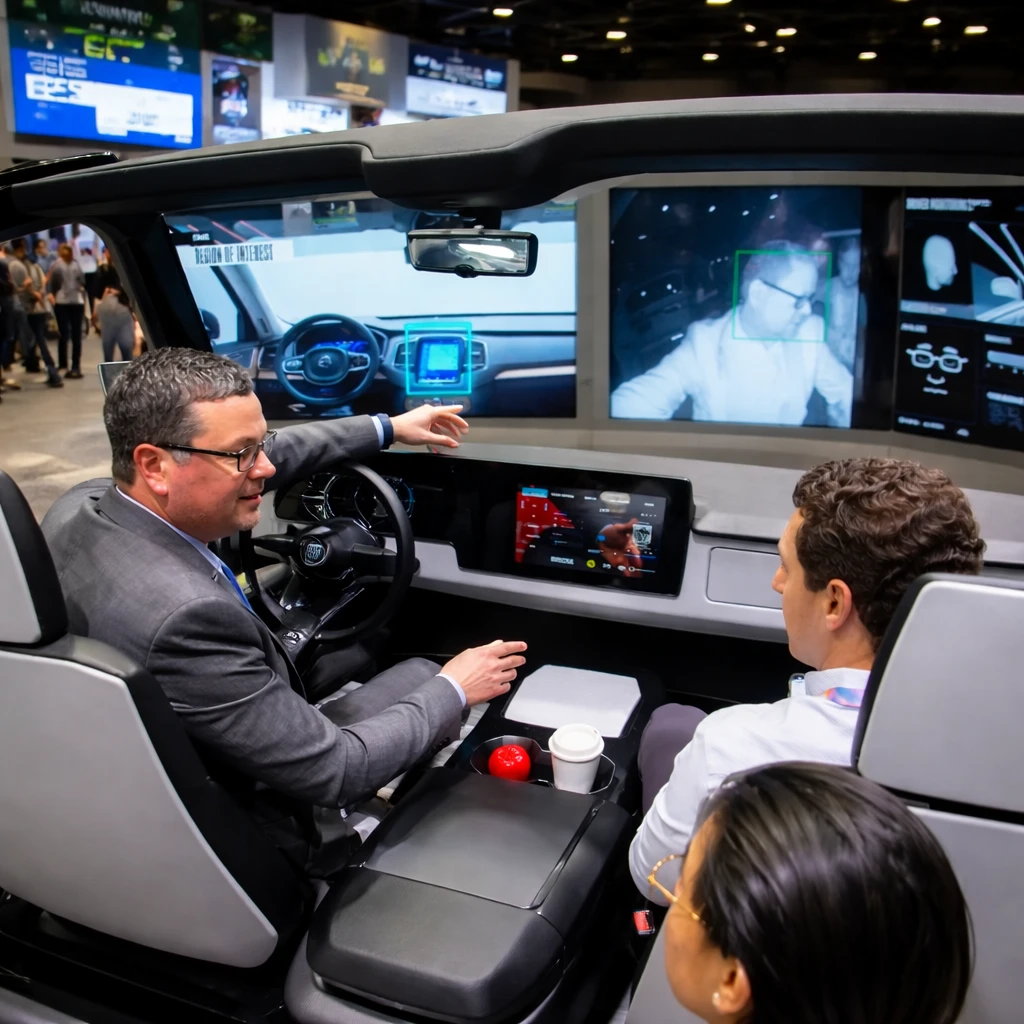
At Gentex's exhibit within CES, visitors experienced a simulated six-passenger van outfitted with advanced AI sensors and cameras. The system demonstrated capabilities such as monitoring driver alertness, seating posture, and behavioral cues like eating, phone usage, or emotional states. Brian Brackenbury, director of product line management at Gentex, stated that the technology can detect a wide array of conditions, including drowsiness and anger, to aid in vehicle safety management.
Brackenbury clarified that the ultimate decisions about how a vehicle responds to collected data rest with car manufacturers. He highlighted that Gentex designs its systems to retain data only temporarily—processing video frames within the car itself before deletion. The company adheres to a guiding principle of not utilizing data purely because technological capabilities exist, underscoring the importance of maintaining data privacy as a core value.