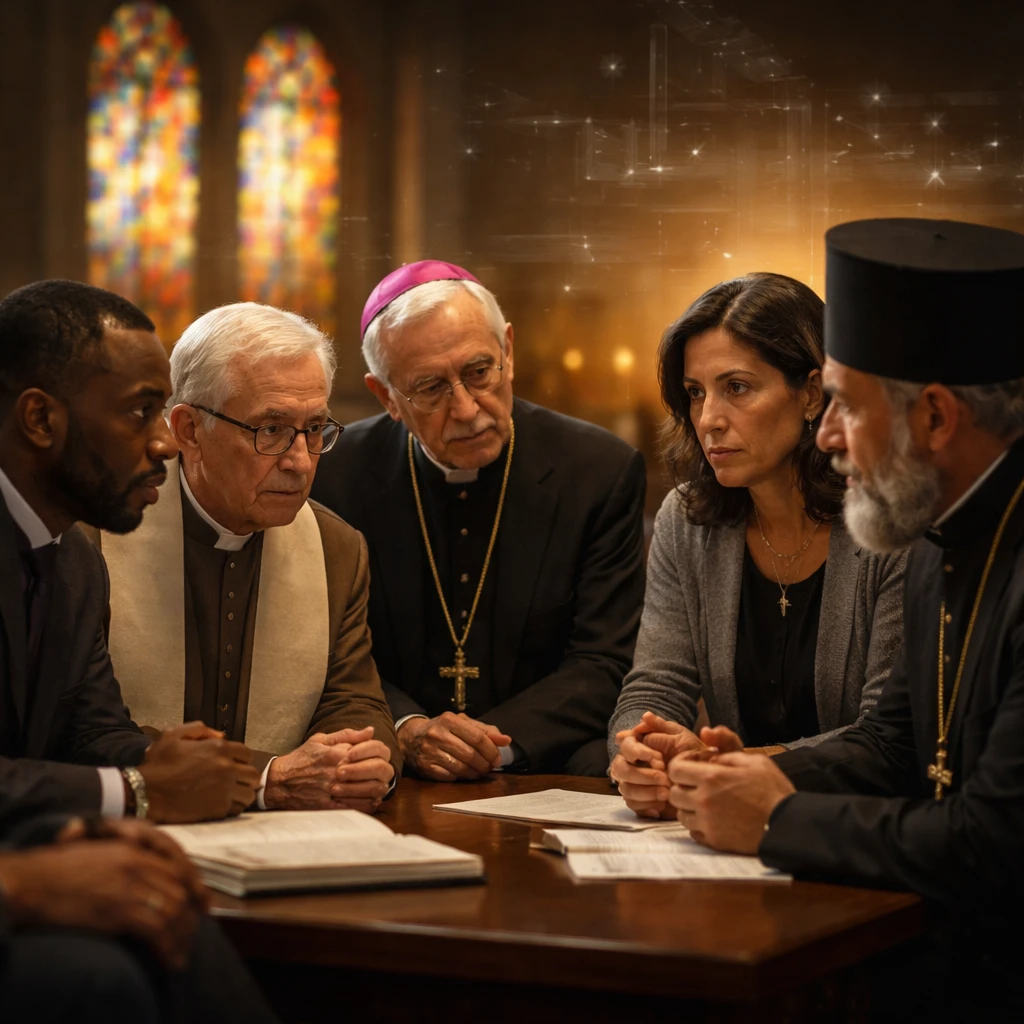

As the technological sector pursues the rapid development of artificial intelligence (AI) with minimal regulatory constraints, a significant and influential global community is pushing back: Christian leaders alongside their faith communities. These groups, spanning Catholics, Evangelicals, and Baptists, are raising alarms on how quickly AI progress is occurring and the possible repercussions on human connections, family structures, employment, and the institution of the church.
It is important to recognize that Christians hold a variety of perspectives. However, in 2024, cross-denominational religious leaders have become more vocal about the ethical and social challenges presented by AI. They are not categorically opposed to technology but express concern over the consequences of advancing AI without adequately addressing emerging harms. Their responses include fostering discussion in sermons, drafting open letters, and direct dialogues with political figures with the goal of shaping both public opinion and policy frameworks.
White evangelicals represent roughly 25% of American voters, positioning their views as a potentially influential factor in political discourse, particularly as friction grows between technology proponents affiliated with former President Trump’s administration and his broader MAGA supporters ahead of next year’s midterm elections.
John Litzler, general counsel and public policy director at the Baptist General Convention of Texas, frames the debate as a moral imperative: “Christ asked, ‘What does it profit a man to gain the world and lose his soul?’ Our concerns stem not from opposition to business or growth but from a desire to preserve the soul of our nation and its individuals.”
The Catholic Church's Leadership and AI Concerns
The Catholic Church's highest echelon has shown noteworthy cautionary signals regarding AI. Pope Leo XIV, whose chosen papal name references a prior era of societal upheaval caused by technological innovation, has spoken publicly about the dual nature of AI. He acknowledges AI's capacity for promoting the Gospel but also warns of its potential misuse in manipulating vulnerable children and propagating ideologies that conflict with human dignity.
In mid-2024, several prominent bishops addressed a joint letter to the United States Congress, offering policy guidance focused on AI governance. This initiative has served as a catalyst for many Christian leaders who emphasize the importance of the Church's voice in defining AI's nature and ethical applications, as noted by Michael Toscano of the Institute for Family Studies.
Specific concerns center on how artificial intelligence may affect family life and the welfare of children. For instance, Pastor Michael Grayston from LifeFamily Austin convened a church gathering discussing risks associated with AI, notably the increasing use of AI companions by teenagers. Grayston explained, “If I face a crisis, I might turn to my AI friend because it’s easier than sharing with real friends, which may result in growing isolation. That path worries me deeply.”
Reluctance Against Technological Deification and AI Acceleration
Many Christians also object to the manner in which some Silicon Valley leaders have employed religious language or symbolism to frame their efforts of creating advanced AI, effectively portraying themselves as god-like creators. Venture capitalist Peter Thiel’s references to the antichrist wielding anti-AI sentiments to gain power have sparked controversy. Furthermore, in November 2024, investor Marc Andreessen shared a social media post perceived as mocking Pope Leo’s remarks about AI.
Andrea Sparks, co-founder of a Texas initiative addressing online child exploitation, found Thiel’s linkage of regulatory resistance to the antichrist “mind-blowing,” emphasizing that the commandments to love God and others contrast with tendencies for AI companions to undermine authentic human relationships.
Some religious scholars and leaders acknowledge AI's beneficial potential. Father Michael Baggot, a professor at the Pontifical Athenaeum Regina Apostolorum and advisor to Magisterium AI, praises AI’s capacity to assist individuals in understanding Catholicism by providing accessible, clear explanations around the clock. He underlines AI’s utility, such as facilitating Bible translations into numerous languages.
Nonetheless, Baggot voices significant reservations about the tech sector’s relentless acceleration of AI without sufficient safeguards, especially concerning minors exposed to AI companions. He taught courses discussing risks associated with AI friendships and has advised families affected by tragedies linked to AI obsession, such as the 2024 suicide of Sewell Setzer, who became romantically fixated on a chatbot.
Labor and Community Concerns Related to AI Integration
Baggot also highlights the church’s teaching on the importance of labor beyond economic utility, focusing on personal growth and community bonding nurtured through work. The prospect of AI rendering human jobs optional is worrisome, as it risks disregarding the social and spiritual dimensions of labor. Simply providing financial support to displaced workers is insufficient without acknowledging these broader needs.
Academic research further underscores these points. Nina Lutz, a doctoral candidate at the University of Washington, interviewed 40 faith leaders and identified apprehensions toward the rapid cessation approach to AI development often described as “accelerationism.” Many religious stakeholders felt sidelined by technology ventures prioritizing speed over ethical considerations.
Faith Communities Engaging in AI Policy Discourse
These collective concerns have propelled religious leaders into the policy arena, urging lawmakers to institute AI guardrails. This stance contrasts with Donald Trump and some technology advocates favoring minimal regulation. In May 2024, Evangelical leaders sent an open letter to Trump, warning that unrestrained AI growth and labor automation pose significant risks.
Later in the year, over forty faith leaders, including representatives from the National Association of Evangelicals, petitioned Congress, cautioning against federal preemption of state AI regulatory efforts via the National Defense Authorization Act. They also advocated for stricter oversight of AI chatbot technologies.
Chris MacKenzie, vice president of communications at Americans for Responsible Innovation—a nonprofit focusing on AI safety—attributes part of their organizational momentum to the voice of faith leaders. He notes many legislators on the political right draw guidance from religious beliefs, amplifying the impact of religious advocacy on policymaking.
Likewise, Michael Toscano coordinates the Faith Family Technology network, a coalition of policymakers, academics, technologists, and religious figures collaborating weekly to influence AI's trajectory. The network operates on the premise that developing AI without input from religious wisdom risks creating technologies detrimental to humanity.
Activities by this faith-centered coalition have included distributing critical letters to policymakers, liaising with conservative media such as Steve Bannon’s podcast noted for opposing AI moratoriums, and assisting with legislative drafting on AI companion regulations, including provisions in Senator Josh Hawley’s bill.
Brad Littlejohn, co-leader of the Faith Family Technology network, observes a shifting alignment among conservative Christians who increasingly oppose the accelerationist agenda embraced by the Trump administration. Given their substantial demographic presence in the United States, their growing dissent could prove influential in shaping AI regulation in coming years. Littlejohn remarked, “The earlier political focus was on censorship battles won under Trump, but the larger, more consequential conflict rests with how AI development is approached.”