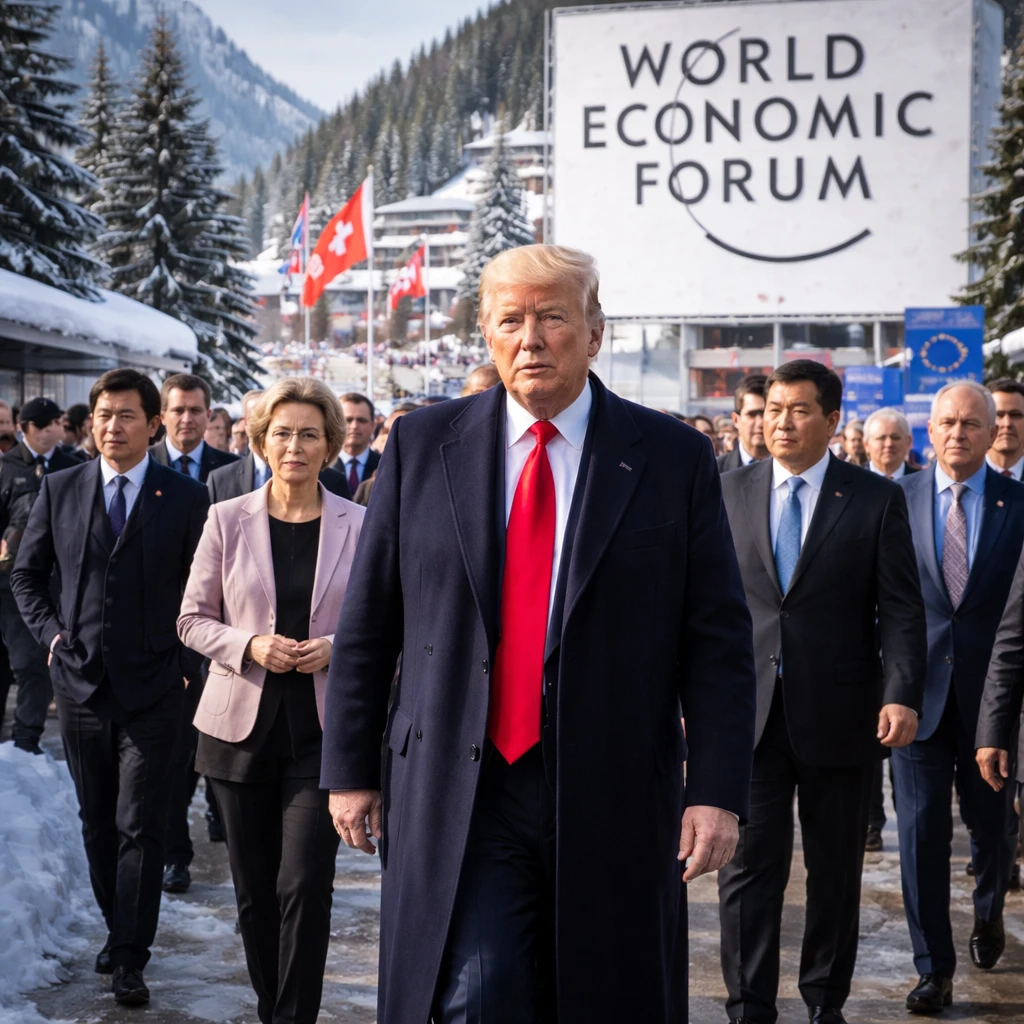
In Davos, Switzerland, a congregation of high-ranking government officials and corporate leaders, including U.S. President Donald Trump, is underway as the annual World Economic Forum commences. This four-day gathering aims to foster dialogue and promote economic progress despite current disruptions to the global order and sharply growing wealth inequality. Multibillionaires have substantially increased their fortunes while large segments of the impoverished population see little benefit.
The Forum’s stated mission is to "improve the state of the world," with this year’s theme focusing on "A Spirit of Dialogue." A central consideration is whether President Trump will engage in meaningful exchanges with attendees or primarily direct his message outward. Nearly 3,000 figures from the business, defense, and policy spheres are slated to tackle pressing issues such as the expanding wealth divide, artificial intelligence's implications for the workforce, concerns surrounding geoeconomic conflicts, and the erosion of trust that now characterizes both domestic and international relationships.
According to Mirek Dušek, the Forum’s programming director, "This dialogue takes place at a critical geopolitical juncture. Perspectives vary, with some viewing the moment as a transitional phase and others as a definitive shift into a new era. What is unquestionable is that the global landscape has become markedly more competitive and contested."
President Trump’s high-profile presence marks his third attendance as U.S. head of state amidst international unease regarding his administration’s geopolitical actions, including an aggressive overture toward acquiring Greenland and strained energy dynamics in Latin America, notably Venezuela. His vocal criticisms of Federal Reserve Chairman Jerome Powell have also raised eyebrows among business and legislative leaders.
Trump's efforts to present himself as a peacemaker will be scrutinized, particularly with an upcoming announcement regarding his "Peace Council" for Gaza. Additionally, he and his administration are scheduled for bilateral discussions within the Davos Congress Center's side rooms. The President appears at ease mingling in this environment with executives who support his business-centric and wealth-generation approach.
However, dissenting voices are also present. Colombian President Gustavo Petro, who has experienced a fraught relationship with Trump, and Iran’s Foreign Minister Abbas Araghchi, representing a nation facing sanctions and significant protests, stand out as notable voices offering alternative perspectives. Meanwhile, significant international actors such as the European Union and China are prominent, with EU Commission President Ursula von der Leyen and China's Vice Premier He Lifeng scheduled to speak early in the forum.
The event unfolds without its founder Klaus Schwab, who retired last April after launching the meeting 55 years ago with a focus on business that has since expanded into broader global discussions. Current co-chairs Larry Fink, CEO of investment giant BlackRock, and Andre Hoffman, Roche's vice chairman, now steer the forum. Among the approximately 850 CEOs and presidents of global corporations attending, Nvidia's CEO Jensen Huang makes his debut, underscoring the focus on technology's role in economy and society. Celebrity advocates, including actor Matt Damon, also participate.
Key topics include AI's future trajectory, its influence on business operations and labor markets, and the prospects of achieving general artificial intelligence. National leaders from Argentina, France, Indonesia, Syria, and Ukraine join the extensive roster of attendees.
Parallel to these discussions, the World Economic Forum reflects upon a disconcerting global context - the escalating divide between the wealthy and poor and the diminishing confidence in institutions. The Edelman Trust Barometer, a respected annual survey encompassing nearly 34,000 people across 28 countries, reveals record highs in economic fears and pessimism, with particular downturns in developed nations. The report highlights a societal shift from collective engagement toward insularity and prioritization of nationalistic and individual interests over global cooperation.
According to Edelman CEO Richard Edelman, "People are retreating from dialogue and commitment, choosing the safety of the familiar over the perceived hazard of change. We are witnessing a transition from 'we' to 'I' mentality." The findings indicate that two-thirds of respondents place their trust primarily in the CEOs of their employers or their local communities, while nearly 70% believe institutional leaders deliberately mislead the public.
Complementing these findings, anti-poverty organization Oxfam released a report ahead of Davos revealing that billionaire wealth surged by more than 16% last year, outpacing the five-year average threefold to exceed 18 trillion dollars, based on Forbes data. The wealth increase of approximately 2.5 trillion dollars in 2023 alone could theoretically eradicate extreme poverty 26 times over. Since 2020, billionaire wealth has grown by over 80%, contrasting starkly with nearly half the global population still living in poverty.
Oxfam attributes this disparity partly to the Trump administration’s policies favoring the ultra-wealthy, including tax reductions for the richest, support for AI-driven market growth benefiting investors, and obstruction of tax reforms targeting major corporations. The advocacy group urges enhanced national-level initiatives to reduce economic inequality through higher taxation rates on the ultra-rich and restrictions limiting their political lobbying power.
President Trump, leading the largest U.S. delegation yet with half a dozen cabinet members, is expected to address housing and affordability issues in his forthcoming Davos speech on Wednesday.
Meanwhile, public dissent persists with protests erupting over the weekend. Hundreds of demonstrators ascended an alpine pass to Davos, carrying banners opposing war profiteering and denouncing economic failures of the global system. Concurrently, prominent global firms such as Microsoft, India’s Tata Consultancy, TikTok, and cybersecurity leader CrowdStrike, alongside governments from Nigeria, Qatar, Ukraine, and the United States, utilize space on the Promenade in Davos to promote their enterprises and national economies.
Local merchants lease storefronts for the duration of the forum to accommodate participants. Critics long have accused the Davos gathering of prioritizing rhetoric over concrete outcomes, viewing Trump’s attendance as emblematic of a disconnect between affluent elites and the disenfranchised. Some detractors criticize Swiss political support for the event, suggesting it perpetuates rather than alleviates global tensions, with Mirjam Hostetmann, president of the Young Socialists of Switzerland, stating, "It is troubling how Swiss politicians court warmongers and their beneficiaries in Davos. The World Economic Forum will never bring peace but only fuel escalation."