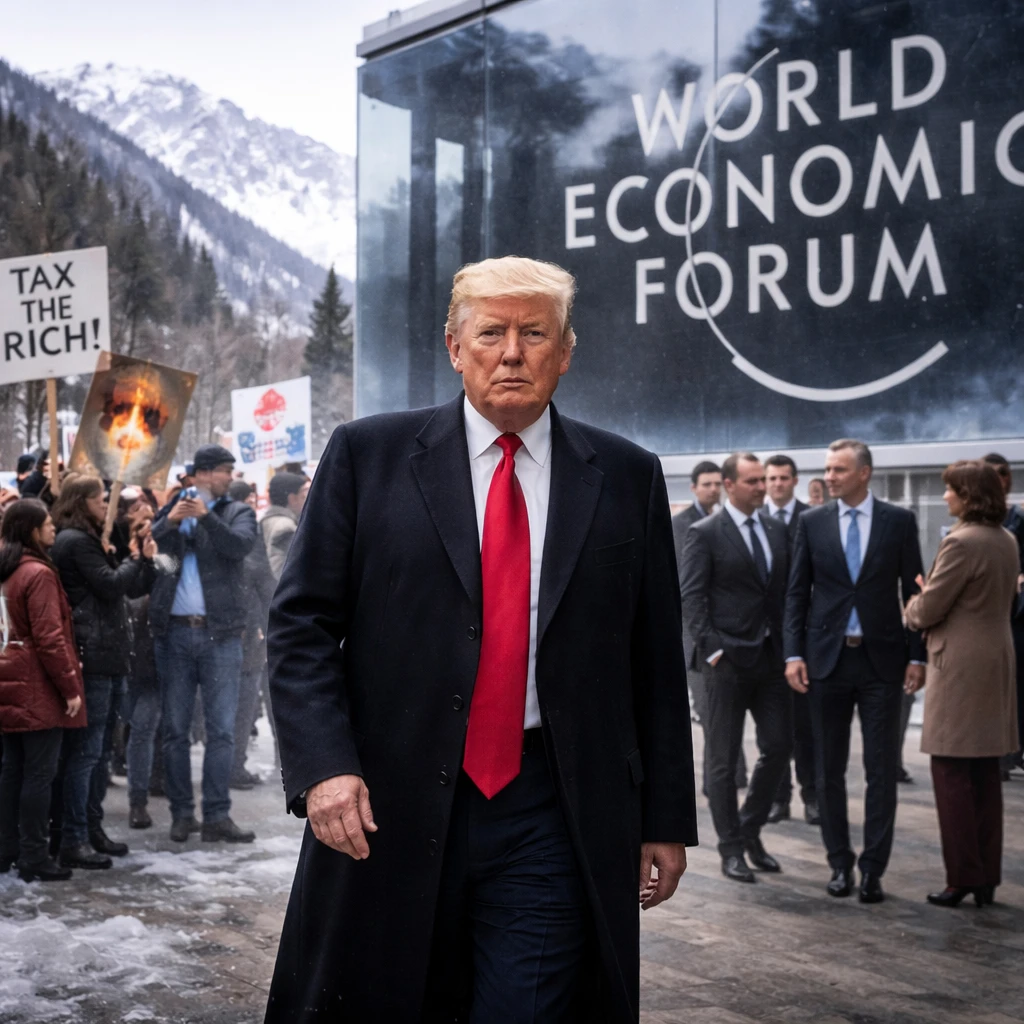
Each year, the alpine town of Davos, Switzerland, hosts a gathering of influential figures from the worlds of commerce, policy, and advocacy, converging to engage in dialogue aimed at economic progress.
This year’s World Economic Forum (WEF), set to span four days beginning Tuesday, operates under the theme "A spirit of dialogue," emphasizing conversation amid a shifting geopolitical landscape. Attendance approaches 3,000, including business executives, government officials, and advocacy representatives, who will confront urgent topics such as the expanding divide between affluent and impoverished populations; the implications of artificial intelligence (AI) on employment; the complexities of geo-economic rivalry; tariffs disrupting established trade relationships; and a pervasive erosion of trust between societies and nations.
Mirek Dušek, a managing director responsible for programming at the forum, noted the significance of timely discussions in a period marked by geopolitical transformation. “It’s really going to be a discussion at a very important moment ... geopolitics is changing,” Dušek explained. “Some people think we’re in a transition. Some people think we’ve already entered a new era. But I think it’s undeniable that you are seeing a more competitive, more contested landscape.”
President Trump’s Third Appearance in Davos
President Donald Trump’s return to Davos marks his third visit as the leader of the United States, with global observers noting tensions surrounding his administration’s unilateral ambitions and foreign policies. Concerns have been raised by U.S. allies regarding his proposal to acquire Greenland; Latin American nations remain apprehensive amidst U.S. endeavors linked to Venezuela’s oil resources; and domestic sectors express unease over the President’s confrontational approach towards the Federal Reserve under Chair Jerome Powell.
In Davos, Trump is anticipated to challenge traditional peace-making narratives. An imminent announcement related to his "Board of Peace" initiative for Gaza is expected, alongside several bilateral meetings occurring in the numerous side rooms of the Congress Center.
The President demonstrates a robust presence among attendees supportive of his business-pragmatic and profit-centric political style. Yet, critiques will also be evident: Colombian President Gustavo Petro, an invited guest, has publicly noted some inconsistencies in relations, while Iranian Foreign Minister Abbas Araghchi, representing a government under U.S. sanctions due to recent protests, will attend as well.
Complementing these dynamics, the European Union and China, regarded as principal counterparts to the Trump administration on the international stage, are allocated prominent speaking slots on the forum’s first day. Ursula von der Leyen, President of the European Commission, and He Lifeng, China’s Vice Premier responsible for economic affairs, are scheduled to address attendees consecutively.
Leadership Changes and Key Participants
The forum also marks a transition in its leadership. Klaus Schwab, founder of the WEF who inaugurated the first business-centric meeting 55 years ago, stepped down in April. Current leadership responsibilities fall to co-chairs Larry Fink, CEO of BlackRock, and Andre Hoffmann, vice-chair of Roche, overseeing expanded multinational discourse.
This year introduces Nvidia CEO Jensen Huang to the forum, joining approximately 850 chief executives and chairs of leading global firms, alongside public figures such as actor and water-access advocate Matt Damon. Central discussions will engage with the trajectory of AI development, its ramifications for labor markets, and prospects surrounding artificial general intelligence.
National leaders from various countries, including Argentina, France, Indonesia, Syria, and Ukraine, will also be present, reinforcing the forum’s comprehensive geopolitical relevance.
Growing Wealth Disparities and Trust Deficits
Public sentiment surrounding economic and institutional trust appears fragile. The Edelman Trust Barometer, a survey encompassing 34,000 individuals across 28 nations, reveals heightened anxiety over trade disputes and recession risks, declining optimism particularly in developed markets, and increasing insularity replacing previous societal grievances.
Richard Edelman, CEO of the public-relations firm behind the survey, observes that many individuals are withdrawing from open discourse and compromise, prioritizing familiar comforts over potentially transformative change. “We favor nationalism over global connection and individual gain over joint progress. Our mentality has shifted from ‘we’ to ‘me’,” he remarked.
The study further found that trust predominantly resides with company CEOs at one’s workplace and among community members, while skepticism about institutional leaders—both corporate and governmental—remains pronounced, with nearly 70% perceiving deliberate misinformation.
Complementing these insights, Oxfam released data indicating a surge in billionaire wealth by over 16% in the previous year, exceeding $18 trillion globally. This increase — threefold higher than the five-year average — contrasts sharply with nearly half the world’s population living in poverty. The organization quantified that the $2.5 trillion increase in billionaire wealth alone could eradicate extreme poverty 26 times over.
Oxfam attributed aspects of this wealth accumulation to the policies of the Trump administration, characterizing the agenda as favoring the ultra-wealthy through tax reductions, encouragement of AI sector growth benefitting affluent investors, and hindrances to taxing large corporations. The group’s position advocates for heightened national initiatives to reduce inequality, augmented taxation on the ultra-rich, and stricter regulations on their lobbying influence.
Trump Delegation and Domestic Themes
Amid these economic and institutional critiques, the Trump administration leads what is described as the largest U.S. delegation to date, including about six Cabinet secretaries. In his forthcoming speech, the President is expected to address challenges surrounding housing and affordability, key issues with implications for domestic economic policy and social stability.
Public Demonstrations and Forum Criticism
As the forum begins, protest activities have surfaced both in Davos and surrounding areas. Hundreds marched up a mountain road into the town, bearing slogans condemning profiteering from warfare and criticizing the forum as the "World Economic Failure."
Participating corporations include major technology and consulting entities such as Microsoft, Tata Consultancy Services, TikTok, and CrowdStrike, alongside governmental representations from Nigeria, Qatar, Ukraine, and the United States, the latter inaugurating a dedicated USA House on the Davos Promenade. Local businesses in Davos cater to the event by leasing prime locations to participants during the forum.
Criticism persists that the WEF generates more dialogue than concrete outcomes and exemplifies a disconnect between global elites and broader populations. Some detractors argue that Swiss political endorsement of the forum, including local politicians flocking to Davos, exacerbates inequalities and fuels conflict dynamics. Mirjam Hostetmann, president of Switzerland’s Young Socialists—known for leading anti-forum demonstrations—asserted, “The WEF will never bring peace, but will only fuel escalation.”