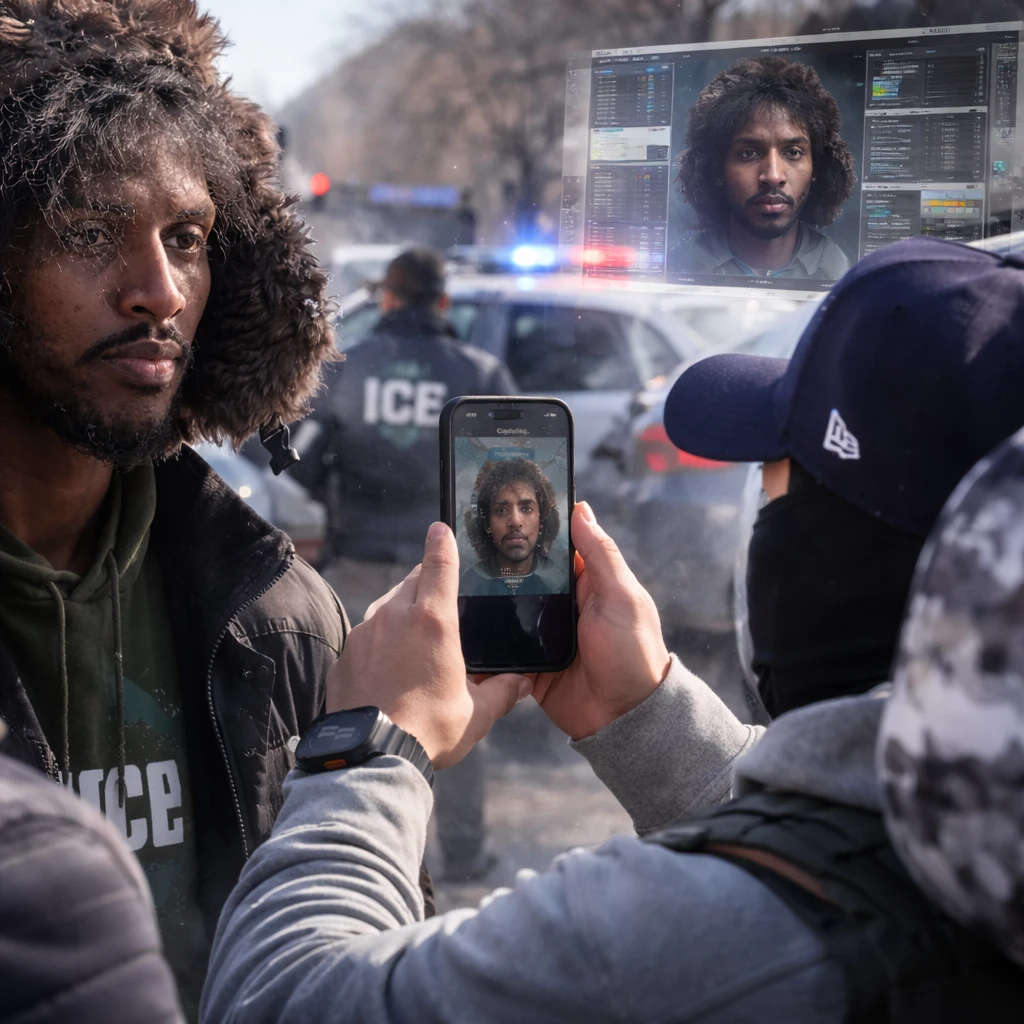

On a chilling morning in a Minneapolis suburb, Luis Martinez experienced a stark example of the escalating immigration enforcement tactics implemented by the Trump administration. As Martinez was en route to his workplace, federal agents surrounded his vehicle, forcing it to halt abruptly in the street. Masked officials approached, requesting identification, and proceeded to scan his face with a cellphone camera held just inches away. The detailed biometric scan collected the contours of Martinez’s eyes, lips, and cheeks, all while agents repeatedly questioned his citizenship status.
This incident mirrors a broader enforcement pattern currently underway in Minnesota and other states where Homeland Security has increased its personnel and operational measures. Government officials maintain that these efforts concentrate on apprehending serious offenders, yet visual evidence, including photos and videos, coupled with internal agency documents, depict a more expansive approach. Central to this new method is the heavy reliance on biometric tracking and the integration of extensive, interconnected digital databases.
Biometric surveillance now operates as a cornerstone of the immigration crackdown, involving a vast web of data-sharing agreements among federal, state, local, and international entities, as well as contracts with technology firms and data brokers. This network facilitates the amalgamation of immigration and travel records, detailed facial photographs, and vehicle-related information into comprehensive databases.
In Martinez’s particular case, the biometric facial scan initially failed to identify him. His eventual release came only after he presented a United States passport, which he said he carries out of apprehension for such encounters. Martinez reflected on the changing climate in Minnesota, once a welcoming place for diverse cultures, now distinctive for its fear-inducing enforcement actions prompting some residents to leave.
Advocates highlight that the fusion of various governmental data sources and surveillance technologies permits unprecedented monitoring capabilities across American cities. Law enforcement agents can use facial recognition to identify individuals on streets, track movement patterns through license plate readers, and even reconstruct personal routines and social connections by accessing commercially available mobile phone location data.
While the Department of Homeland Security refrains from disclosing detailed information about these surveillance tools citing law enforcement sensitivity, it asserts that such technologies assist in apprehending dangerous criminals including gang members, sex offenders, and identity thieves, all while purportedly upholding civil liberties and privacy rights.
Former Customs and Border Protection adviser Dan Herman emphasized the scale and sensitivity of data available to government agencies, cautioning about the potential misuse of such information. He regards the vast access to trade, travel, immigration, and screening data as a valuable asset for national security but warns about possible abuses impacting privacy and civil liberties.
In a recent disclosure, the Department of Homeland Security revealed the use of the Mobile Fortify facial recognition application, which compares live facial scans against "trusted source photos" to confirm identities during enforcement operations. This app, developed by NEC for Customs and Border Protection and Immigration and Customs Enforcement, employs biometric comparison techniques resembling those seen in airport security but lacks clear provisions for informing subjects or obtaining consent during street-level encounters.
Reports and observational footage reveal that agents rarely seek permission prior to conducting facial scans, and on occasions, continue despite objections. Instances in areas like Columbia Heights, Minnesota, showed officials holding their phones just a foot from individuals’ faces to obtain biometric information. Lawsuits filed by entities such as Illinois and Chicago allege the Mobile Fortify app has been utilized over 100,000 times in the field.
Experts warn that the absence of federal regulatory frameworks for facial recognition deployment presents challenges related to accuracy, oversight, transparency, discrimination, and access to remedies. Adding to concerns, the Trump administration curtailed efforts to outfit ICE officials with body cameras recently, although some agents involved in a fatal shooting in Minneapolis were reportedly equipped with these devices, and related footage is under review.
The department also indicated an expansion in the use of cutting-edge technologies, confirming active testing and deployment of over 100 artificial intelligence systems in various law enforcement applications. Congress authorized a substantial increase in budget—in excess of $2.7 billion—for Customs and Border Protection to enhance border surveillance incorporating AI and emerging technology advancements.
Meanwhile, tech contracts continue to grow, exemplified by a $30 million extension to Palantir for developing systems aimed at identifying individuals for deportation. The Trump administration also acknowledged leveraging Palantir’s AI models to process immigration enforcement tip submissions. Partnerships with license plate reader companies like Flock Safety further augment surveillance capabilities.
Legal and civil rights observers, including Brennan Center for Justice's Rachel Levinson-Waldman, caution about the broader implications of such surveillance funding and technology. There is concern about the expansion of tools designed initially for immigrant enforcement being applied to monitor U.S. citizens engaging in lawful activities, including protests.
In summary, the integration of biometric and digital technologies has significantly escalated under the current administration’s immigration policy framework, raising complex issues surrounding privacy, civil rights, and the reach of government surveillance.
Photography contributions from freelance journalist Adam Gray in Minneapolis.