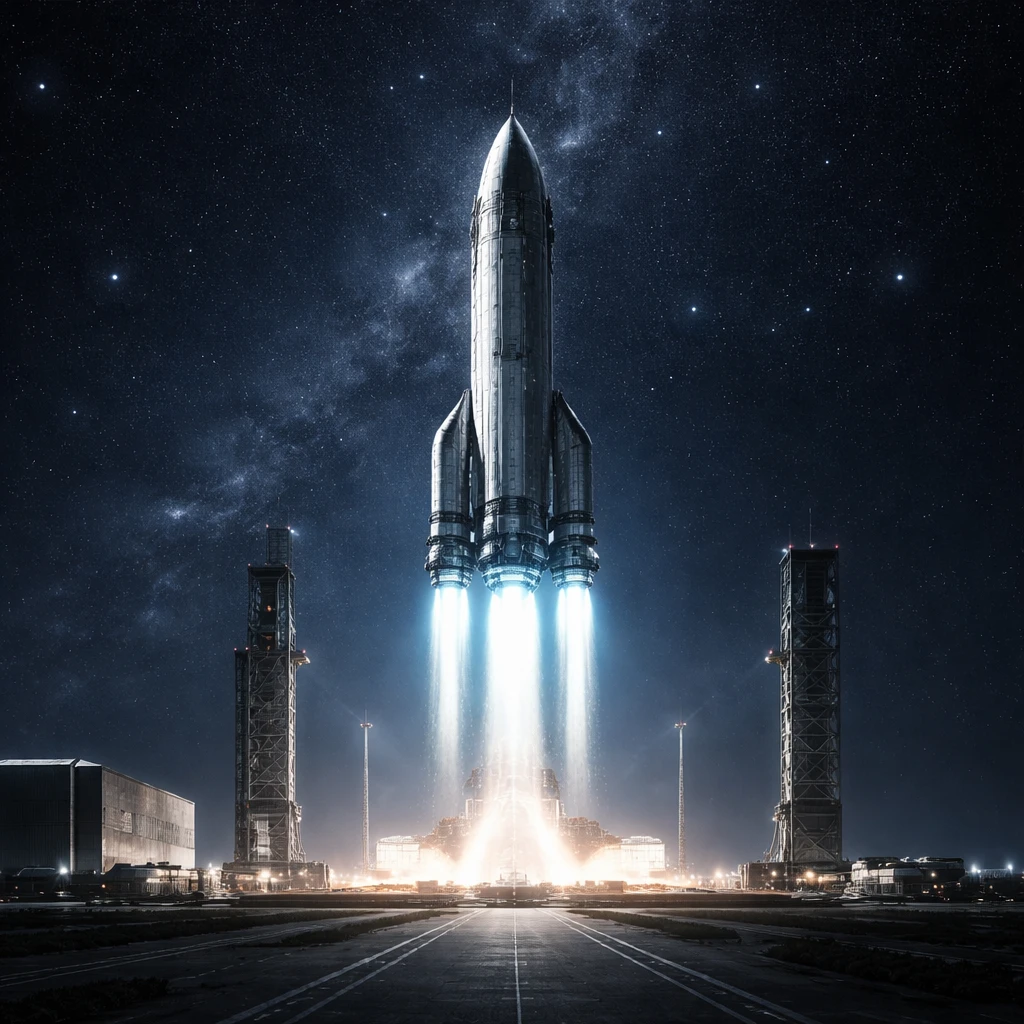

In a defining moment at SpaceX’s Starbase facility located in Texas, CEO Elon Musk conveyed a vision for his company that significantly transcends its established goals. Instead of focusing solely on conventional objectives like landing humans on Mars or deploying satellite constellations, Musk positioned SpaceX as the driving force behind turning the aspirational universe of Star Trek into a concrete future.
The announcement was made during a visit by Defense Secretary Pete Hegseth and senior members of the Pentagon's leadership contingent, part of an "Arsenal of Freedom" tour showcasing American industrial capabilities. Despite the occasion's official purpose, Musk took the opportunity to lay out a more expansive and ambitious conceptual framework for SpaceX’s enduring mission.
Giving a glimpse into the operational prowess of Starbase, Musk described the facility as having been constructed "out of nothing" by the SpaceX team and now serving as a "gigantic rocket manufacturing system." Notably, this installation has been legally recognized as a city and is accessible to the public, allowing visitors to drive along the roadway and observe the impressive spacecraft hardware assembled there.
Turning squarely to the raison d’etre of SpaceX, Musk stated, "I'll tell you a little bit just about the purpose of SpaceX. It’s like—we want to make Star Trek real." He then enhanced this narrative, expressing a goal to establish the equivalent of "Starfleet Academy," the fictional institution educating interstellar explorers in the Star Trek universe, thereby bridging the gap between science fiction and tangible scientific achievement.
Expanding on this narrative, Musk detailed a future where large spacecraft—populated with many individuals—would traverse space not only destined for other planets and the Moon but ultimately propelled beyond our own star system. He envisaged potential encounters with extraterrestrial beings or the discovery of the remnants of ancient alien civilizations, emphasizing the exploratory zeal driving these ambitions, even though the precise outcomes remain unknown.
Musk asserted the importance of venturing into the vast unknown regardless of uncertainties, reiterating the desire to develop "epic futuristic spaceships with lots of people in them, traveling to places we've never been to before." This statement marked a notable expansion from prior statements focusing primarily on Mars colonization, advancing toward a longer-term vision encompassing interstellar travel and contact with alien life.
These remarks present an evolution in Musk’s long-standing message regarding humanity’s future. Historically, he has stressed that ensuring the survival of human civilization necessitates spreading beyond Earth. This has previously been articulated in blunt terms such as "Become multiplanetary or die," penned in a social media post, and forewarnings that space colonization is essential to preserve human existence in the event of global catastrophe.
While Mars has served as the immediate focal point historically, Musk’s recent articulation broadens the scope considerably. He advances the notion that SpaceX’s purpose includes building not just spacecraft that reach orbit or land humans on the Red Planet, but also creating crews of explorers aboard advanced vehicles venturing to uncharted star systems.
Importantly, Musk’s presentation was not a sales pitch for a new rocket model or a specific technology demonstration; rather, it was a narrative defining SpaceX’s overarching mythology and strategic identity. He employed the cultural touchstone of Star Trek as an inspirational blueprint and underscored science fiction not merely as entertainment but as a precursor to achievable scientific ventures and human expansion into space.
Although Musk did not present any timelines for realizing these ambitions, the determination to build the necessary ships, train human beings for interstellar travel, and embark on expeditions to discover what lies beyond remains unequivocal. As Musk succinctly summarized the mission, "That's the goal." This vision construes SpaceX not just as a rocketry company but as humanity’s vehicle toward a future once confined to the realm of speculative fiction.