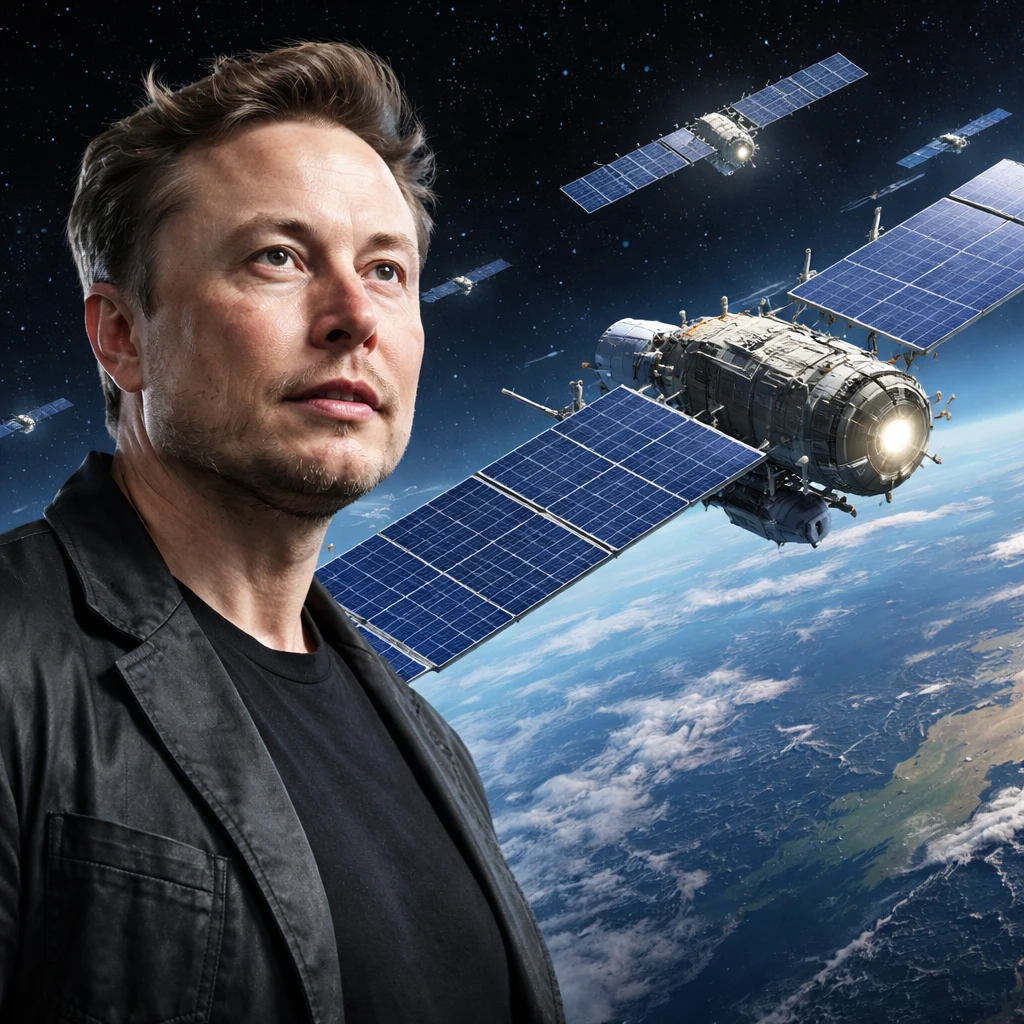

Elon Musk has declared a bold initiative to revolutionize data processing for artificial intelligence by establishing extensive solar-powered data centers in outer space. In a move reminiscent of his previous ventures that disrupted the automotive and aerospace sectors, Musk envisions deploying nearly one million satellites in orbit to facilitate this advanced infrastructure.
This week, Musk officially merged his AI venture with SpaceX and announced plans for an initial public offering of the unified company. Articulating his vision on the SpaceX platform, Musk asserted that orbital-based AI is essential for scalable growth, highlighting the constant availability of solar power beyond Earth's atmosphere with the remark, "It's always sunny in space!"
Despite Musk's enthusiasm, scientific and industry experts caution against underestimating the substantial technical, economic, and environmental challenges linked to such an ambitious project. The numerous complexities have invited rigorous scrutiny concerning viability and sustainability.
Challenges of Heat Dissipation in Space
One of the critical concerns revolves around heat management. Data centers on Earth consume vast amounts of electricity and generate considerable heat requiring sophisticated cooling systems. Relocating these centers to space aims to alleviate terrestrial power grid strains and decrease the environmental footprint tied to land-based server farms, which occupy extensive land and water resources to maintain operational temperatures.
However, the vacuum of space presents a paradox for heat dissipation. While outer space is frigid, the absence of an atmospheric medium obstructs heat transfer through convection or conduction. Conventional computer components could overheat more rapidly in this environment because heat can only be expelled via radiation, much like a thermos maintaining coffee heat through insulation that limits air contact.
Josep Jornet, a professor in computer and electrical engineering at Northeastern University, explained that uncooled chips in space would succumb to excessive heat rapidly. Possible solutions include designing vast radiative panels that emit infrared light to radiate heat into space. Although this technology has been demonstrated on a small scale such as the International Space Station, scaling it for Musk's vision requires extraordinarily large and delicate constructs that currently do not exist.
Addressing Space Debris and Satellite Longevity
Aside from thermal challenges, the accumulation of orbital debris introduces considerable risks. A single malfunctioning satellite or one losing orbiting stability may cause a chain reaction of debris collisions. Such incidents could disrupt critical services including emergency communications and meteorological observations.
Musk has acknowledged this threat, noting that over seven years and approximately 10,000 Starlink satellites, there was only one minor debris event. However, this footprint is significantly smaller than the proposed million-satellite constellation. John Crassidis, a former NASA engineer and University at Buffalo academic, warns that increased satellite density heightens the probability of catastrophic collisions at velocities reaching 17,500 miles per hour.
Maintenance poses another formidable obstacle. Satellites experience hardware degradation over time, with specialized AI components such as GPUs particularly vulnerable to damage from solar radiation. On Earth, faulty servers can be repaired or replaced by technicians, but in orbit, no repair crews are available.
Industry professionals like Baiju Bhatt, CEO of space-based solar energy firm Aetherflux, indicate that redundancy through extra hardware onboard might mitigate failures, but it would substantially increase the cost. Given Starlink satellites presently have approximately a five-year operational life, repeated, expensive replacements challenge the economic feasibility of Musk’s plan.
Competition and Strategic Advantages
Musk is not the sole innovator pursuing the space-based computing frontier. Starcloud, a Washington-based entity, has launched satellites equipped with Nvidia AI chips for testing. Google is investigating orbital data centers through Project Suncatcher, and Blue Origin, led by Jeff Bezos, plans a vast constellation to boost communications, though with lesser emphasis on AI.
Nonetheless, Musk possesses a strategic edge through SpaceX’s launch capabilities. Competitors have relied on Musk's Falcon rockets to deliver their technology to orbit. Industry analyst Pierre Lionnet notes that Musk charges external companies substantially higher launch fees compared to internal missions, an apparent tactic supporting his competitive positioning.
Musk has expressed resolute optimism, forecasting that within approximately 30 to 36 months, space-based AI operations will surpass terrestrial centers economically, signaling a transformative shift in the technology landscape.