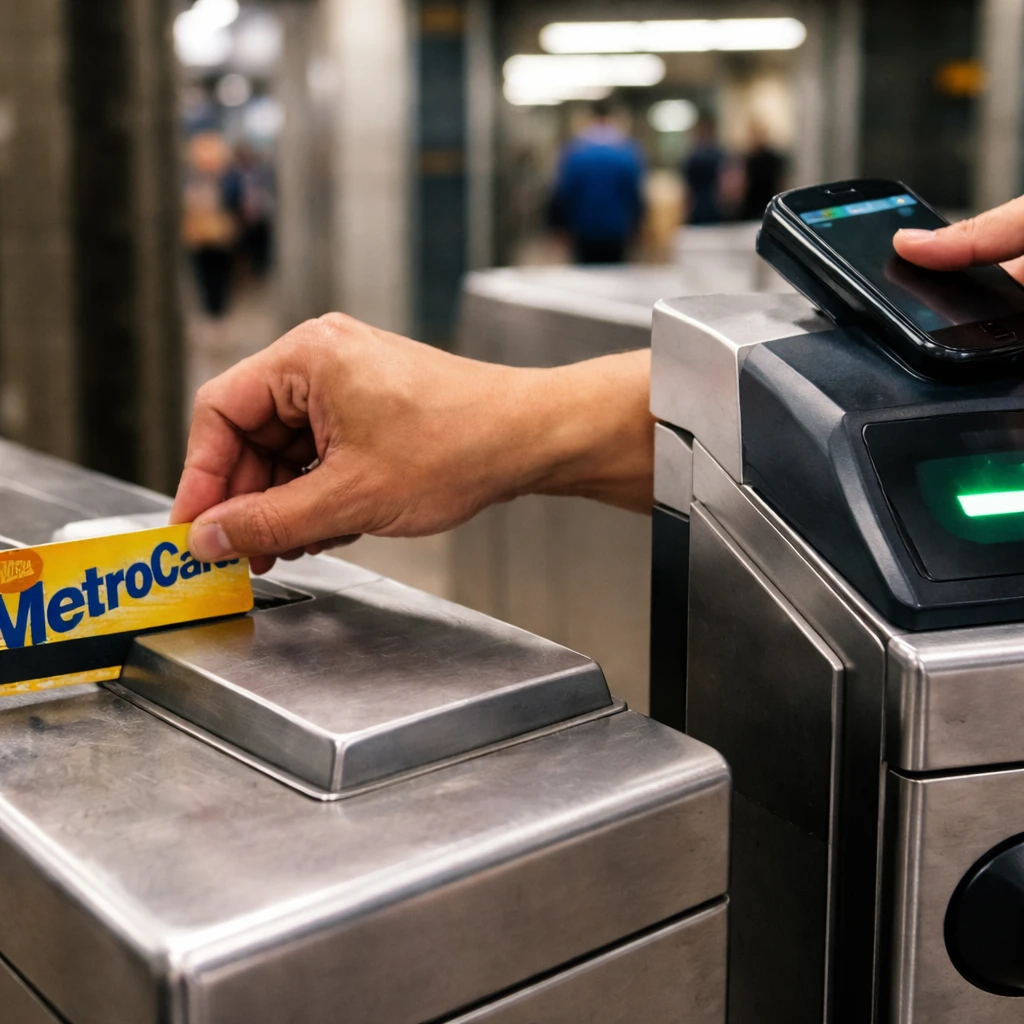

In 1994, New York City marked a significant upgrade to its transit payment system with the launch of the MetroCard, ending the era of subway tokens that had been in place since 1953. This much-anticipated transition infused modernity into the world's one of the oldest and largest subway networks by introducing a swipeable plastic card as fare payment.
Fast-forward more than 30 years, and the MetroCard — once seen as revolutionary yet often criticized for its delicate magnetic strip — is now being retired. The Metropolitan Transportation Authority (MTA) has announced the final date to purchase or refill a MetroCard as December 31, 2025. Beyond this point, riders will rely exclusively on OMNY, a contactless fare payment system that enables commuters to tap their credit card, smartphone, or other smart devices to pay at turnstiles and on buses.
Since its official rollout in 2019, OMNY has rapidly gained traction, with over 90% of subway and bus riders adopting the tap-and-go method for fare payments. This system, which permits a simpler and faster transaction process, aligns New York City with other major metropolitan hubs around the world, including London and Singapore, who have embraced similar contactless transit payment technologies for years. Within the United States, cities such as Chicago and San Francisco have also implemented comparable pay-as-you-go transit systems, the latter launching its version earlier in the same year.
The MetroCard was a game changer for New York commuters when it debuted. Before its arrival, riders depended exclusively on tokens — the small brass-colored coins initially issued in 1953 and traditionally bought from subway station booths. Originally, fares were paid by paper tickets costing five cents in 1904, equivalent to roughly $1.82 in current dollars.
Jodi Shapiro, curator of the New York Transit Museum in Brooklyn, which opened an exhibit recently commemorating the MetroCard’s impact, explains that while tokens were effective, the MetroCard introduced a transformative mindset for the city’s transit users. The card’s swipable technology demanded a novel interaction, reshaping daily commuting rituals.
Upon introduction, the MTA launched extensive public awareness campaigns aimed at educating passengers on correctly swiping the originally blue-colored cards to minimize issues like error messages or lost fares. For a brief time, the MTA even considered a mascot named the Cardvaark to promote the new card but eventually abandoned the idea.
The MetroCard also gained cultural significance through numerous special edition releases marking various events and partnerships. Highlights include commemorative cards for the 2000 World Series dubbed the “Subway Series” between the New York Mets and the Yankees when fares were $1.50. The card’s designs featured artwork from renowned musicians like David Bowie and Olivia Rodrigo, influential New York hip hop groups including the Wu-Tang Clan, Notorious B.I.G., and LL Cool J, as well as beloved television series such as Seinfeld and Law & Order.
Collector Lev Radin from the Bronx values cards that showcase New York City to the world, admiring those depicting city landmarks, skylines, and the people who define the city’s unique character. Meanwhile, becoming proficient in the perfect MetroCard swipe—angle and speed—became an unofficial rite of passage distinguishing longtime New Yorkers from visitors. Even notable figures occasionally struggled, such as former presidential candidate Hillary Clinton, who famously required several attempts to swipe her card successfully at a Bronx station, while Senator Bernie Sanders seemed unaware that tokens were no longer accepted.
Transitioning from the MetroCard to OMNY has presented a different experience for both the transit authority and riders. Unlike the MetroCard’s launch, which demanded intensive public education, OMNY has needed relatively less adjustment due to its similarity with everyday contactless payments. For those wary of using credit cards or smartphones, OMNY offers a reloadable card option akin to the MetroCard's format, ensuring continued access for diverse commuter preferences.
The MTA has assured riders that existing MetroCards will remain valid until 2026, allowing users to expend their stored balances during this interim period. The agency emphasizes that the modern system is expected to save over $20 million annually by eliminating MetroCard-related expenses. Moreover, OMNY introduces capped weekly fares — unlimited rides within a seven-day window after reaching 12 paid trips — which will reach a maximum of $35 per week once the fare increases to $3 in January.
Nevertheless, the new technology’s implementation is not without criticism. Some voices have raised concerns about data privacy and heightened surveillance potential associated with contactless payments and digital transactions.
Despite increasing adoption, a segment of riders remains attached to the MetroCard. At a busy turnstile near Times Square, 70-year-old Manhattanite Ronald Minor expressed his reluctance, citing difficulties with the reload process for OMNY cards and concerns about excluding older passengers from accessible options. "It's hard for the elders," Minor said, emphasizing the need for transition strategies sensitive to all rider demographics.
Similarly, John Sacchetti, encountered at the Port Authority stop, favored the MetroCard’s feature that displays remaining balance during each swipe, providing immediate awareness of transit spending. He acknowledged OMNY’s inevitable integration while anticipating some adjustment period for users. "It's just like everything else, just something to get used to," Sacchetti commented.
As New York phases out this transportation staple, commuters and city officials alike navigate the balance between embracing technological progress and meeting the diverse needs of a vast urban population accustomed to decades of MetroCard use.