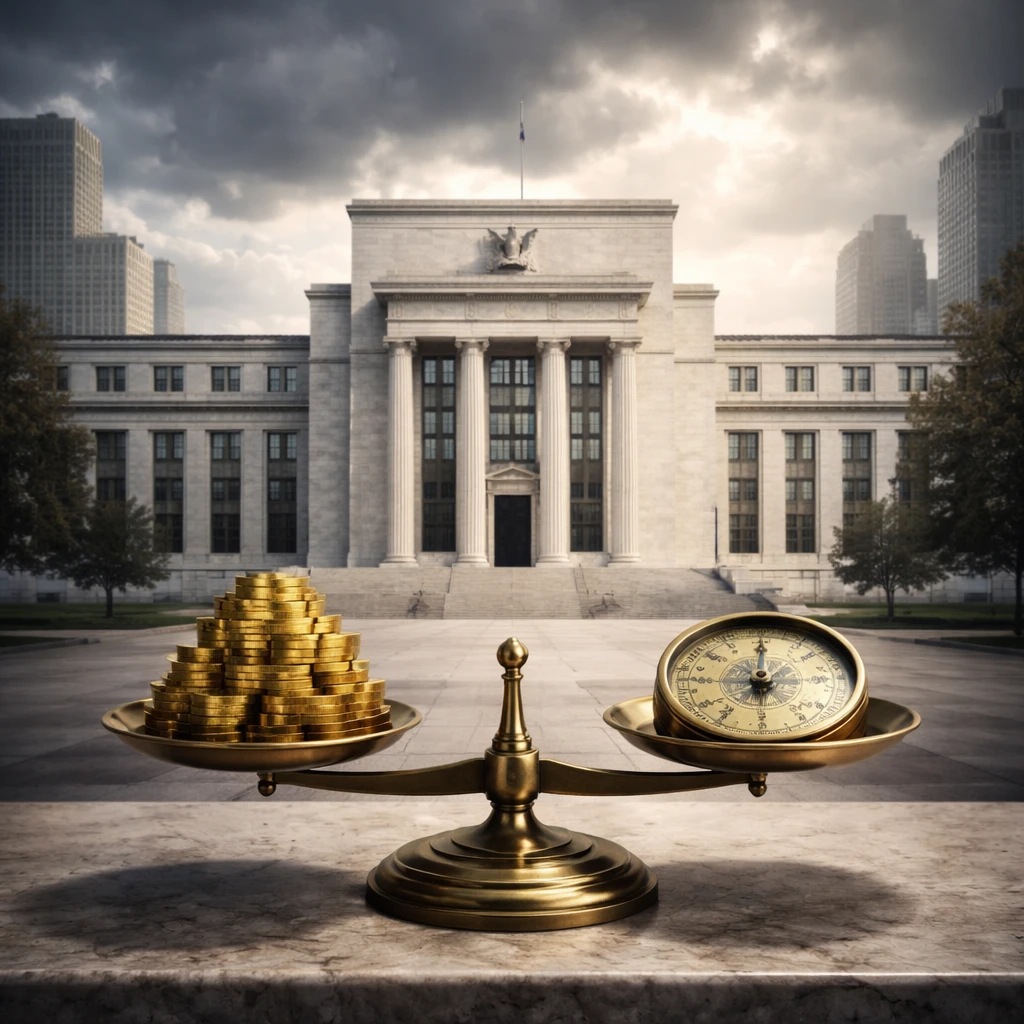

In the last seven years, optimism has dominated Wall Street, exemplified by the S&P 500's extraordinary achievement of rallying at least 16% annually across two significant three-year periods: 2019 to 2021 and 2023 to 2025. This strong performance has also been mirrored by gains in the Dow Jones Industrial Average and the Nasdaq Composite, both reaching multiple record closing highs during this timeframe.
While such market advances are well-aligned with long-term historical patterns of sustained growth over multidecade periods, the path between these milestones is intermittently marked by instability and unpredictability. Market participants have habitually faced various headwinds that could abruptly interrupt bullish momentum. Presently, one such formidable influence is emerging from an unusual source — the Federal Reserve.
The Federal Reserve, as the principal monetary authority in the United States, typically serves as a stabilizing entity for financial markets. Its overarching mandate includes promoting maximum employment and maintaining price stability through monetary policy actions. These objectives, while straightforward in concept, involve complex and often challenging implementation.
Decision-making responsibility for U.S. monetary policy rests mainly with the 12-member Federal Open Market Committee (FOMC), chaired by Jerome Powell. The committee utilizes tools such as adjustments to the federal funds target rate — the overnight lending rate between financial institutions — to influence economic conditions. Changes to this rate impact borrowing costs for both consumers and businesses.
In addition to rate adjustments, the FOMC engages in open market operations, managing the purchase and sale of U.S. Treasury bonds to affect liquidity and broader interest rate levels within the economy.
Monetary policymakers base their decisions heavily on lagging economic data, which can sometimes lead to untimely or inappropriate policy responses relative to current economic realities. While the market can usually tolerate missteps by the Fed if there is a clear and unified approach to policymaking, recent developments have signaled a growing divergence in views within the FOMC.
Contrasting with past unity, recent FOMC meetings have exhibited unprecedented levels of discord. Over the four latest meetings prior to the January 28 session, at least one member dissented from the majority decision on the federal funds rate in each instance. Remarkably, the later meetings of October and December featured dissents that opposed each other directionally — one member opposed reducing rates, while another advocated for a more aggressive 50 basis point cut instead of the group's 25 basis point consensus.
This level of internal disagreement is remarkably rare. Historical records over the past 36 years indicate only three FOMC meetings with dissenting opinions pulling in opposite directions, two of which have occurred within the last three months. Such fractures within the Federal Reserve's policymaking body contribute to investor uncertainty and erode confidence in the institution's capacity to manage economic stability effectively.
Exacerbating these concerns is the impending conclusion of Jerome Powell's term as Fed chair, scheduled for May 15, 2026. While this transition was anticipated, the absence of a confirmed successor, with President Trump's nominee yet unnamed as of this analysis, adds an additional layer of ambiguity. Market reaction to the new appointee remains uncertain, potentially disrupting the continuity that investors value.
Moreover, the challenges extend beyond internal Fed dynamics. An examination of historical patterns surrounding federal funds rate adjustments reveals complex implications for the stock market. Conventional wisdom suggests that rate hikes act as a brake on an overheating economy by making borrowing more expensive, thus cooling inflationary pressures. Conversely, rate cuts typically imply easing financial conditions, presumed beneficial for economic growth and equity valuations.
However, historical occurrences paint a more nuanced picture. Data from the 21st century highlight instances where rate-cutting cycles coincided with significant equity market weaknesses, including bear markets and crashes. Notably, three key episodes exemplify this trend:
- Beginning January 3, 2001, the FOMC embarked on an 11-month reduction of the fed funds rate by 475 basis points down to 1.75%. Despite rate easing, it took nearly 645 days for the market to recover from the dot-com bubble burst.
- Starting September 18, 2007, a protracted 15-month rate cut brought the rate from 5% to near zero. The stock indexes experienced significant losses, bottoming out approximately 538 days after the initial cut.
- On August 1, 2019, prior to the brief COVID-19 induced market collapse, the FOMC reduced rates from 2.25%-2.50% to effectively zero over several months, with the market bottoming 236 days post initial cut.
These cases demonstrate that rate cuts can presage economic or market distress, as the Federal Reserve often reduces rates reactively in the face of emerging weaknesses.
When considered alongside the current divergence within the FOMC and the scheduled leadership transition, a confluence of risk factors — a 'perfect storm' — materializes for Wall Street. Although equity markets have historically rewarded long-term investors with growth, 2026 looms as a potentially volatile year marked by uncertainty surrounding monetary policy direction and its effects on the broader economy and financial markets.