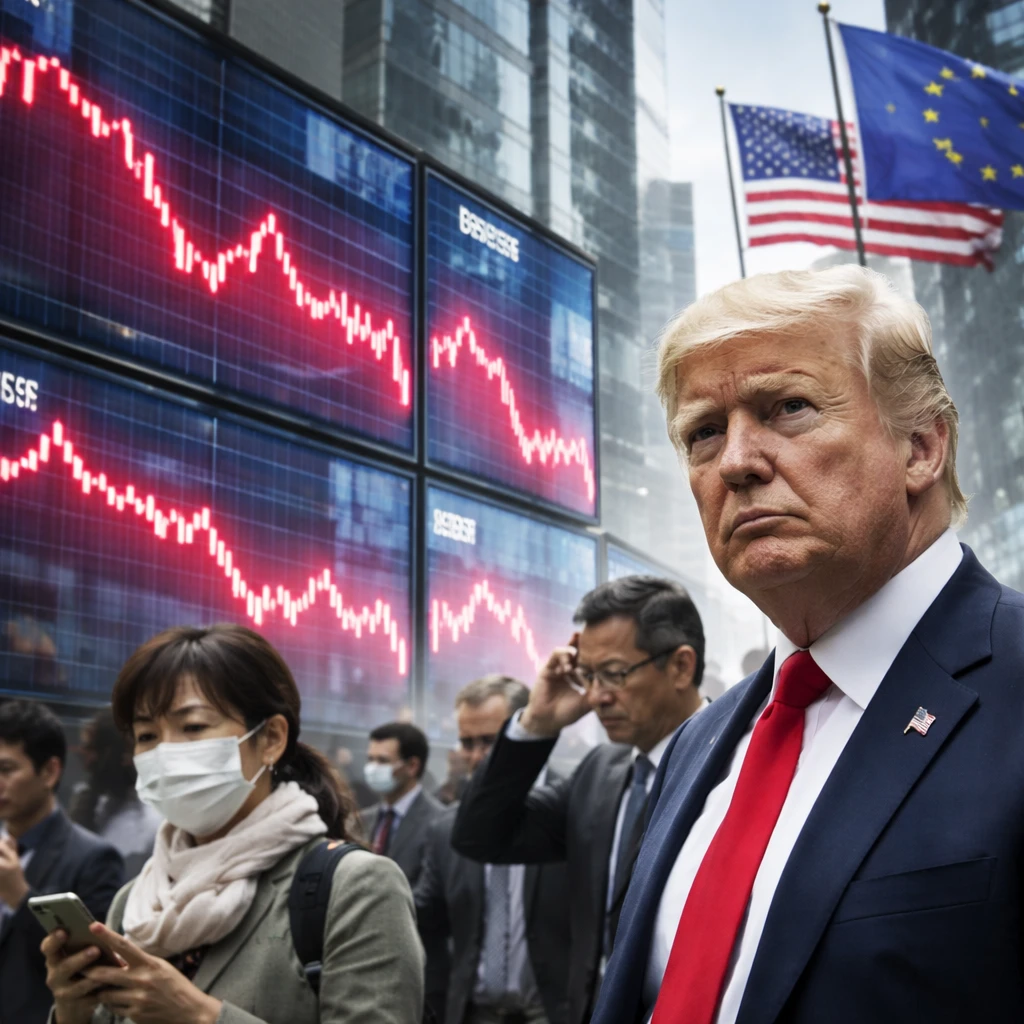

In trading sessions globally, markets reacted strongly to the Trump administration's recent tariff announcements targeting select European nations in connection with the Greenland contention. European indices retreated notably, with France's CAC 40 decreasing by 1.2% to 8,014.42, Germany's DAX declining 1.5% to 24,581.44, and the UK’s FTSE 100 slipping 1.3% to 10,068.04. U.S. equity futures mirrored this downtrend, as the S&P 500 futures dropped by 1.8%, and the Dow Jones Industrial Average futures fell 1.6%.
On Saturday, President Trump declared that a 10% import duty would commence in February on products from Denmark, Norway, Sweden, France, Germany, the United Kingdom, the Netherlands, and Finland. This was framed as a response to their opposition towards American aspirations of exerting control over Greenland, a strategic territory. The announcement ignited significant diplomatic consternation across Europe, prompting leaders to deliberate on measures such as retaliatory tariffs and the unprecedented invocation of the European Union's anti-coercion mechanism.
In related commentary at the World Economic Forum in Davos, Swiss Alps, U.S. Treasury Secretary Scott Bessent advised a tempering of immediate reactions, noting that the United States' relationships with European nations remain robust. He encouraged trade partners to "take a deep breath" as these issues unfold.
Meanwhile, developments in East Asia compounded market volatility. Tokyo's Nikkei 225 closed down 1.1% at 52,991.10 following Prime Minister Sanae Takaichi’s announcement of a snap election scheduled for February 8. Her decision, articulated earlier in the week, includes plans to dissolve the Japanese parliament and potentially suspend the consumption tax on food temporarily. Market participants are apprehensive of potential increases in government spending attributable to Takaichi's likely renewed mandate, spurring concern over Japan’s fiscal sustainability.
This apprehension materially influenced the bond sector, with yields on long-duration Japanese government bonds surging sharply. The 40-year government bond yield climbed to an unprecedented 4%, while other long-term government bonds reached multi-decade highs, reflecting heightened investor unease.
Elsewhere in Asia, equity markets broadly experienced mixed results. Hong Kong's Hang Seng index decreased by 0.3% to 26,487.51, the Shanghai Composite held mostly steady near 4,113.65, South Korea’s Kospi declined 0.4% to 4,885.75, and the Australian S&P/ASX 200 fell 0.7% to 8,815.90. Conversely, Taiwan’s Taiex increased modestly by 0.4%, while India's Sensex dropped 0.8%.
Senior research strategist Michael Brown of Pepperstone highlighted the prominence of geopolitical developments this week, particularly in the context of ongoing discussions at the World Economic Forum. He emphasized that these events are likely to remain focal points for investors and policymakers alike in assessing global market sentiment.
Looking ahead, several important economic data releases are on the horizon, including further U.S. corporate earnings reports and updates on inflation metrics favored by the Federal Reserve. The Fed's forthcoming policy meeting, scheduled in two weeks, is anticipated to maintain the current benchmark interest rate as it balances a decelerating labor market against inflation readings still exceeding the 2% target.
Additionally, the Bank of Japan is expected to conclude its monetary policy review meeting later in the week, with market participants attentive to any signals concerning policy shifts.
In commodity markets, U.S. benchmark crude oil prices dipped 49 cents to $58.95 per barrel, while Brent crude, recognized internationally, declined 33 cents to $63.61 per barrel. Currency exchange rates reflected cautious sentiment as well, with the U.S. dollar softening against the Japanese yen from 158.09 to 157.83 yen, and the euro strengthening against the dollar from $1.1645 to $1.1716.