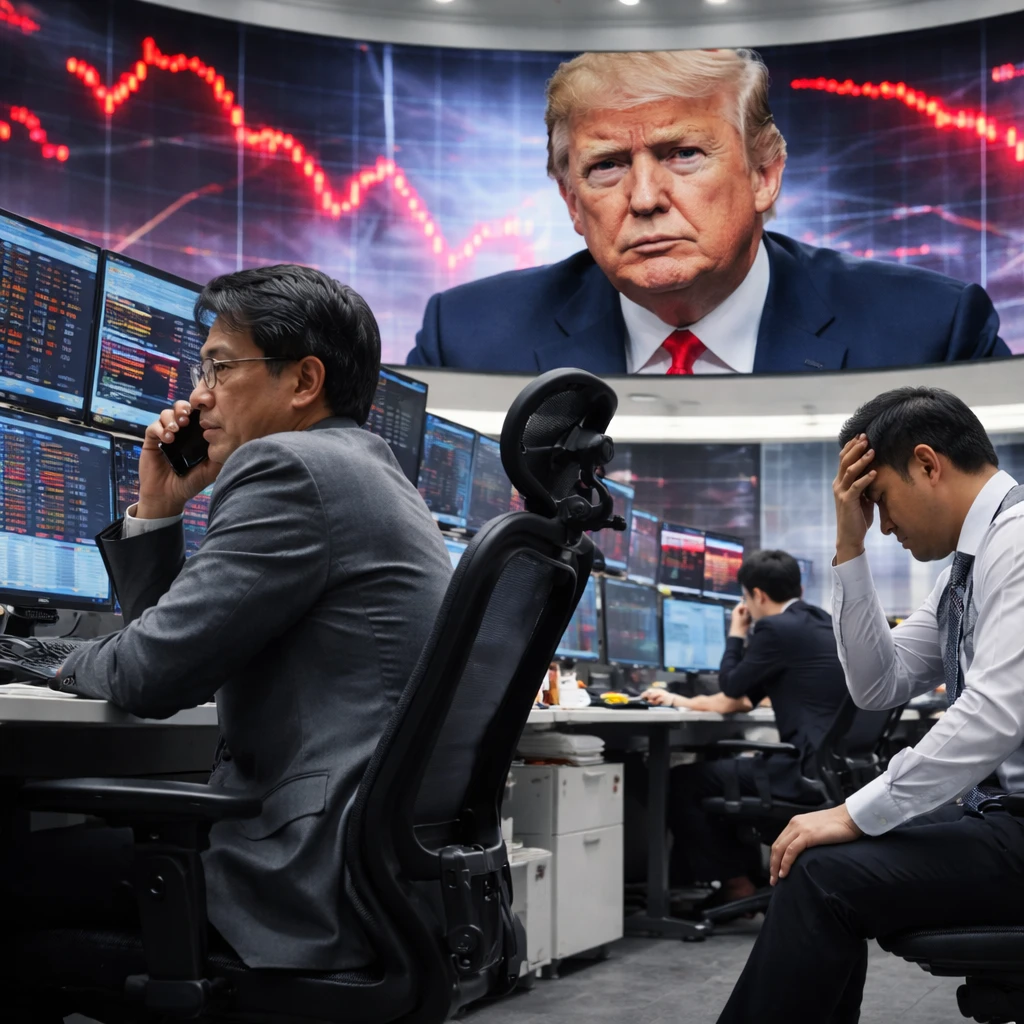

On Monday, global markets experienced marked declines as uncertainties intensified surrounding President Donald Trump's appointment for the next chair of the Federal Reserve amid rising worries of a bubble in the artificial intelligence (AI) sector. U.S. futures fell, while key Asian indices retreated sharply, reflecting investor nervousness linked both to potential changes in central bank policies and market exuberance in tech stocks.
South Korea's Kospi index, sensitive to technological sector fluctuations, led the downturn by falling 5.1%, prompting a temporary halt in trading. Samsung Electronics shares declined 5.6%, and chip manufacturer SK Hynix experienced a steeper drop of 7.6%. These losses interrupt a trend of record-setting performances fueled by enthusiasm around AI innovations and partnerships with industry giants like Nvidia and OpenAI.
Simultaneously, U.S. stock futures revealed negative momentum; the S&P 500 futures were down by 1.2%, and the Dow Jones Industrial Average futures slipped 0.8%. Market participants are increasingly apprehensive about Kevin Warsh, Trump's nominee for Federal Reserve Chair, and the potential direction he may set for interest rate policy amid fears that Fed independence might wane under political influence. This concern has already contributed to a decline in the value of the U.S. dollar and a rise in gold prices over the previous year.
In early trading, gold prices dropped 3.5% and silver fell 2.1%, both metals having experienced substantial rallies recently that abruptly reversed last Friday. Such volatility reflects changing investor sentiment triggered by shifts in monetary policy expectations and market dynamics.
Energy markets also responded: benchmark U.S. crude oil prices declined by $3.46 to close at $61.75 per barrel. During remarks made aboard Air Force One, President Trump emphasized the importance of seeking a "satisfactory" deal with Iran to prevent the development of nuclear weapons. Trump's statement indicated ongoing diplomatic discussions, which analysts believe alleviated some concerns over possible disruptions in oil supply, contributing to Brent crude's $3.58 fall to $65.74 per barrel.
The downturn extended to other Asian markets with Tokyo’s Nikkei 225 retreating 1% to 52,791.59 after initially posting gains, Hong Kong’s Hang Seng dropping 2.9% to 26,580.78, and Shanghai Composite index sliding 1.8% to 4,043.68. Australia’s S&P/ASX 200 decreased by 1% to 8,778.60, while Taiwan’s Taiex dropped 1.4%, reflecting a regional market selloff linked to both global concerns and sector-specific pressures.
In the U.S., the previous Friday ended with declines across major indices; the S&P 500 fell 0.4% to 6,930.03, the Dow Jones lost 0.4% finishing at 48,892.47, and the Nasdaq Composite declined 0.9% to 23,461.82. Despite the broader market downward trend, select companies such as Tesla and Apple posted gains. Tesla shares climbed 3.3%, rebounding from earlier losses in the week following strong quarterly profit results surpassing analyst expectations. Similarly, Apple added 0.5% after reporting a quarter profit exceeding forecasts.
Warsh's nomination for Fed Chair awaits Senate confirmation and carries significant implications for economic and market trajectories worldwide. The Federal Reserve’s leadership influences interest rate decisions which can either stimulate economic growth or curb inflation. President Trump has advocated for lower interest rates to boost growth, although such policy carries the risk of accelerating inflation.
Recent data indicating higher-than-expected wholesale inflation suggests the Fed might maintain current interest rates for a longer duration rather than implement reductions as it did late last year. Historically, the Fed operates with a significant degree of independence to make decisions that may be economically challenging in the short term but necessary to achieve long-term goals such as containing inflation near the 2% target.
The precious metals sector experienced substantial volatility, with gold prices plummeting over 11% to settle at $4,745.10 per ounce after a dramatic run-up that doubled prices within a year, briefly surpassing $5,000 before reaching a peak near $5,600 earlier in the week. Silver faced an even sharper fall of around 31%, reflecting the reversal in investor enthusiasm for these asset classes.
Currency markets showed modest shifts; the U.S. dollar dipped slightly against the Japanese yen, moving from 154.94 to 154.81 yen, while the euro fell marginally to $1.1851 from $1.1853, indicative of cautious trading amid broader uncertainty.