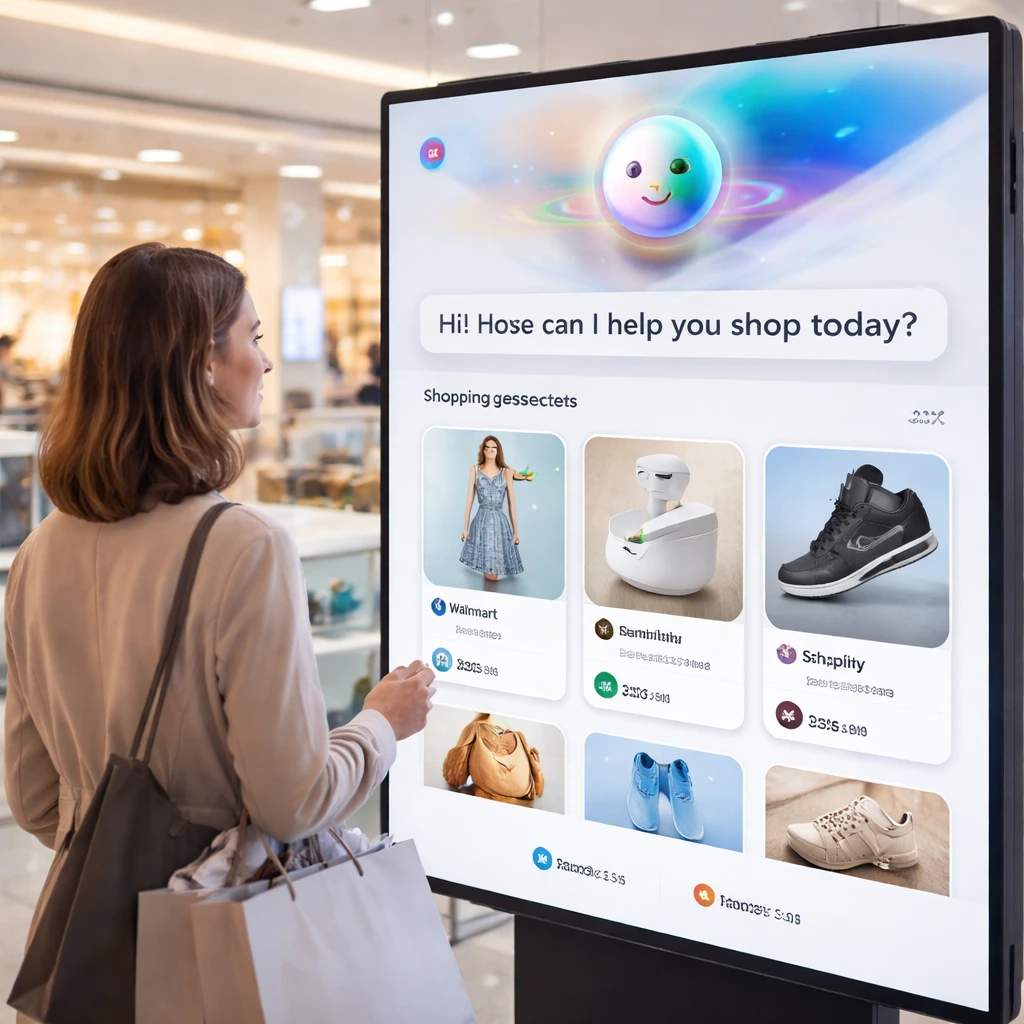

Google unveiled plans on Sunday to augment the shopping functionalities of its Gemini AI chatbot through strategic partnerships with leading retail companies such as Walmart, Shopify, and Wayfair. The collaboration is designed to transform Gemini from a mere shopping assistant into an active virtual merchant, enabling users to complete purchases directly within the chatbot experience.
Central to this development is an instant checkout mechanism, which permits customers to finalize transactions from selected merchants using a variety of payment methods without needing to exit the Gemini chat interface. Both Google and Walmart confirmed the arrival of this feature, underscoring its convenience and potential to streamline online shopping.
The announcement coincided with the commencement of the National Retail Federation's annual convention held in New York. This event, attracting around 40,000 participants from retail and technology sectors over three days, has a strong focus on the evolving influence of artificial intelligence on e-commerce and consumer purchasing patterns.
John Furner, soon to be the president and CEO of Walmart, emphasized the significance of this shift in retail dynamics. In a joint statement with Google and Alphabet CEO Sundar Pichai, Furner depicted the transition away from traditional web or app-based searching toward agent-assisted commerce as a pivotal evolution in retail strategy.
The operational model of Google’s enhanced AI shopping feature is straightforward: for inquiries such as recommendations for winter ski trip gear, the Gemini chatbot retrieves products from inventories of partnered retailers. Specifically for Walmart customers who link their Walmart accounts with Google, the chatbot tailors recommendations based on prior purchases. Additionally, products selected for purchase through Gemini can merge with existing Walmart or Sam’s Club online shopping carts, simplifying the user experience.
Earlier initiatives in this domain include a comparable agreement between OpenAI and Walmart, publicized in October. This arrangement allows ChatGPT users to utilize an instant checkout feature for most Walmart products, excluding fresh foods, facilitating integrated shopping through AI platforms.
Tech giants such as Google, OpenAI, and Amazon are actively competing to develop AI-based shopping tools that enable seamless browsing and purchasing within a single application, negating the necessity of redirecting to retailer websites for transactions. This technological competition has intensified over recent months, particularly between OpenAI and Google.
Preceding the recent holiday season, OpenAI introduced an instant checkout feature inside ChatGPT that enables consumers to buy items from selected retailers and Etsy vendors without leaving the app environment.
According to estimations by Salesforce, AI influenced approximately $272 billion in global retail sales over the holiday season, accounting for about 20% of total sales, signifying the growing impact of AI on consumer spending.
Currently, these AI-assisted shopping capabilities within Gemini are limited to United States consumers, with future expansions planned for additional countries. Initially, payments are restricted to cards linked to users' Google accounts; however, forthcoming updates will incorporate PayPal as a payment option, broadening user flexibility.
The primary goal behind integrating chatbots into e-commerce is to simplify the process of product discovery and purchase. Unlike the conventional method of manually inputting search keywords, users can engage via typing or voice commands in an interactive dialog, refining queries progressively. Furthermore, advancements in AI agents are underway, pushing beyond existing generative chatbots, although their current capacity to make autonomous purchasing decisions on behalf of consumers remains limited.
Mike Edmonds, Vice President of Agentic Commerce and Commercial Growth at PayPal, commented at the convention that widespread adoption of agent-led commerce will not occur instantaneously. He advised that retailers should proactively adapt rather than adopt a passive stance toward this transforming landscape.
Shopify’s founder and CEO, Tobi Lutke, expressed to a small media group that many consumers appreciate the personalized touch of a virtual shopper who understands their preferences and budget. He also stressed Shopify’s commitment to ensuring technology does not excessively automate the buying process, maintaining shopper control while enhancing product discovery.
Walmart's Furner reiterated the company’s objective of leveraging AI to effectively bridge the gap from desire to possession in the retail experience.
During the National Retail Federation conference, Furner and Pichai announced Walmart’s plans to expand its drone delivery operations in collaboration with Wing, an Alphabet subsidiary. This expansion will add drone services to 150 additional Walmart stores, increasing the total drone delivery locations to 270 by 2027 and covering a vast geographic area from Los Angeles to Miami.