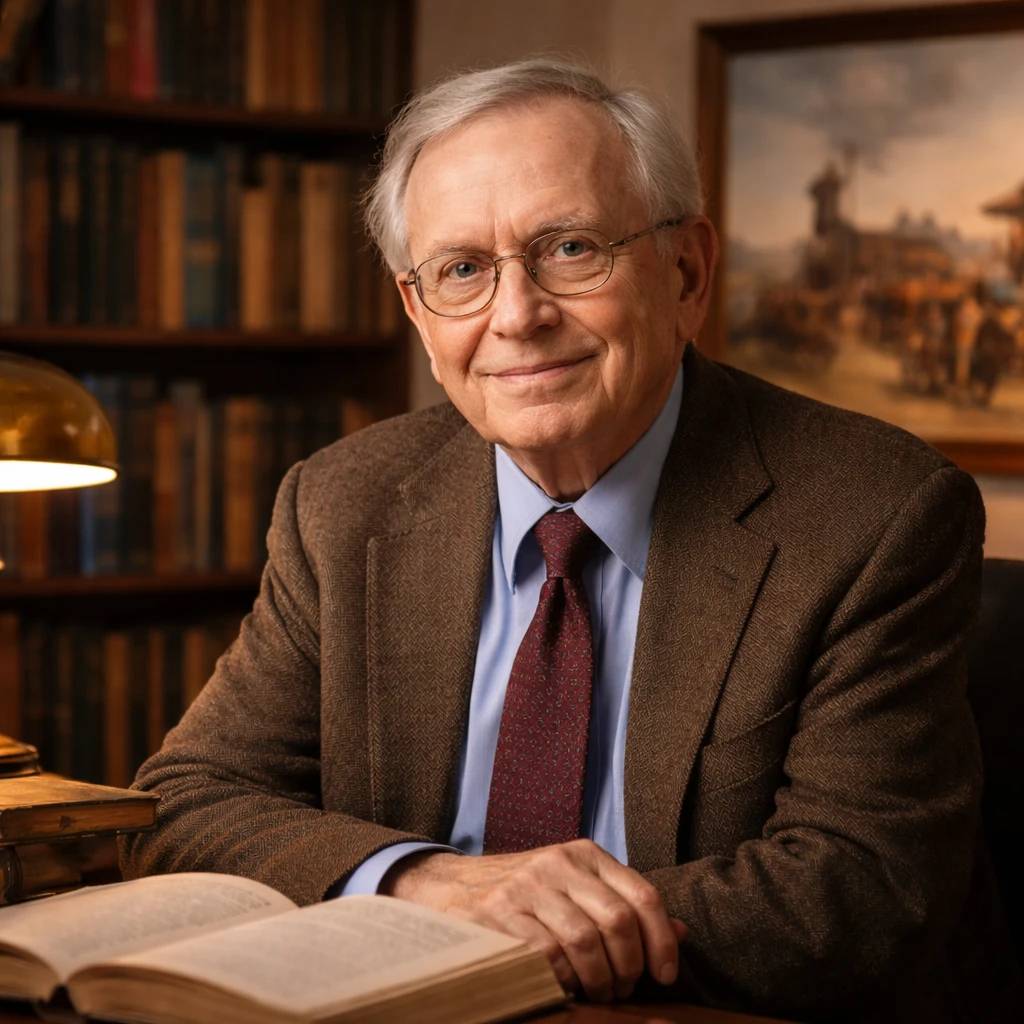

Daniel Walker Howe, an acclaimed historian and winner of the Pulitzer Prize, passed away at the age of 88 on December 25, as confirmed by a University of California, Los Angeles spokesperson, where he held the title of professor emeritus. Further specifics regarding his death have not been disclosed.
Howe’s distinguished 2007 book, What Hath God Wrought, published by Oxford University Press, earned him the Pulitzer Prize in 2008. This extensive work examines the era between 1815 and 1848, a formative phase in American history marked by rapid technological progress and transformative social movements. It belongs to an ambitious series from Oxford University Press that also includes prize-winning works such as David M. Kennedy’s Freedom from Fear and James M. McPherson’s The Battle Cry of Freedom.
The nearly 900-page volume explores key themes including the conclusion of the War of 1812, westward territorial expansion under the banner of "Manifest Destiny," the rise of Andrew Jackson and the emergence of modern political parties, as well as the increasingly contentious debates surrounding slavery preceding the Civil War. It also highlights the Seneca Falls Convention of 1848, marking the early stages of the organized feminist movement in the United States.
The historical period Howe covered resonates with challenges familiar to contemporary observers. In the years before the Civil War, America was transitioning to a more industrialized society with deepening divisions. Communication accelerated significantly; the book’s title, What Hath God Wrought, references the first telegraph message sent in 1844. This era experienced a surge in the production of newspapers and books facilitated by cheaper printing and more efficient mail systems, alongside substantial modernization of infrastructure through the construction of roads, bridges, canals, and other public projects.
Despite these advancements, resistance emerged notably from Southern leaders who opposed federally funded "internal improvements," fearing that such progress could threaten the institution of slavery. Howe observed that opposition to these projects sometimes stemmed from vested interests wishing to preserve the existing social order rather than purely economic concerns.
In a notable critical review for The New Yorker, historian Jill Lepore praised Howe’s book as a "heroic attempt" to synthesize over 150 years of historical scholarship, underscoring its narrative ambition and analytical depth. Howe’s work was selected over another significant scholarly volume, Charles Sellers’ The Market Revolution: Jacksonian America, 1815-1846, which took a more critical stance on technological progress and its social ramifications. This other book depicted Andrew Jackson as a defender of working-class interests against industrial elites and was not included in the Oxford series due to its negative outlook.
Howe had studied under Sellers at the University of California, Berkeley during the 1960s but developed contrasting interpretations. He posited that innovation played a largely positive role in enhancing democratic values. Notably, What Hath God Wrought is dedicated to John Quincy Adams, an aristocratic historic figure and Jackson’s political adversary, reflecting Howe’s nuanced view on leadership and reform.
In a 2007 interview, Howe emphasized how technological and economic improvements often went hand in hand with moral and societal advancements, citing examples such as the promotion of humane laws, expanded education access, resistance to slavery’s extension, and sometimes incremental progress in women’s rights.
Beyond this pivotal work, Howe authored other scholarly texts including The Unitarian Conscience: Harvard Moral Philosophy 1805-1861, The Political Culture of the American Whigs, and Making the American Self: Jonathan Edwards to Abraham Lincoln. His academic career spanned multiple institutions: Yale University beginning in 1966, UCLA from 1973 to 1993, and Oxford University from 1993 to 2002. Howe married Sandra Fay Shumway in 1961 and was father to three children: Christopher, Rebecca, and Stephen.
Born in Ogden, Utah, and raised in Denver, Howe recounted an early fascination with history sparked by stories his father told him about ancient military campaigns, such as Hannibal’s crossing of the Alps. He completed his undergraduate studies in history and literature at Harvard University before earning his doctorate in history from the University of California, Berkeley in 1966.
Howe expressed his intention in writing What Hath God Wrought as creating an accessible narrative for a general audience rather than solely an academic readership. The book merges traditional narrative history with contemporary scholarly insights on social movements, presenting American history as a dynamic debate over whether national greatness is defined by military strength and economic might or by moral progress.
He reflected that by 1848, Americans perceived their nation’s greatness through continental expansion, but subsequent decades would see this greatness reexamined through the preservation of the Union, industrial development, scientific advancements, and eventually the fulfillment of early feminist and abolitionist aspirations. Howe underscored the complex, long-term nature of historical progress and the often imperfect human understanding of such processes.