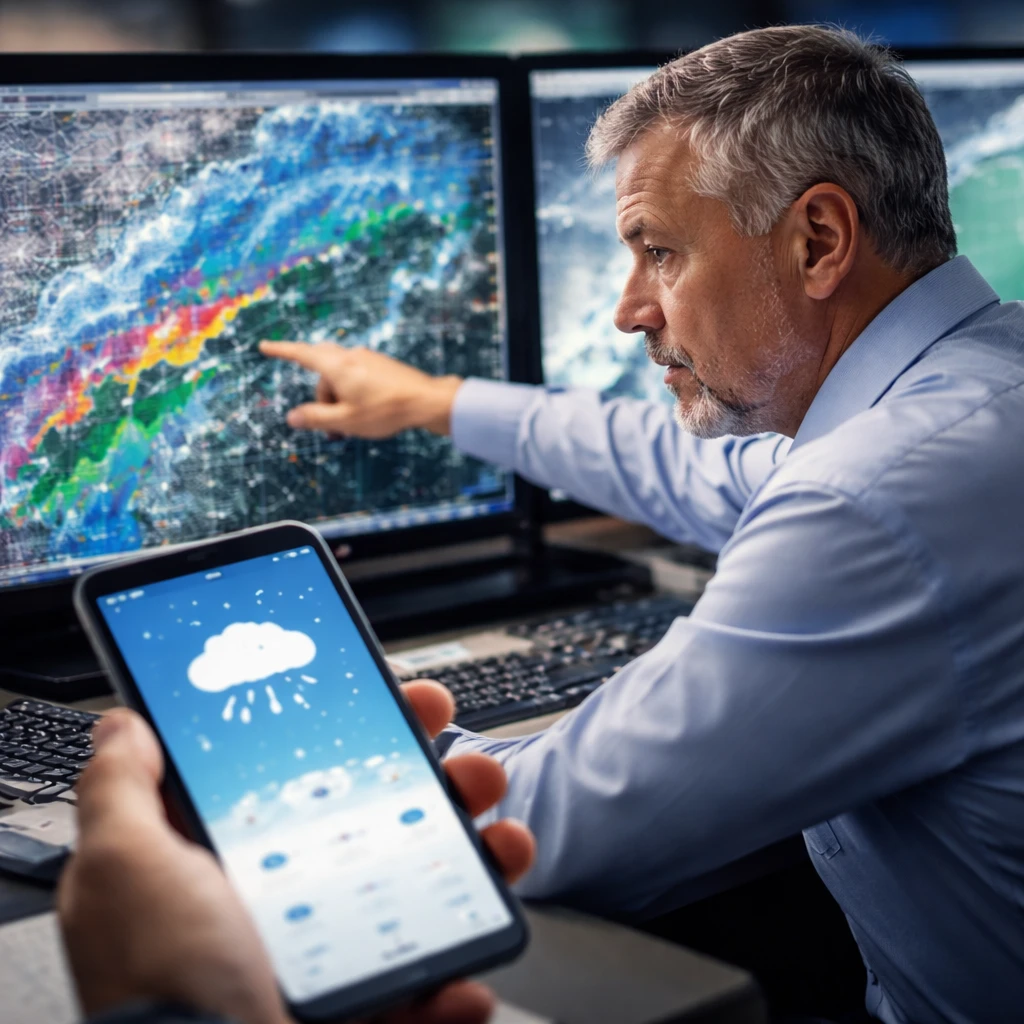

In the wake of a severe winter storm sweeping through vast regions of the United States, experts in meteorology emphasize the importance of human interpretation in weather forecasting, particularly when conditions are complex and evolving rapidly. Smartphone weather apps, though convenient and visually engaging during mild conditions, often fall short in providing accurate guidance during intricate weather scenarios involving snow, sleet, freezing rain, and subzero temperatures.
The storm’s complexity, marked by a mixture of heavy snowfall, perilous ice accumulation, and bitterly low temperatures, underscores the variability of weather even within short distances. Meteorologists caution that relying solely on app-based forecasts might lead users to overlook crucial nuances. For instance, a few miles difference can mean the distinction between falling snow, sleet, or hazardous freezing rain.
University of Georgia meteorology professor Marshall Shepherd, a former president of the American Meteorological Society, highlighted this challenge by noting that weather applications frequently struggle with storms involving multiple types of precipitation. "Apps don’t understand the details of why snow, sleet or freezing rain happens," he explained, pointing to the difficulty these platforms face in delivering clear, accurate messaging under complex conditions.
The involvement of human forecasters with local knowledge is particularly vital for extreme weather events, according to University of Oklahoma meteorology professor Jason Furtado. He pointed out that many apps implement artificial intelligence to interpolate data from broad regional models to a specific location, potentially causing significant inaccuracies in forecasting.
Nevertheless, some applications incorporating National Weather Service data alongside expert meteorological input serve as valuable tools for the public. These apps, such as The Weather Channel’s widely used platform, integrate numerous models, observational data, and real-time human analysis. James Belanger, vice president of The Weather Company, stressed the importance of their comprehensive approach during critical weather episodes. "It’s an all-hands-on-deck kind of approach that we take," he said, acknowledging that not all apps maintain similar levels of expertise and resources.
Meteorology experts explain that many weather apps obtain their foundational data from the National Weather Service and occasionally supplement it with proprietary insights and reliable European forecasting models. To specify forecasts at the local level, these apps often rely on software techniques that adapt broader regional data based on the user’s geographic location, such as ZIP codes or proximity to weather stations.
However, according to Northern Illinois University meteorology professor Victor Gensini, numerous apps tend to oversimplify uncertainties inherent in weather predictions. They display precise-looking figures that can misrepresent the inherent unpredictability during major storms. This shortcoming is accentuated in storms with rapidly changing and diverse precipitation types where nuance is critical.
Steven DiMartino, of the subscription service NY NJ PA Weather, which prides itself on delivering forecasts grounded in meteorological expertise rather than pure model output, describes how weather apps produce data without adequate explanation. "Anyone can look at data, but you need a meteorologist, you need that human touch to look at it and say, ‘Hmm, that looks like an error; we’re gonna tweak this,’" he said, emphasizing the importance of professional judgment to refine forecasts.
Cory Mottice, a National Weather Service meteorologist who developed the app EverythingWeather, noted that while his app sources real-time forecasts from professional meteorologists across over 125 service offices nationwide, it remains independent and is intended simply to facilitate public access to authoritative forecasts. This contrasts with many apps that use raw, unexamined computer model data, which can mislead users during extreme weather events when human oversight is absent.
The Weather Channel app’s methodology exemplifies how extensive data integration enhances forecasting reliability. They utilize upwards of 100 weather models from around the world, combine crowdsourced observations from over 100,000 volunteers, and employ artificial intelligence to synthesize this information into actionable forecasts. Despite this, final forecast content is always carefully vetted by a team of more than 100 meteorologists prior to public release.
Belanger underscored the combined value of advanced technology and human experience, stating this synergy is vital for delivering the most accurate predictions, especially during complex storms like the ongoing winter weather event.
Meteorologists also issue caution regarding the use of social media as a weather information source. While it can amplify official warnings, social media platforms often accelerate the spread of misinformation or sensationalized messages that lack nuance. Victor Gensini pointed out that weather is intrinsically complex, and social media tends to reward confident, dramatic statements rather than careful, detailed analysis, making it a problematic source during significant weather crises.
Kim Klockow McClain, an extreme weather social scientist, observed that public exposure to continuously alarmist forecasts may ultimately erode trust in meteorological information. Thus, accurate, consistent communication from trusted experts is essential to maintain public confidence during prolonged or severe weather events.