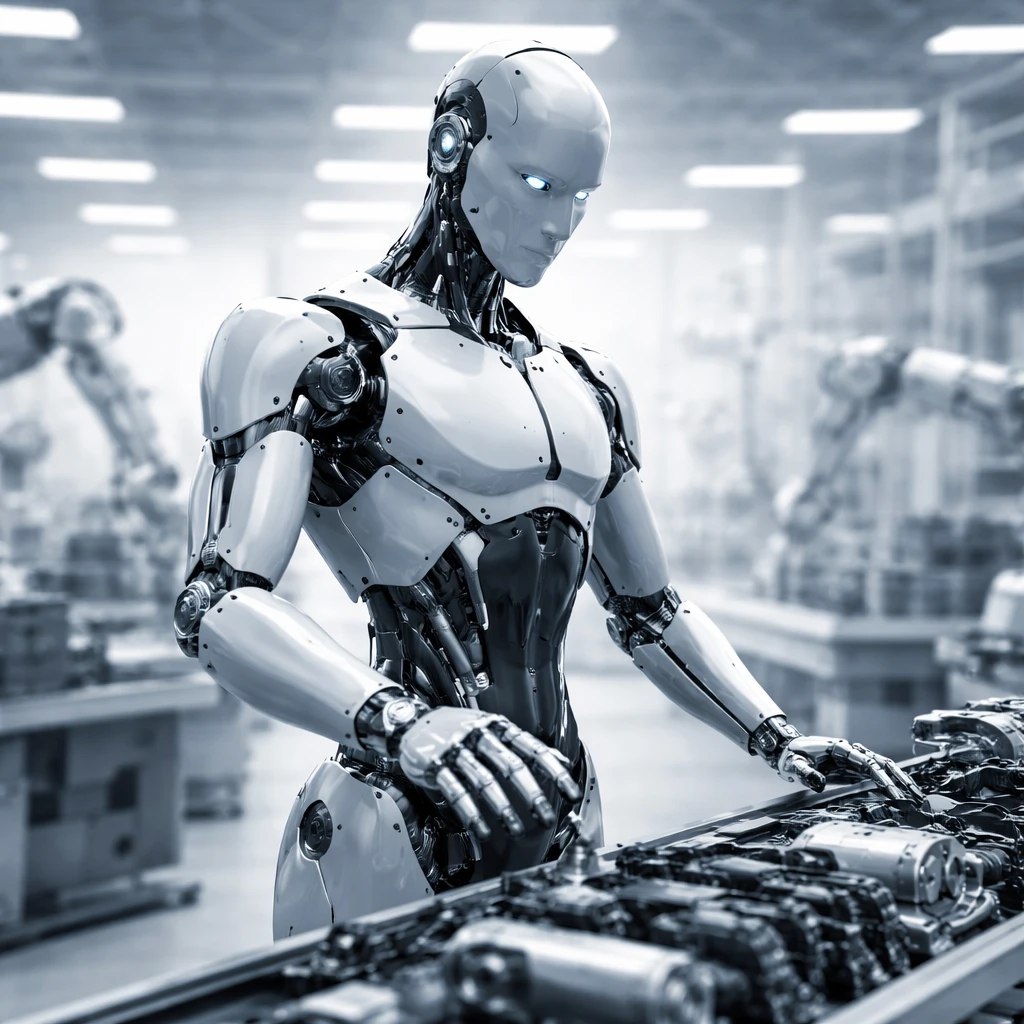
At the 2026 Consumer Electronics Show, Hyundai's affiliate Boston Dynamics unveiled its latest humanoid robot, named Atlas, marking a significant development in industrial robotics. The company announced that production of the fully electric Atlas robot has begun immediately following the reveal. Early shipments are slated for delivery to Hyundai's Robotics Metaplant Application Center (RMAC) and for use by Google DeepMind in upcoming months. Hyundai has indicated plans to incorporate Atlas robots within its global manufacturing network, including starting operational deployment at its Savannah, Georgia facility by 2028.
Following the unveiling, Hyundai's shares experienced an uplift in the Korean stock market, fueled by investor enthusiasm over the potential breakthroughs in applying advanced AI humanoid robots in practical factory environments. Yet, historical patterns of robotics technology hype urge a prudent approach when assessing the potential impact of these developments.
### The Distinctive Features of Boston Dynamics' Atlas
While factory robots have been common for years, the Atlas robot differentiates itself with its humanoid form and capabilities comparable to human physicality. Hyundai emphasizes key functional attributes including hands that measure tactile feedback at a human scale, advanced joints capable of complex rotation, and a lifting capacity up to 110 pounds. Notably, Atlas can be trained to perform new tasks in under one day and operates autonomously with the ability to handle battery replacements without human intervention.
Hyundai highlights Atlas's suitability for executing precise tasks and repetitive labor that can otherwise be burdensome for human workers. The company projects annual production of 30,000 units at a U.S.-based manufacturing site, expressing expectations that humanoid robots will emerge as the largest segment within the Physical AI industry. The goal is to mass-produce and deploy Atlas robots at scale across various industrial locations as ready-to-use production assets.
Images released feature Aya Durbin, lead for humanoid application products at Boston Dynamics; Zachary Jackowski, Boston Dynamics’ vice president and general manager for Atlas; and the Atlas robot itself, underlining the high-profile nature of the project within Hyundai’s broader robotics strategy.
### Planned Industrial Applications and Collaborative Prospects
Beginning in 2028, Hyundai plans to integrate Atlas robots into processes with demonstrable safety and quality advantages such as parts sequencing. The company intends to expand Atlas's role to include component assembly tasks and eventually assign jobs that involve repetitive movements, heavy lifting, and intricate operations. This approach aims to enhance workplace safety for factory personnel by allocating hazardous or monotonous jobs to robots.
Successful implementation at Hyundai may have positive implications for other automotive manufacturers, notably Toyota, which collaborates with Boston Dynamics on robotics research. Beyond the automotive sector, Boston Dynamics is also developing strategic partnerships with technology leaders Nvidia and Google's DeepMind to advance robotics capabilities.
### Investor Caution in Light of Robotics History
While the prospect of humanoid robots in industry captures imagination and investor interest, prior attempts to commercialize humanoid robotics reveal a pattern of overpromising and underdelivering. Previous initiatives have frequently encountered technical challenges and failed to establish sustainable business models.
For instance, SoftBank’s 2014 launch of Pepper, a humanoid robot designed for interactive customer service, ultimately faltered due to mechanical flaws and limited task proficiency, leading to discontinuation by 2021. Similarly, the start-up 1X's NEO robot, intended to assist with domestic chores, struggled with basic tasks and lacked autonomy, requiring remote control through virtual reality. This project earned criticism and was identified as a notable technological failure by MIT Technology Review in 2025.
Other concepts like Samsung's Ballie, introduced in 2020 as a domestic assistant robot, have yet to materialize commercially despite initial fanfare. Ballie did not appear at CES 2026, and the company has not announced plans for its market launch.
A Bloomberg reporter covering CES 2026 observed humanoid robots demonstrated for household tasks often operated at sluggish speeds, underscoring the difficulty of deploying robots in unstructured environments. However, the reporter suggested industrial factories, which offer more controlled conditions and predictable repetitive tasks, may see quicker adoption of these technologies.
### Market Outlook and Long-Term Potential
Research by Morgan Stanley projects the humanoid robotics market could reach a valuation exceeding $5 trillion by 2050, with deployment surpassing one billion units worldwide. Approximately 90% of these humanoids are expected to serve commercial and industrial functions. Nonetheless, Morgan Stanley forecasts gradual market penetration until the mid-2030s, with acceleration anticipated toward the late 2030s and 2040s.
Given the complexity and emerging nature of humanoid robotics, investors should approach current developments with tempered expectations. Although automakers and heavy manufacturing sectors stand to benefit initially, the evolution toward widespread adoption involves technological uncertainties, potential operational setbacks, and market volatility.
### Conclusion
Hyundai's announcement of the Atlas robot signals a noteworthy advancement in humanoid robotics aimed at industrial applications. While boasting notable design and operational innovations, the path to mass deployment remains cautiously promising. Historical precedents in robotics caution against premature optimism, underscoring the need for measured investor patience and continued observation of production performance and task integration in real-world settings.
January 13, 2026
Finance
Hyundai Advances Humanoid Robotics with Atlas Launch and Production Ambitions
Atlas Robot Rolls Out for Industrial Deployment Amid Growing Investor Interest and Market Caution

Priya Menon
Industrials & Aerospace Analyst
Summary
Hyundai's Boston Dynamics introduced a fully electric humanoid robot, Atlas, at CES 2026, announcing immediate production and plans for industrial use starting in 2028. The robot features human-scale dexterity and autonomous capabilities designed for factory tasks. Hyundai's ambition to mass-produce 30,000 units annually signals a major push in the Physical AI market, especially in automotive manufacturing. However, past robotic initiatives caution investors to temper expectations about near-term returns and widespread adoption.
Key Points
Boston Dynamics' Atlas is a fully electric humanoid robot with human-like dexterity and capabilities, designed for industrial tasks including assembly and repetitive labor.
Hyundai plans to produce 30,000 Atlas units annually in the US, aiming for deployment within its factories starting in 2028, focusing initially on safer, quality-assured processes like parts sequencing.
The humanoid robot market is projected to grow substantially by 2050, predominantly driven by commercial and industrial use, but adoption will likely be gradual, picking up speed in the 2030s and 2040s.
Risks
- Historic humanoid robot initiatives have often failed due to mechanical shortcomings and limited practical utility, indicating significant technological and market adoption challenges.
- Household and service-sector humanoid robots have demonstrated slow and inefficient task execution, suggesting industrial-scale deployment is more feasible in the near term than consumer applications.
- Given the complexity and novelty of humanoid robotics, there are inherent uncertainties and potential volatility in realizing financial returns or operational success in the short to medium term.
Disclosure
This analysis is based solely on information publicly available as of the time of reporting.