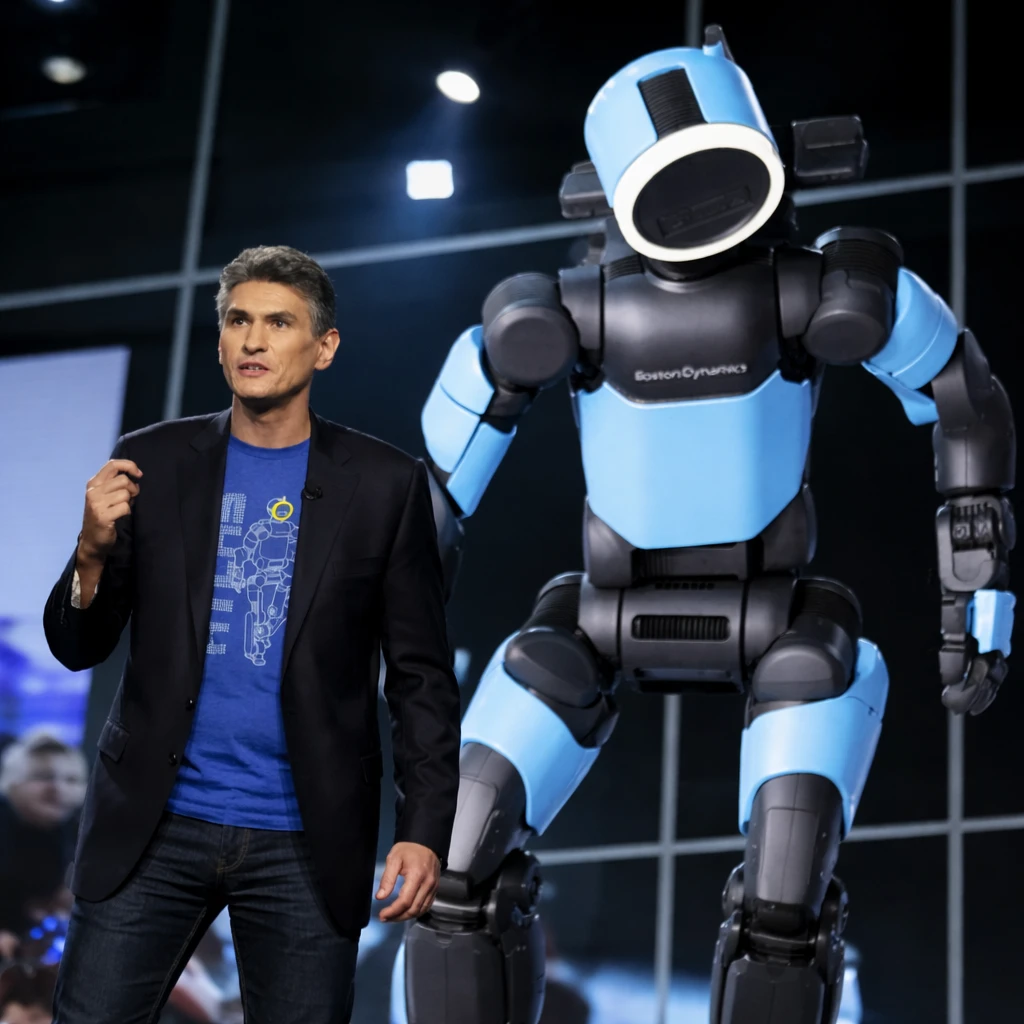

During the Consumer Electronics Show (CES) held in Las Vegas, Boston Dynamics, a subsidiary controlled by Hyundai Motor Company, unveiled a public demonstration of its humanoid robot, Atlas. This marked the first occasion where the robot was displayed live to an audience. In a ballroom setting, the life-sized machine, possessing two arms and legs, initiated its routine by rising independently from the floor.
The robot exhibited fluid locomotion across the stage, executing gestures such as waving to attendees and moving its head with a range reminiscent of an owl. This display was managed via remote operation by an engineer situated nearby; however, Boston Dynamics’ general manager for humanoid robots, Zachary Jackowski, indicated that the commercial iteration of Atlas is intended to navigate autonomously in real-world scenarios.
Hyundai's involvement includes production of a model of Atlas designed specifically for automotive manufacturing tasks. This version is slated for deployment by 2028 at Hyundai’s electric vehicle manufacturing facility located near Savannah, Georgia.
Boston Dynamics, hailing from Massachusetts and with a significant development history in robotics spanning several decades, is recognized for its commercial product Spot — a quadruped, dog-like robot. At the CES opening event hosted by Hyundai, a formation of four Spot units performed a synchronized dance to a K-pop song, underscoring the entertainment and technological appeal of these machines.
Further expanding its technological ecosystem, Hyundai announced a renewed partnership with Google’s artificial intelligence subsidiary DeepMind. This collaboration intends to incorporate DeepMind's AI solutions into Boston Dynamics’ robotic platforms. Notably, Google previously owned Boston Dynamics from 2013 until its sale to SoftBank, from which Hyundai acquired the company in 2021.
Demonstrating humanoid robots publicly often involves significant risk due to potential operational errors, as evidenced by recent incidents such as a Russian humanoid robot falling during a public showcase. Consequently, robotics firms generally opt to display their prototypes through curated video content on social media channels, allowing for control over the presentation and avoidance of showing performance shortcomings.
Monday's live demonstration of Atlas, in contrast, proceeded without observable errors. The humanoid robot concluded its performance by swinging its arms in a theatrical manner and presenting a static, blue-colored model of the forthcoming product version of Atlas. This new design exhibited subtle differences from the prototype.
The convergence of recent advancements in artificial intelligence and robotics, coupled with significant funding inflows, has accelerated development in the humanoid robotics sector. Despite this momentum, industry experts maintain that widely adopted humanoids capable of performing varied human tasks in workplaces and homes remain in the longer-term future.
Alex Panas, a McKinsey partner who moderated a substantial robotics panel at CES, noted that the critical considerations pertain to defining practical applications and suitable environments for the technology. He highlighted that while some robots will adopt human-like forms, others may not, stressing that technological components such as software, chipsets, and communication systems are increasingly integrating to unlock new functionalities.
At present, humanoid robots lack the dexterity and versatility to pose widespread risks to human employment. Nevertheless, as these machines advance in capability, the discussion regarding their influence on labor markets is anticipated to intensify. Hyundai’s Georgia electric vehicle plant, targeted for Atlas testing and deployment, was previously the location of a federal immigration crackdown resulting in hundreds of arrests, including over 300 South Korean nationals.