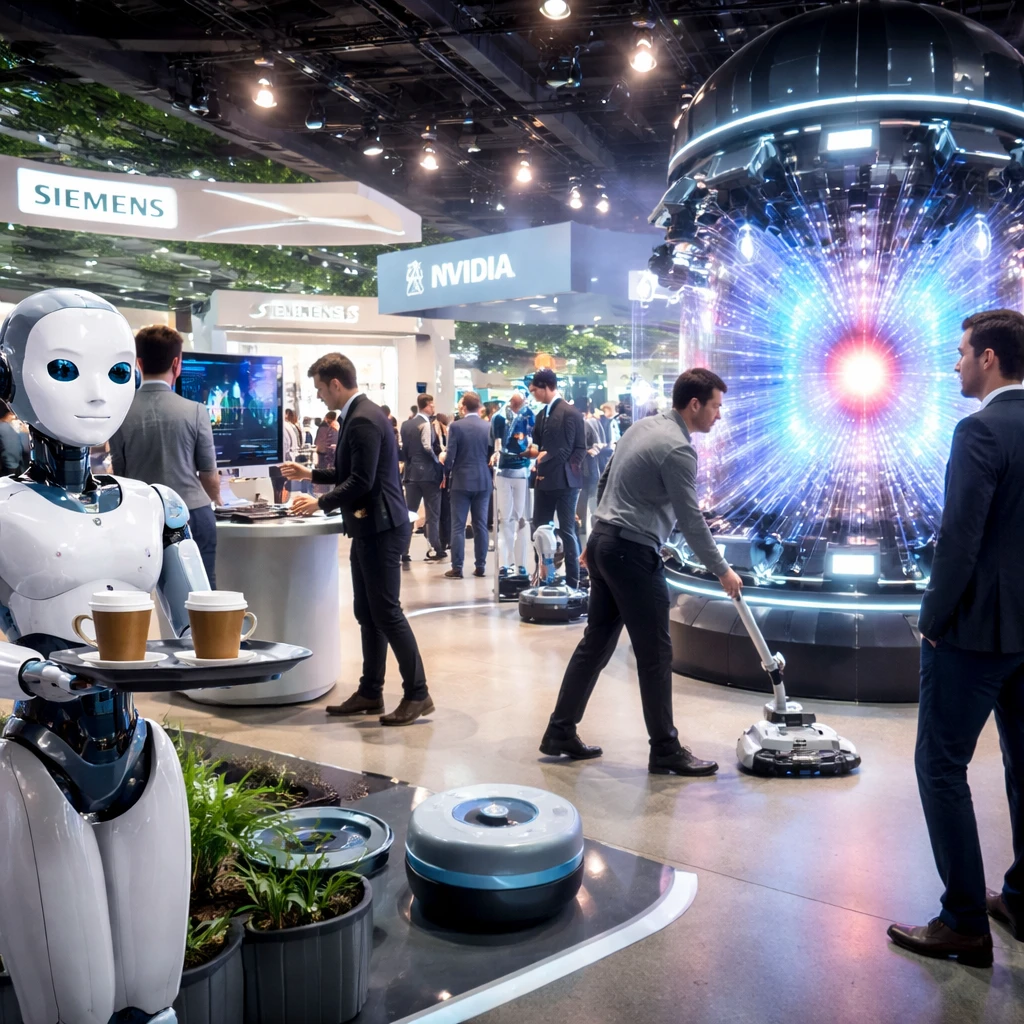

On the second day of CES, visitors to the newly opened exhibition spaces encountered a wide array of technological innovations ranging from robotics to AI-driven platforms designed to enhance individual, enterprise, and environmental functions. The day began with Siemens President and CEO Roland Busch delivering a keynote focused on how artificial intelligence is revolutionizing customer operations across various sectors. His presentation featured the announcement of a deepened collaboration with Nvidia, represented by CEO Jensen Huang, pledging to drive a new industrial revolution fueled by AI that aims to reimagine every facet of manufacturing, production processes, and supply chain optimization.
Lenovo concluded the day's events with a lavish presentation underscored by appearances from prominent technology figures including Nvidia’s Jensen Huang, AMD CEO Lisa Su, and Intel CEO Lip-Bu Tan. The focus centered on how Lenovo’s AI platforms serve a broad spectrum: from consumer wearables enhancing personal life, to enterprise solutions empowering businesses, and innovations addressing global challenges.
The CES stage serves as an annual platform for enterprises to unveil products destined for retail release within the year. The following are notable innovations introduced on Day 2:
Razer Expands Into AI-Enhanced Gaming and Personal Assistance
Gaming hardware manufacturer Razer, known for high-impact devices like haptic seats and tri-screen laptops, expanded beyond core gaming technology into AI-powered prototypes. These include an over-ear gaming headset that also functions as a general personal assistant, and a desk companion device designed to offer gaming guidance alongside life management capabilities. The desk companion, evolving from Razer’s earlier Project Ava AI assistant, now exists as a holographic avatar inside a compact glass tube positioned near the user’s computer. This device incorporates speakers and a camera for environmental awareness and is compatible with various AI models; demonstrations featured OpenAI’s ChatGPT running on the headset (Project Motoko) and xAI’s Grok operating Project Ava. Razer anticipates launching both products commercially later this year, although they remain in developmental stages.
Autonomous Robots Proposed to Streamline Airport Ground Operations
Oshkosh Corporation introduced a set of self-driving robots designed to optimize post-landing airport procedures collectively named “the perfect turn.” These robots are engineered to manage complex, time-sensitive tasks such as refueling, cabin cleaning, cargo handling, and passenger transitions, aiming to reduce delays while maintaining safety standards. Their autonomous nature offers advantages in extreme weather scenarios—including harsh winters and extreme heat—where human operation becomes challenging. Testing in collaboration with major airlines has commenced, with plans to debut at major hub airports like Atlanta and Dallas, followed by broader deployment over the coming years.
Roborock Innovates With Stair-Climbing Cleaning Robot
Roborock unveiled the Saros Rover, a robotic vacuum cleaner equipped with mechanical legs resembling those of a chicken, enabling it to ascend and descend staircases while performing cleaning tasks. Although the unit demonstrated slow but thorough cleaning of stairs during its CES showcase, the manufacturer indicates capability for navigating various stair designs, including spiral staircases. The device remains under development, with no announced release date.
Withings Enhances Health Monitoring With Advanced Smart Scale
Withings presented an upgraded version of its Body Scan scale, a device that resembles a conventional bathroom scale but offers comprehensive biometric analysis within a 90-second session. Users who remove shoes and socks can receive readings for up to 60 health biomarkers such as heart and vascular age, metabolic rate, and nerve health. The device detects electrodermal activity via foot and hand pads, reflecting skin conductivity changes related to sweat gland function. Launching in spring with a price of $600, the scale syncs with an accompanying app, which requires a subscription ($10 monthly or $100 annually) to deliver personalized health insights and guidance aimed at longevity and behavioral improvements.
Collaborative AI-Driven Fusion Energy Research Advances
In the domain of clean energy, Commonwealth Fusion Systems in partnership with Nvidia and Siemens announced efforts to accelerate nuclear fusion development by integrating AI techniques. Their ongoing project includes SPARC, a prototype power plant roughly 70% complete, intended to demonstrate feasibility for fusion as a carbon-free energy resource. The initiative involves creating a "digital twin" of the physical reactor to simulate performance, enabling expedited problem-solving and data analysis that could condense years of experimental work into weeks.
Bob Mumgaard, CEO of Commonwealth Fusion Systems, confirmed installation of their first high-temperature superconducting magnet in SPARC and stated plans for a subsequent grid-connected reactor, ARC, targeted for deployment in the early 2030s. This system will use powerful magnets to create the conditions necessary for sustainable fusion reactions.