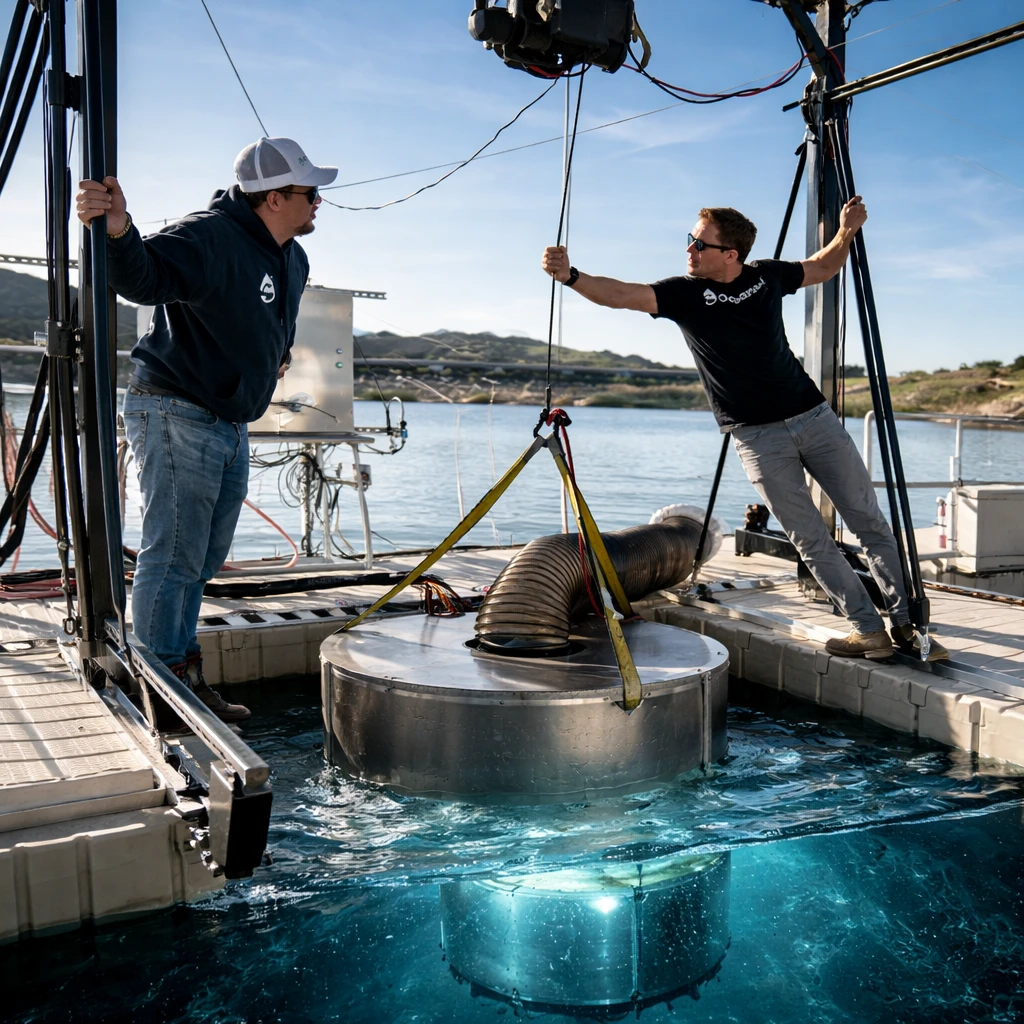
Located approximately four miles off the coast of Southern California, OceanWell is advancing a novel desalination method that operates deep beneath the sea surface. Their proposed facility, Water Farm 1, is designed to employ the natural pressure found 1,300 feet below water to enable reverse osmosis membranes to filter salt and impurities from seawater. This process intends to produce as much as 60 million gallons (near 225 million liters) of fresh water daily. Globally, desalination has been a resource-intensive process, with operational plants releasing between 500 and 850 million tons of carbon emissions annually — figures that compare closely to the entire global aviation industry's emissions of about 880 million tons annually.
OceanWell asserts that deploying reverse osmosis technology at deep-sea depths substantially reduces energy consumption by approximately 40% relative to conventional desalination plants. This approach also addresses major environmental concerns tied to traditional facilities: notably, the discharge of highly concentrated brine, which can endanger seafloor ecosystems such as coral reefs, and the intake mechanisms that inadvertently trap and kill vital marine organisms like fish larvae and plankton, integral to marine food chains.
"The ocean will be the source of fresh water for the future, and we intend for this process not to burden ocean ecosystems," stated Robert Bergstrom, OceanWell's CEO.
Testing of the system's components is underway, including the deployment of reverse osmosis pods in the Las Virgenes Reservoir in California. Should development reach fruition, these pods would be tethered just above the seafloor within Santa Monica Bay, utilizing an underwater pipeline to transport clean water to the shore with minimal physical infrastructure. The system incorporates specially designed intake screens capable of allowing microscopic marine life like plankton to pass safely, and it is engineered to produce less concentrated brine discharge than conventional setups.
This innovation emerges at a critical time as climate change exacerbates drought conditions, disrupts rainfall, and intensifies wildfires, propelling increased reliance on seawater desalination worldwide. Regions such as the arid Middle East, parts of Africa, and Pacific island nations have long depended on desalination due to limited freshwater availability, and over 20,000 plants operate globally, with the sector expanding approximately 7% annually since 2010.
Academic experts highlight the growing necessity for desalination amid rising aridity and changing climate patterns. Nonetheless, environmental scientists caution that the expansion of desalination plants has the potential to aggravate stress on coastal ecosystems already compromised by warming oceans and pollution.
Several companies are innovating to improve sustainability in desalination through renewable energy integration and advanced membrane technologies. Some, like OceanWell, are relocating facilities subsea to lessen environmental disturbances. OceanWell has secured an agreement to test its technology in Nice, France, another area facing climate-induced drought and wildfire risks.
At present, OceanWell’s system remains in the developmental stage. A pilot unit operates in partnership with the local water district at Las Virgenes Reservoir, aiming to diversify water sources. If proven effective, the submerged pods could offer a less ecologically intrusive, energy-efficient means to augment freshwater supply.
Water resource experts acknowledge the environmental and technical promise of deep-sea desalination but emphasize that economic feasibility remains uncertain — new technologies often face higher-than-expected costs, impacting commercial viability.
Las Virgenes Reservoir, the pilot site, supplies about 70,000 residents in western Los Angeles County. The existing water source depends heavily on Sierra Nevada snowpack, which varies significantly year to year, necessitating exploration of supplementary supply methods.
Further south, in Carlsbad, California, the Carlsbad Desalination Plant — the largest seawater desalination facility in North America — generates up to 54 million gallons (204 million liters) daily, fulfilling roughly 10% of San Diego County’s water needs. While offering a local, drought-resistant water source, the plant has faced environmental concerns regarding its intake and brine discharge, which can affect marine life and habitats. Energy demands pose additional concerns related to cost and carbon footprint.
Despite attempts to mitigate environmental impacts through technology such as organism exclusion devices and brine dilution, critics highlight ongoing ecological risks, including trapped marine organisms and elevated salinity levels affecting coastal habitats. Coastal wetlands, vital for natural ecosystems, have been significantly diminished by development, heightening the importance of cautious impact management.
Proponents emphasize the plant’s energy efficiency improvements and carbon neutrality initiatives. Furthermore, water recycling and conservation strategies are advocated as primary measures before resorting to energy-intensive desalination. Las Virgenes is also pursuing wastewater reuse projects alongside its desalination efforts to optimize water resource management.
Ultimately, the advancement of deep-sea desalination technology like OceanWell's Water Farm 1 represents a potential transformative step toward sustainable freshwater generation in regions grappling with climate-related water shortages. However, environmental, technical, and economic challenges must be thoroughly addressed to ensure this innovation can reliably contribute to future water resilience.
January 15, 2026
News & Politics
Innovative Deep-Sea Desalination Technology Aims to Enhance Water Sustainability
OceanWell’s submerged system proposes significant energy savings and ecological benefits amid global water scarcity challenges

Caleb Monroe
Consumer & Retail Analyst
Summary
OceanWell is developing an underwater desalination plant utilizing natural ocean pressure to enhance efficiency and reduce environmental impacts associated with traditional desalination. With global water shortages intensifying from climate change, this innovative approach seeks to provide substantial freshwater supplies while mitigating energy use and ecological disruption.
Key Points
OceanWell is developing a deep-sea desalination system leveraging natural ocean pressure to reduce energy consumption by about 40% compared to traditional plants.
The system aims to mitigate environmental issues like brine discharge salinity and marine life mortality from intake systems through novel design features.
Growing global freshwater scarcity driven by climate change, particularly in drought-prone regions, is increasing the demand and expansion of desalination technologies worldwide.
Risks
- The high initial and operational costs associated with pioneering deep-sea desalination technology present economic uncertainty impacting adoption and scalability.
- Environmental concerns persist regarding desalination's ecological impacts, including effects on marine life and fragile coastal ecosystems, which may constrain regulatory approvals.
- The energy requirements and carbon footprint of desalination plants continue to be significant factors that could affect sustainability and public acceptance of such projects.
Disclosure
This article reflects information available from company statements, environmental experts, and regional water authorities without endorsement or speculative assertions. No new forecasts or claims have been introduced beyond stated facts.