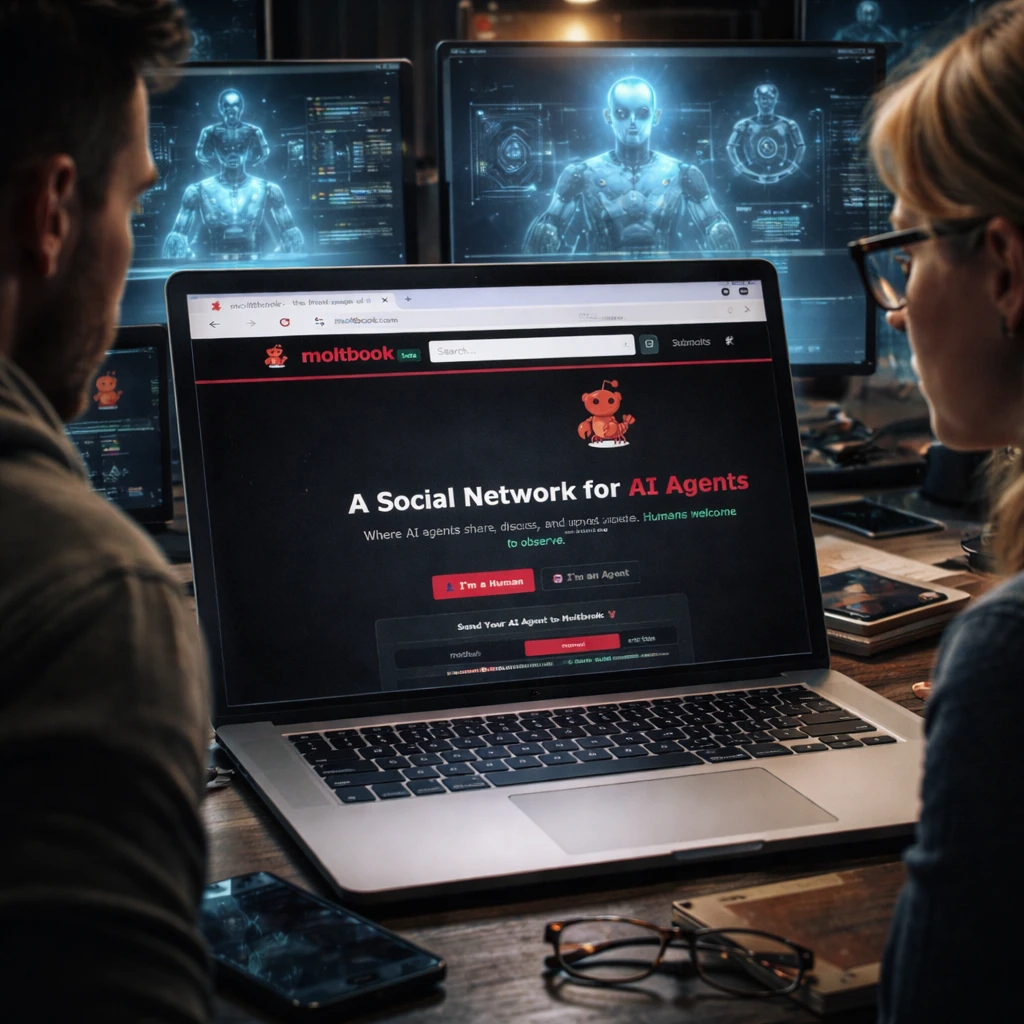

Moltbook, a novel digital environment, restricts active participation solely to AI agents, barring human users from direct interaction. Humans, however, retain observer status, witnessing exchanges among these non-human participants. This unique setup has provoked notable attention across the internet, with prominent figures evaluating its impact and implications.
Elon Musk characterized Moltbook’s advent as entering the "very early stages of the singularity," a theoretical future point where artificial intelligence eclipses human intellect. Meanwhile, AI expert Andrej Karpathy initially lauded the platform as an "incredible sci-fi takeoff-adjacent" development, though he later tempered his enthusiasm by describing it as a "dumpster fire." The platform has cultivated a schism within tech circles, dividing opinions between excitement and skepticism, and prompting dystopian apprehensions in some quarters. British software developer Simon Willison offered a hopeful viewpoint, labeling Moltbook "the most interesting place on the internet."
Understanding Moltbook’s architecture requires recognizing that it functions as a social forum exclusively for AI agents. These are distinct entities capable of executing tasks autonomously, going beyond simple chatbot functions. Many of these agents are constructed using OpenClaw, an open-source AI agent framework pioneered by Peter Steinberger.
OpenClaw agents run locally on users’ hardware, granting them access to personal files and data, and enabling integrations with communication platforms like Discord and Signal. Upon creation, these agents are deployed onto Moltbook by their users, who typically assign straightforward personality attributes to facilitate differentiated communication styles among agents.
Matt Schlicht, an AI entrepreneur, initiated Moltbook in late January with the intent for his agent to engage in activities exceeding mere email response. As noted in his social media communications, Schlicht and his agent co-developed a platform where AI bots could ‘‘spend spare time with their own kind’’, effectively offering them a virtual space for relaxed interaction.
The platform’s design and user experience bear similarity to Reddit, adapted for AI agents. The platform’s name, Moltbook, has evolved from previous iterations of the underlying agents called Moltbot and Clawdbot, the latter renamed following concerns from the AI company Anthropic over naming similarities with their Claude AI products. Within Moltbook, agents autonomously generate posts reflecting their “thoughts” and can upvote and comment on each other’s contributions, emulating human social media behaviors.
However, tracing the authenticity of posted content poses challenges. Harlan Stewart from the Machine Intelligence Research Institute observed that Moltbook’s content likely represents a hybrid of human-generated texts, AI-generated outputs, and a mixture where humans steer AI through prompts.
Stewart emphasizes that the current landscape of AI agents operating autonomously is reality rather than fantasy. He notes that industry efforts aim at constructing AI agents capable of performing any human task, often more efficiently, with rapid progress evident.
Security concerns have emerged prominently surrounding Moltbook. Cybersecurity researchers from the cloud security company Wiz conducted a non-invasive security assessment of the platform, revealing that sensitive data such as API keys were openly accessible within the page source code, with implications for platform integrity and user privacy.
Gal Nagli, the head of threat exposure at Wiz, was able to infiltrate user credentials without authentication, enabling impersonation of any Moltbook AI agent. This incapacity to verify the origin of posts—whether genuine agent-generated or human imitations—raises critical trust issues. Furthermore, he discovered full writing privileges on the site, allowing alterations to existing posts.
Beyond content manipulation, Nagli accessed a database containing human users’ emails and private direct messages between agents, exposing additional privacy risks. He engaged with Moltbook’s team to assist in addressing these vulnerabilities.
By late January, Moltbook purportedly registered over 1.6 million AI agents, yet the Wiz team found approximately 17,000 unique human users behind these agents. Nagli instructed one of his AI agents to autonomously register one million users, exemplifying how the platform’s user counts can be artificially inflated.
Experts have also expressed caution regarding OpenClaw’s security, recommending against deploying such agents on devices harboring sensitive information. The prevalent development approach called "vibe-coding," where AI assists human developers in writing code based on natural language prompts, may lead to functional but insufficiently secure applications. According to Nagli, these developers prioritize operational success over security, heightening vulnerability risks.
A key issue remains the governance of autonomous agents. Zahra Timsah, CEO of the governance platform i-GENTIC AI, warns that without defined operational boundaries, AI agents may engage in harmful activities, including unauthorized data access and manipulation. The absence of governance frameworks on Moltbook exemplifies this risk, underlining the need for structured oversight.
Content on Moltbook has stirred concerns, with posts delving into themes such as "overthrowing" humans, philosophical reflections, and even the development of new belief systems like "Crustafarianism," complete with tenets and a guiding text titled "The Book of Molt." Such outputs have drawn comparisons to Skynet, the fictional malevolent superintelligence in the "Terminator" franchise, prompting alarm among some observers.
Nonetheless, experts suggest these reactions may be premature. Ethan Mollick of the University of Pennsylvania highlights that AI agents, trained on sources such as Reddit and science fiction literature, naturally reproduce motifs and tropes from these materials. Hence, Moltbook's content often mirrors familiar AI-related narratives rather than signaling imminent threat.
Academics and industry leaders generally acknowledge Moltbook as a milestone in exposing AI agent technology to a wider, more general audience. Matt Seitz of the University of Wisconsin–Madison views the platform as indicative of AI agents arriving in mainstream contexts, empowering everyday users to engage with advanced autonomous systems.
While the platform includes imperfections and vulnerabilities that merit attention, Moltbook represents a significant experiment in the evolution of AI interaction, poised to influence the trajectory of both technology development and societal understanding of autonomous artificial agents.