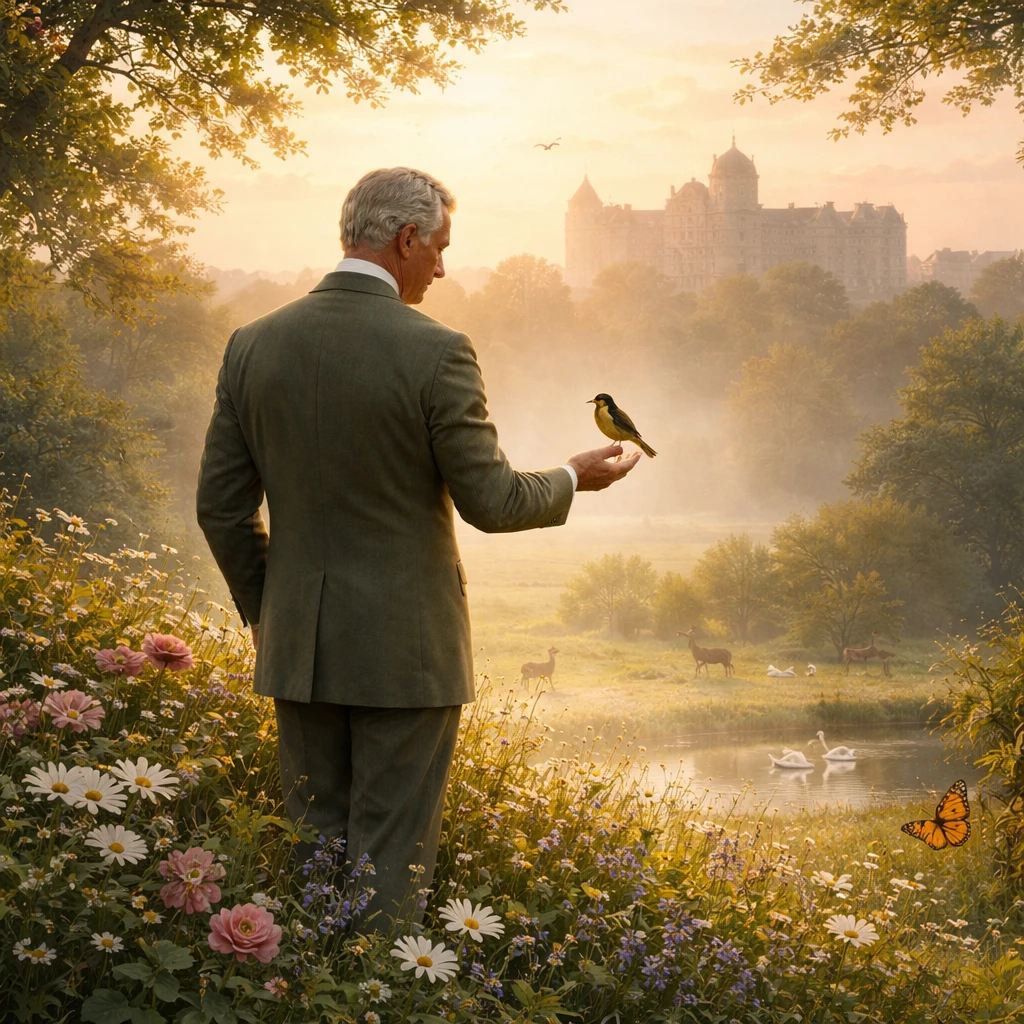

King Charles, the 77-year-old monarch, has introduced a new documentary that delves into his conviction regarding humanity's essential relationship with the natural world and the critical challenges posed by global environmental issues such as climate change and biodiversity loss. The film, entitled "Finding Harmony: A King's Vision," was produced in partnership with the King’s Foundation charity and is scheduled for release on Amazon Prime Video next month.
In the documentary, the King articulates a personal philosophy centered on "harmony," describing it as a recognition that humans are an integral part of nature, not separate from it. He remarked, "It all boils down to the fact that we are actually nature ourselves. We are a part of it, not apart from it, which is really how things are being presented for so long." The film’s narrative signals hope that increased awareness of this connectedness could grow during his lifetime, stating, "Maybe, by the time I shuffle off this mortal coil, there might be a little more awareness... of the need to bring things back together again."
The documentary premiered on Wednesday evening during a prestigious event held at Windsor Castle, marking the first occasion a film screening took place within a royal residence. The event was attended by King Charles and Queen Camilla, alongside several distinguished British actors including Judi Dench, Kenneth Branagh, Benedict Cumberbatch, and Kate Winslet, the latter serving as the documentary's narrator and a King’s Foundation ambassador.
The screening occurred in the Waterloo Chamber of Windsor Castle, a grand hall traditionally used for investitures but, in times past under Queen Elizabeth II and Queen Victoria, hosted theatrical productions. On this occasion, it was transformed into a cinematic venue befitting the film's environmental themes.
Kate Winslet opened the event by expressing gratitude toward King Charles for his visionary leadership in environmental protection. She emphasized that the film would demonstrate how the King’s philosophy has been enacted globally across diverse cultures and over many years, often predating broader public awareness of ecological issues.
Spanning 90 minutes, the documentary traces the various stages of King Charles’s commitment to environmental causes, beginning well before such issues gained mainstream attention. The film consciously avoids traditional royal pageantry, instead focusing on the monarch's environmental advocacy, featuring moments where Charles watched old speeches and recounted instances of being labeled "bonkers" due to his early warnings on plastic pollution and his unconventional environmental practices, such as communicating with plants.
Archival footage included a 1970 speech in which Charles cautioned about the emerging threat of plastic pollution, illustrating his longstanding concern and foresight. Reflecting on this, he said, "It was quite a long time ago, and I remember being, well, profoundly concerned about all this. It seemed crazy to go on without thinking carefully about how we manage all this."
Further, the documentary highlights tangible examples of the King's environmental principles put into practice, focusing on properties such as Dumfries House in Scotland and Highgrove House in the Cotswolds. These estates serve as centers for education, skill development, sustainability, and community programs, aimed at ecological restoration and economic renewal. Notably, Poundbury, a town developed on Duchy of Cornwall land, exemplifies Charles’s integration of sustainable design, architecture, and urban planning philosophies.
Recalling the acquisition of Dumfries House, the King acknowledged the decision was "somewhat risky," but deemed it essential for showcasing the potential to rejuvenate entire areas. He emphasized fostering new hope and raising aspirations through collaborative, integrated efforts. He highlighted the importance of sustainability in this context, describing it as "critical," and regarded the region as a leading example of fostering green economy jobs and enterprises.
The documentary also captures more informal moments at Highgrove, showing King Charles personally engaged in activities such as feeding chickens at "Cluckingham Palace" and discussing preferred potato varieties, adding a touch of personal charm to the thematic content.
In addition to recounting his lifelong environmental concern, the film also features footage from the King’s childhood and moments with young Princes William and Harry. Throughout, the monarch conveys a sense of urgency and frustration about the planet’s deteriorating state, stating, "It’s rapidly going backwards. I’ve said that for the last 40 years but, anyway, there we are. So, that’s why I get a bit, anyway... I can only do what I can do, which is not very much."
King Charles stresses that the environmental crisis extends beyond climate change to encompass biodiversity loss, declaring, "People don’t seem to understand it’s not just climate that’s the problem. It’s also biodiversity loss... So, we’re actually destroying our means of survival, all the time." He insists restoration is possible but acknowledges, "We should have been doing it long ago. We’ve got to do it as fast as we can now."
The film’s production spanned six months and included filming across four continents in the previous year. It illustrates various international projects in Afghanistan, Guyana, and India aligned with the King's values of "harmony."
"Finding Harmony: A King's Vision" will be released globally on Amazon Prime Video beginning February 6.