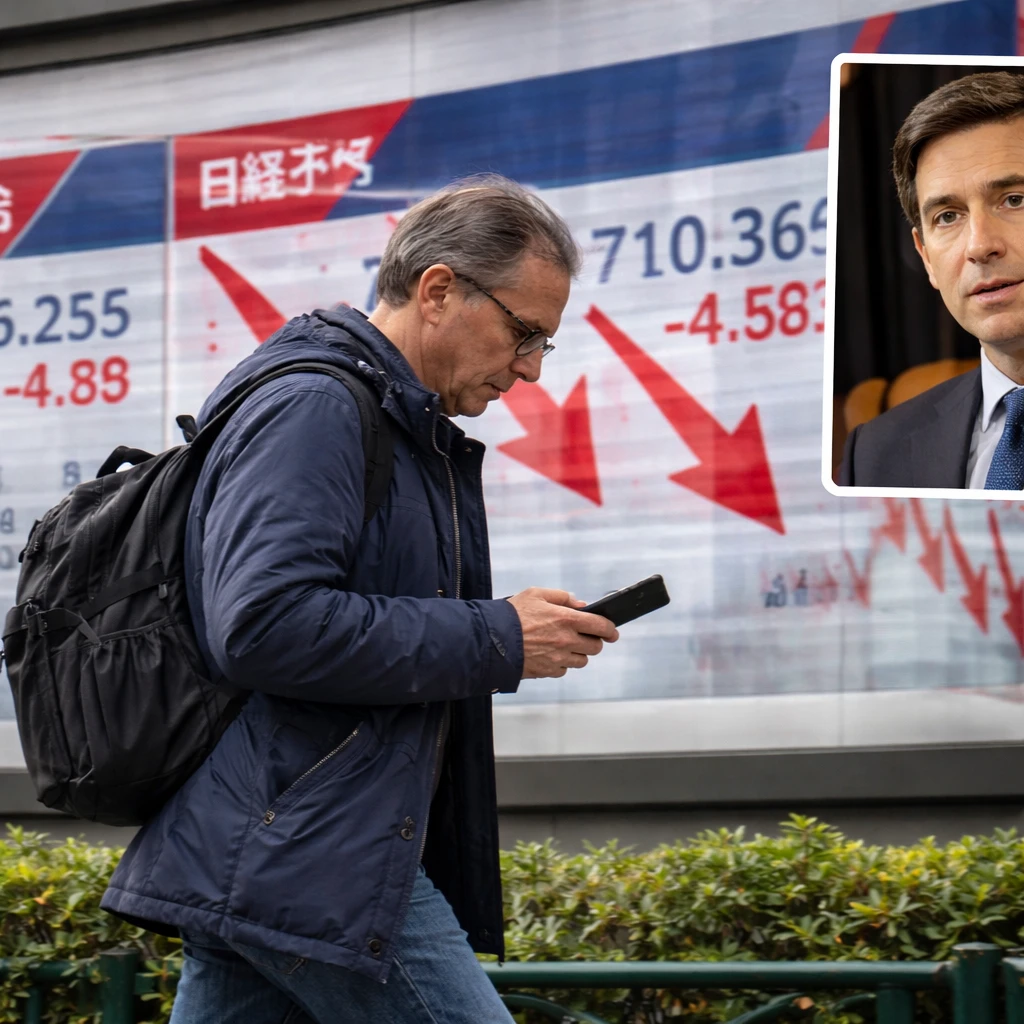

On Friday, U.S. financial markets saw considerable volatility as investors digested news regarding President Donald Trump's nomination of Kevin Warsh as the next Federal Reserve chair. This development spurred market participants to reevaluate expectations surrounding the trajectory of U.S. interest rates.
The major equity indexes reflected this uncertainty, with the S&P 500 falling 0.4% by the closing bell after earlier declines reaching as much as 1.1%. The Dow Jones Industrial Average decreased by 179 points, matching the 0.4% decline, while the tech-focused Nasdaq composite dropped 0.9%.
Currency markets also displayed instability; the U.S. dollar's value rose eventually, but not without experiencing fluctuations immediately following the announcement. Precious metals markets were hit particularly hard, echoing their dramatic performance over the previous year by plunging further — gold and silver prices experiencing significant corrections after a year marked by substantial growth.
The leadership of the Federal Reserve holds substantial sway over the global economy and financial markets, primarily by setting interest rate policies that influence borrowing costs, investment valuations, and overall economic momentum. The Fed's mandate to promote a robust job market while curbing inflation poses a delicate balancing act, especially given President Trump’s advocacy for lower interest rates, which typically encourage economic growth but risk accelerating inflation.
Financial markets have expressed concern that the Federal Reserve may lose autonomy due to political pressures from the administration, a sentiment that had boosted gold's allure as a hedge and contributed to the dollar's relative weakness over the recent year.
The prevailing assumption is that the Federal Reserve should function independently from political branches, allowing it to make necessary but sometimes unpopular decisions — such as raising interest rates to lower inflation to its target of approximately 2% — even at the cost of short-term economic slowdown.
Kevin Warsh's nomination, pending Senate approval, places this independence into question. Familiar to investors due to his prior service as a Fed governor, Warsh is known for his critical stance on some expansive monetary policies, including objections to the Fed's bond-buying programs meant to keep rates low.
On Wall Street, some interpreted Warsh's nomination as an indication that the Fed might maintain its autonomy and adhere to higher interest rates if required to temper economic overheating and inflation, despite the potential dampening effect on equity prices.
Conversely, Warsh has recently critiqued Fed Chair Jerome Powell and expressed support for reducing rates, which aligns more closely with the Trump administration’s preferences. Thierry Wizman, a strategist at Macquarie Group, characterized Warsh as more aligned with President Trump rather than the institutional Fed, noting Warsh's consistent alignment with Trump on monetary policy since 2009. While this does not guarantee imminent rate cuts, it may suggest a readiness to adopt them sooner when conditions warrant.
The metals sector suffered sharp declines concurrent with these developments. Gold prices fell 11.4% to $4,745.10 per ounce, halting a historic rally that saw gold double in value over the past year, reaching a record above $5,000 earlier in the week and peaking above $5,600 on Thursday.
Silver experienced an even steeper descent, declining 31.4%, intensifying the market correction after a similar rapid ascent.
The surge in precious metals over the previous year reflected investor caution amid various risks, including concerns about Fed independence, elevated valuations in the U.S. stock market, tariff uncertainties, and substantial government debt burdens globally. The precipitous drop on Friday suggests a natural correction following prices ascending rapidly and significantly.
Shares of mining companies mirrored the metal price drops, with Newmont’s stock declining 11.5% and Freeport-McMoRan’s falling by 7.5%.
In contrast, Tesla’s stock rebounded with a 3.3% gain after a decline the previous day, buoyed by better-than-expected quarterly profits, while Apple edged up 0.5% after reporting a stronger quarterly bottom line than analyst projections.
For the day, the S&P 500 lost 29.98 points to end at 6,939.03, the Dow Jones slipped 179.09 points to finish at 48,892.47, and the Nasdaq composite decreased by 223.30 points to close at 23,461.82.
Meanwhile, Treasury yields saw slight fluctuations; the 10-year note’s yield moved marginally higher to 4.25% above Thursday’s 4.24%, after briefly touching 4.28% during early trading sessions. Rising yields typically correspond with decreasing bond prices. The slight upward pressure on yields might be linked to a recent report indicating wholesale inflation in the U.S. was higher than economists anticipated last month, potentially supporting a case for the Federal Reserve to maintain steady interest rates instead of cutting them, as it did late last year.
Internationally, European stock indexes recorded gains, contrasting with mixed Asian market performances. Notably, Jakarta’s bourse rose by 1.2%, following the resignation of its stock market CEO on Friday. Previous days had seen declines linked to a warning from MSCI, an influential indexing company, about market risks including inadequate transparency.