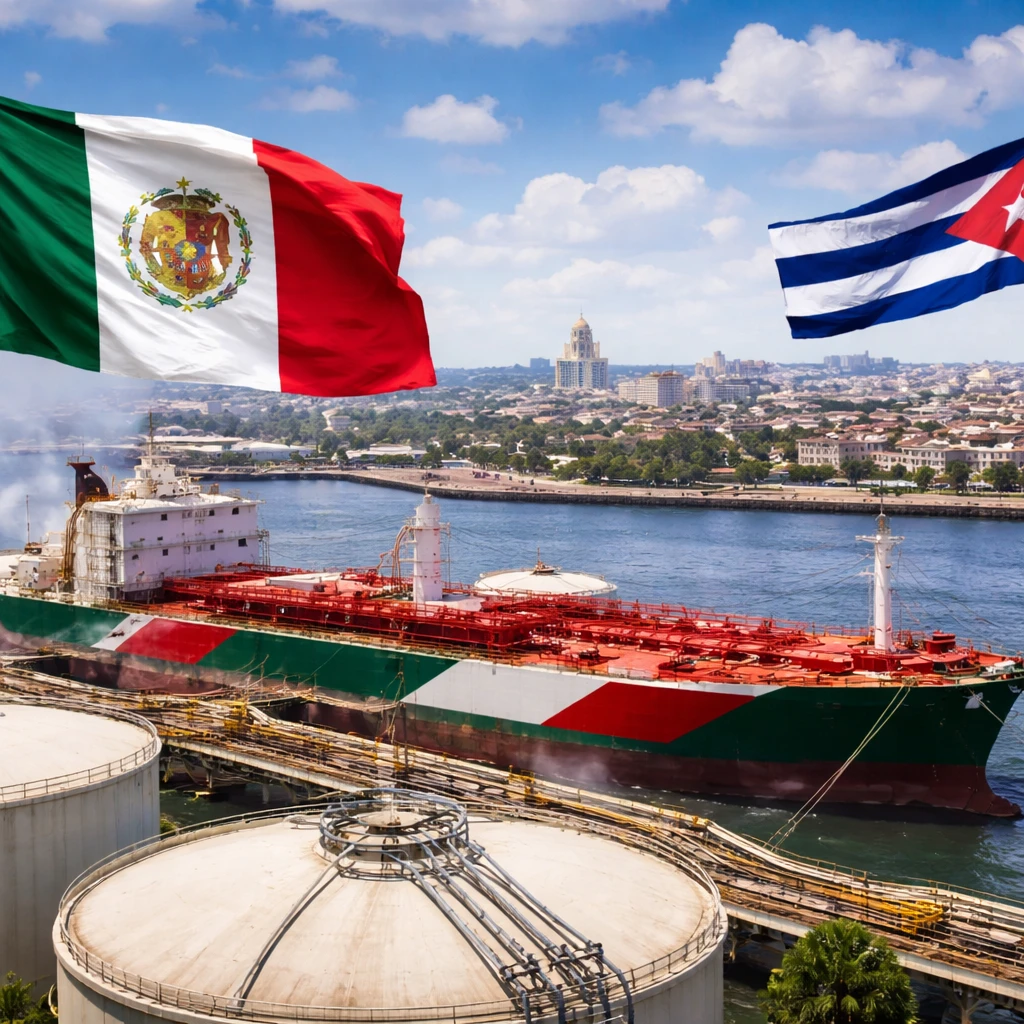

As United States policy towards Venezuela and Cuba continues to tighten under President Donald Trump's administration, Mexico has taken on a significant yet sensitive role as a fuel supplier to Cuba. The emerging dynamics create additional complications for Mexico’s diplomatic ties with the U.S., despite Mexican officials maintaining that exports to the island have not increased over usual levels.
On Wednesday, Mexican President Claudia Sheinbaum acknowledged Mexico’s enhanced role against the backdrop of Venezuela's ongoing crisis, stating that Mexico has become an "important supplier" of crude oil to Cuba. However, she clarified that "no more oil is being sent than has been sent historically; there is no specific shipment." Sheinbaum further elaborated that these fuel deliveries occur under existing contracts or as part of humanitarian assistance, though she did not provide exact numbers regarding barrel volumes exported.
The strained history between Cuba and the U.S., especially following the 1959 revolution and the subsequent American trade embargo in response to the nationalization of U.S.-owned properties, has led to persistent economic and energy challenges on the island. Numerous countries, including Mexico, have criticized this embargo. Cuban citizens frequently endure prolonged power outages—lasting up to eight hours—and long fuel station queues.
Residents such as José Martínez, a 65-year-old with daily power interruptions, express concerns that the Venezuelan turmoil will exacerbate Cuba's energy crisis. “The blackouts are going to intensify with all this,” he said, also attributing aggressive U.S. actions to desires over Venezuela’s oil resources. Meanwhile, local vendor Yeison Gálvez, 37, emphasized Cuba’s reliance on Venezuelan fuel, predicting that decreased supplies may force Cubans to rely more on foot transportation.
The possibility of alternative suppliers stepping in following the U.S. approach to Venezuela remains uncertain. Mexico has refrained from making definitive statements about future export plans to Cuba. Notably, exports to Cuba account for a minor portion of Mexico’s total oil shipments—approximately 3.3%—and the economic benefits remain questionable amid a continuing decrease in Pemex's oil production.
From January to September 30, 2025, records indicate Mexico shipped an average of 19,200 barrels daily to Cuba, including 17,200 barrels of crude oil and 2,000 barrels of refined products, according to official filings by Pemex to the U.S. Securities and Exchange Commission. Pemex did not respond immediately to requests for more detailed data.
Jorge Piñón of the University of Texas at Austin, who monitors oil shipments with satellite tools, corroborated those figures, noting approximately 22,000 barrels per day for the same period. Piñón reported that this volume fell to 7,000 barrels daily after U.S. Secretary of State Marco Rubio’s visit to Mexico City in September 2025. In the same timeframe, Venezuela’s government exported roughly 35,000 barrels daily to Cuba, supplying about one-quarter of the island’s fuel needs.
Piñón sees no prospect of Mexico boosting its exports to Cuba further, warning that such action would provoke intense backlash from the U.S. Oscar Ocampo of the Mexican Institute for Competitiveness anticipates increased U.S. pressure on Mexico regarding Cuba, particularly concerning oil exports, a view shared by many analysts.
Historically, Mexico has provided fuel shipments to Cuba during times of energy shortages and social unrest, including notable humanitarian aid deliveries after widespread Cuban protests in 2021 and extended blackouts in late 2024. For instance, following the 2021 unrest, Mexico delivered 100,000 barrels of fuel, and in October 2024, it sent over 400,000 barrels within days.
Ocampo highlights concerns about the opacity of these transactions, particularly since 2023 when shipments have been handled through Pemex's private subsidiary, Gasolinas Bienestar, whose financial details remain unclear. Official SEC reports from Pemex assert these exports are contract-based sales at market prices valued around $400 million. Nevertheless, Ocampo suggests it is difficult to verify whether these are strictly commercial transactions or if discounts, exchanges of services such as medical deployments, or humanitarian aid factor into the arrangements.
Amid these complexities, Mexico’s reduced crude oil production is significant. Projections suggest 2025 will be the year Pemex exports the least crude in recent history—under 600,000 barrels per day, compared to more than 1 million barrels just a few years prior. This declining production adds a financial dimension to the limited scale and profitability of oil shipments to Cuba.
As this evolving energy and geopolitical landscape unfolds, the balance Mexico maintains between fulfilling historic oil supply obligations to Cuba and managing pressures from the United States carries important implications for regional energy markets and international relations.