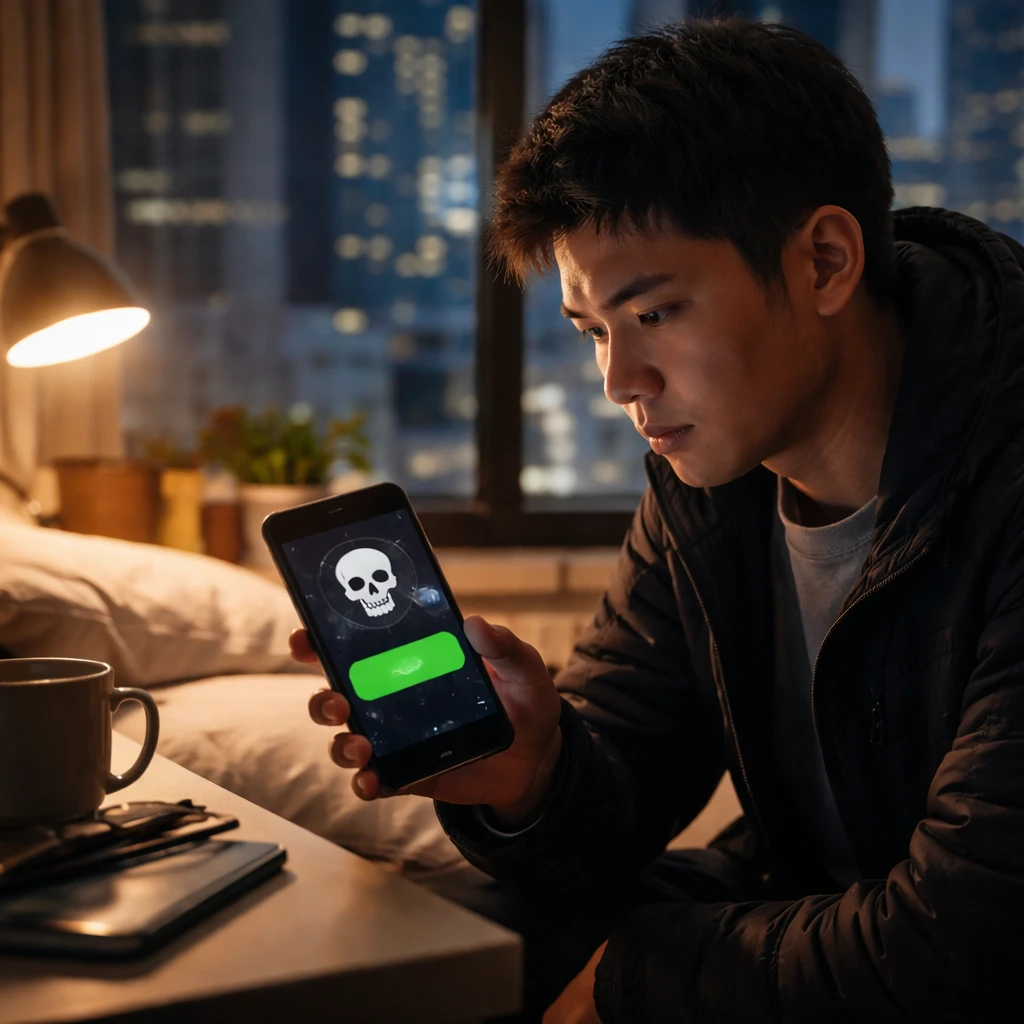

In today's rapidly urbanizing China, a novel mobile application titled “Are You Dead?” has recently captivated the attention of young people living alone in far-flung cities. True to its direct and somewhat provocative name, this app offers a simple function: with one tap on a large green circle displayed on the phone screen, users can instantly send a message confirming they are alive to a trusted friend or relative. The service, which costs 8 yuan (approximately $1.10), addresses safety and reassurance concerns for those who may be physically distant or isolated.
The concept is reminiscent of Western emergency alert pendants used primarily by elderly individuals, however, this Chinese innovation has found surprising popularity among younger demographics. Created by a team of three young adult developers in their twenties, "Are You Dead?" recently secured the position as the top paid app on Apple's China App Store. It has also garnered substantial downloads internationally in countries such as Singapore, the Netherlands, the United Kingdom, India, and the United States, reflecting the developers’ belief that loneliness and personal safety are universal issues transcending national boundaries.
Ian Lü, aged 29 and one of the application’s creators, explained that urban migration and pursuing vocational dreams away from family contribute to an increasing number of individuals living alone. Having experienced solitude firsthand during five years residing in Shenzhen, Lü emphasized that introverted personalities in particular benefit from a minimally obtrusive check-in tool. He noted that it is generally impractical to communicate daily just to indicate one is alive.
The emergence of “Are You Dead?” mirrors profound societal shifts in China over recent decades. Historically, multigenerational households were common, with family members living in close proximity. However, swift economic development and urbanization have led to a demographic dispersal, with hundreds of millions relocating to urban centers far from their extended families.
Official statistics reveal that by 2024, over 100 million Chinese households comprise single individuals. Among these users, Chen Xingyu, 32, residing in Kunming, expressed intrigue about the app’s unusual moniker but voiced privacy concerns, particularly about data security and potential leaks, especially given the perceived female user base. Similarly, Shanghai-based designer Yuan Sangsang, who has lived alone for a decade and self-identifies as a “single cow and horse,” highlighted the app’s practical utility in ensuring that relatives are notified if she were to pass away unnoticed—an issue underscored by fears of dying alone and not being promptly discovered.
While similar technology traditionally targets senior citizens, the app’s adoption trends skew younger, as many users treat it as a humorous yet meaningful social indicator rather than solely a safety tool. Chinese social media analysis suggests the app’s name and function resonate with young users as an informal and candid check-in between close friends.
Commentary from the Chinese Business Network interpreted the app’s rapid success as a metaphor for contemporary youth conditions—pointing to a desire not just for physical safety measures but for acknowledgment and emotional connection in a fast-paced, sometimes isolating societal landscape.
However, the app’s name confronts a cultural taboo, as discussing death openly is generally avoided in Chinese society. This sensitivity is evident in common practices like omitting the fourth floor in building numbering due to phonetic associations between the number four and death. Recognizing public unease, the developers indicated plans to adopt a new, more subdued name: "Demumu," aimed at appealing to global solo dwellers. Yet, subsequent user feedback revealed the new name did not meet expectations, leading the developers to solicit public suggestions for alternative names, offering a reward of 666 yuan (about $96) for the winning entry.
Overall, “Are You Dead?” highlights the evolving challenges and lifestyle realities faced by young, urban Chinese individuals living independently. It also reflects broader themes of social connection, privacy concerns, and cultural attitudes towards mortality amid rapid demographic changes.