
Oxford Robotics Institute Deploys Quadruped Robots to Innovate Forest Mapping
February 2, 2026
Business News

Oxford Robotics Institute Deploys Quadruped Robots to Innovate Forest Mapping

Advanced robotic canines utilize AI, lasers, and cameras to monitor woodland ecosystems while encountering unexpected responses from natural fauna

Summary

The Oxford Robotics Institute has introduced quadruped robotic systems designed to conduct detailed forest mapping. Equipped with sophisticated sensors and artificial intelligence, these robots accurately identify and track arboreal health and ecosystem conditions. Contrarily, natural dogs within these environments display confusion when encountering these robotic counterparts. This initiative aims to enhance sustainable forest management through precise data collection.

Key Points

The Oxford Robotics Institute has created quadruped robots to map forests with high precision using lasers, cameras, and AI.
These robotic dogs efficiently monitor tree health and track environmental changes to assist sustainable woodland management.
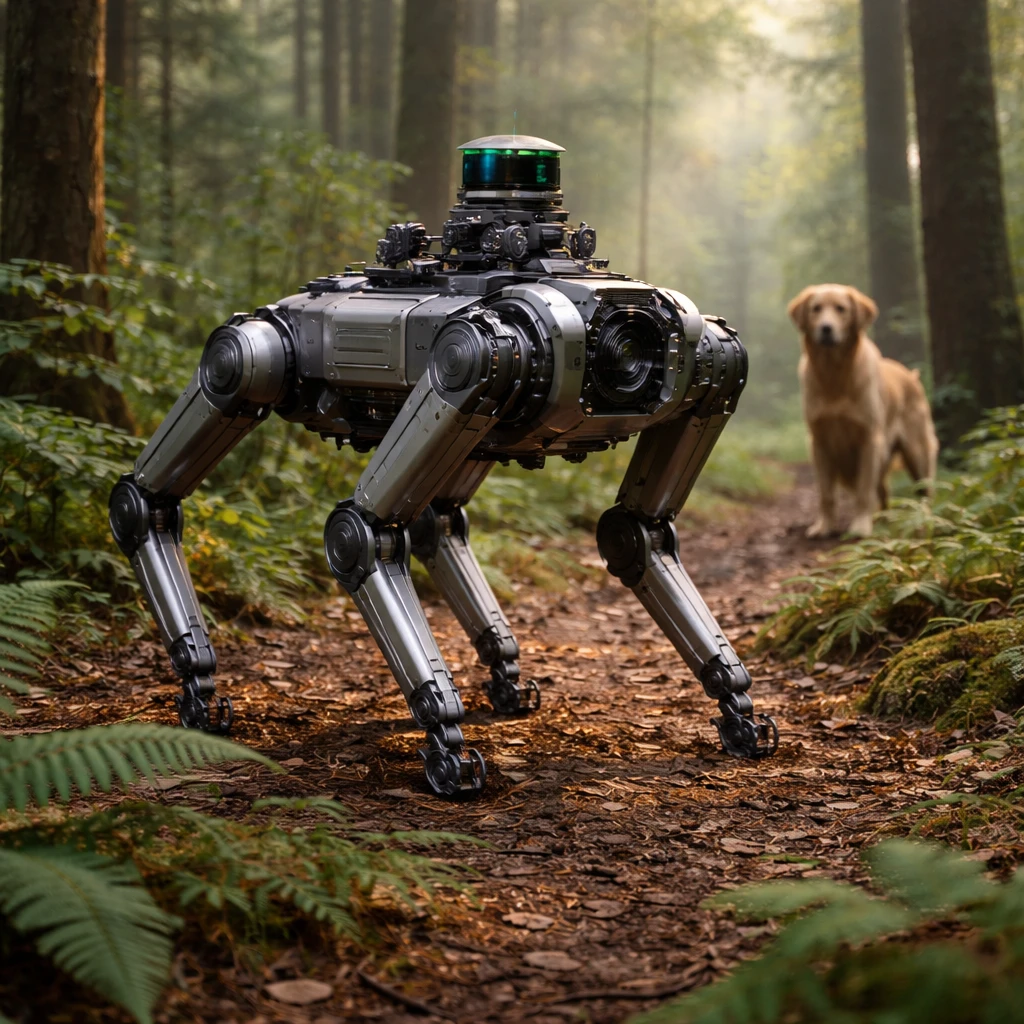
Natural dogs in the forest interact with these robots and exhibit confusion due to the novelty and differences from biological animals.
The robots’ advanced mobility allows them to navigate forest terrain and avoid disturbing wildlife, including real dogs.

Researchers at the Oxford Robotics Institute have developed and deployed a new generation of quadruped robots, commonly referred to as “robot dogs,” to perform comprehensive mapping of forested environments. These robots employ a combination of laser scanning, high-resolution cameras, and advanced artificial intelligence algorithms to meticulously record and assess the condition of individual trees and larger woodland ecosystems.

This robotic technology enables rapid and precise data collection critical for monitoring forest health, identifying disease outbreaks, and supporting sustainable management practices. The ability to operate autonomously and navigate complex terrain allows these machines to cover extensive forest areas methodically, providing valuable ecological insights with enhanced efficiency compared to traditional manual surveys.

Interestingly, interactions between these robotic quadrupeds and natural dogs share the forest have produced noteworthy behavioral observations. Real dogs presented in these environments often exhibit signs of confusion and curiosity when encountering their mechanical counterparts. This reaction is presumably due to the unfamiliar appearance and movement patterns of the robots, which differ significantly from natural animal behaviors.

The development team emphasizes the robots’ agility and navigational precision, which contribute to their capacity to move past or avoid wildlife, including live dogs, without incident. This dexterity is vital for minimizing disturbance to natural inhabitants and ensuring that ecological data collection remains unobtrusive.

The integration of technologies such as lidar-based laser scanning, digital imaging, and AI-driven interpretative software underpins the robots’ ability to generate detailed forest maps. These maps inform conservationists and forest managers about tree health metrics and ecosystem dynamics, thereby facilitating targeted actions to sustain woodland resilience and biodiversity.

By combining mechanical innovation with ecological science, the Oxford Robotics Institute’s robot dogs represent a pioneering step in forest monitoring. Their deployment marks an intersection of automation and environmental stewardship designed to support long-term sustainability initiatives.

While the robotic systems prove advantageous in their technical capacities and ecological applications, the responses observed from real dogs highlight an ongoing interface between technology and natural wildlife, underscoring the adaptive challenges present in integrating robotics within living ecosystems.

Risks
  • Natural animals, such as real dogs, may react unpredictably or be disturbed by the presence of robotic counterparts in their habitat.
  • Integration of robots into natural environments may lead to unforeseen ecological impacts or behavioral changes among woodland fauna.
  • Reliance on robotic data collection depends on the machines’ operational integrity, which could be affected by forest conditions or technical failures.
  • The acceptance and effectiveness of robotic monitoring are contingent upon continual refinement to minimize disruption and maximize accurate ecological assessment.
Disclosure
Education only / not financial advice
Search Articles
Category
Business News

Business News

Related Articles
U.S. Risks Losing Edge in AI Innovation Due to Fragmented Regulation, Warns White House AI Coordinator

David Sacks, the White House AI and crypto coordinator, cautioned that the United States might fall ...

Zillow Faces Stock Decline Following Quarterly Earnings That Marginally Beat Revenue Expectations

Zillow Group Inc recent quarterly results reflect steady revenue growth surpassing sector averages b...

Coherent (COHR): Six‑Inch Indium Phosphide Moat — Tactical Long for AI Networking Upside

Coherent's vertical integration into six-inch indium phosphide (InP) wafers and optical modules posi...

Buy the Dip on AppLovin: High-Margin Adtech, Real Cash Flow — Trade Plan Inside

AppLovin (APP) just sold off on a CloudX / LLM narrative. The fundamentals — consecutive quarters ...

Oracle Shares Strengthen Amid Renewed Confidence in AI Sector Recovery

Oracle Corporation's stock showed notable gains as the software industry experiences a rebound, fuel...

Figma Shares Climb as Analysts Predict Software Sector Recovery

Figma Inc's stock experienced a notable uptick amid a broader rally in software equities. Analysts a...