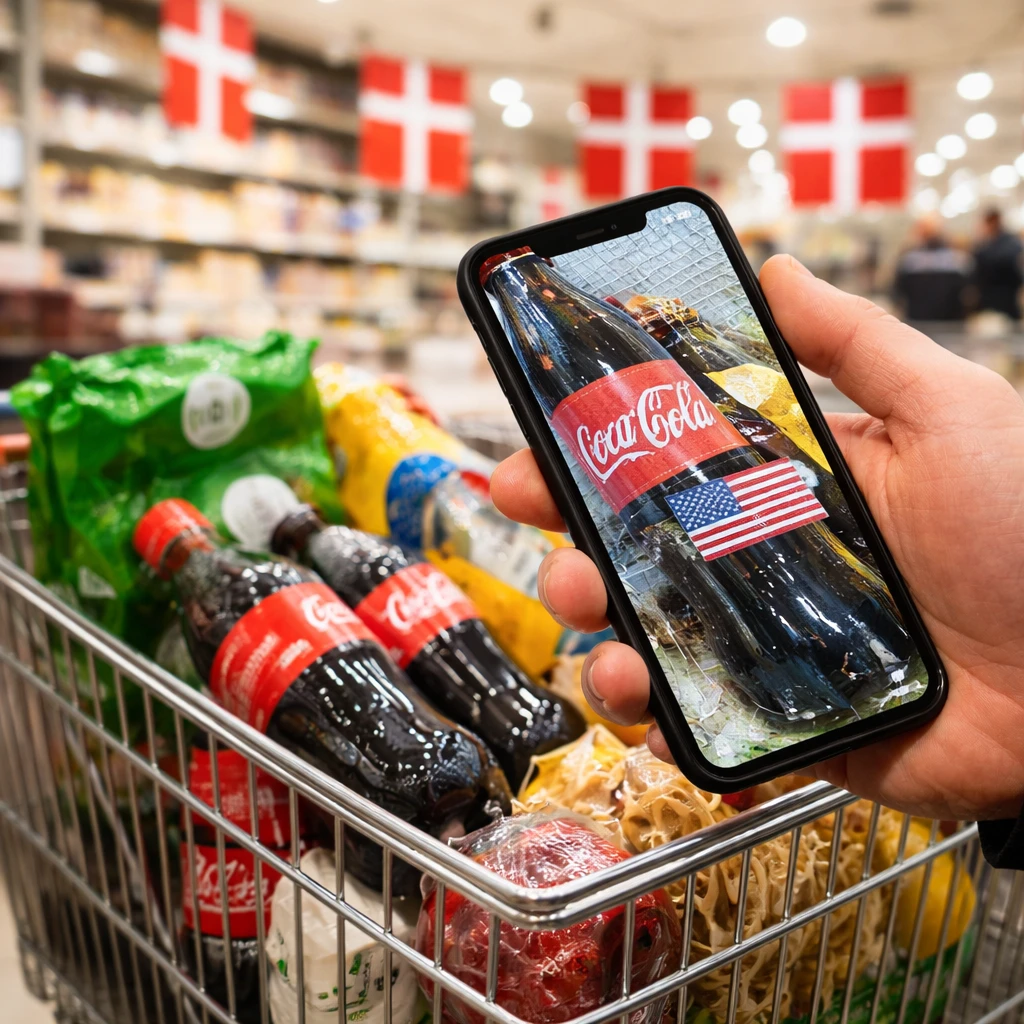
Mobile app developers facilitating consumer boycotts of U.S. products report a significant rise in downloads and activity in Denmark and internationally following recent diplomatic tensions concerning Greenland. Ian Rosenfeldt, a Copenhagen-based digital marketing professional, created the "Made O'Meter" app to assist shoppers wanting to avoid American brands. Since its launch in March, it has accumulated over 100,000 downloads, with approximately 30,000 occurring during a three-day span in late January amid the diplomatic dispute.
Rosenfeldt conceived the app within a Facebook community of Danes discussing practical means of avoiding U.S. merchandise. He explained that conventional barcode scanning tools offered limited insight into product nationality, complicating efforts to make conscious choices. The latest iteration of "Made O'Meter" incorporates artificial intelligence to analyze multiple products simultaneously and proposes comparable European-made alternatives. Users can customize settings to exclude "USA-owned brands" or restrict selections to "EU-based brands," with claimed accuracy exceeding 95%. During a demonstration in a Copenhagen grocery store, Rosenfeldt highlighted the AI's capacity to extract detailed product information to inform consumer decisions.
Following initial interest upon release, app engagement subsided until January when President Trump's vocal push to acquire Greenland, a geopolitically strategic and mineral-rich autonomous Danish territory, reignited interest. Daily scans surged from approximately 500 last summer to nearly 40,000 on January 23, before stabilizing at about 5,000 per day. Usage spans multiple countries including Denmark, Germany, Spain, Italy, and Venezuela.
Rosenfeldt characterized the situation as becoming deeply personal, expressing concern about "losing an ally and a friend." The U.S. president had announced potential tariffs on Denmark and other European nations opposed to U.S. plans for Greenland but retracted the threat citing a "framework" for future Arctic cooperation negotiated with NATO assistance. Subsequent technical discussions commenced involving the U.S., Denmark, and Greenland, all underscoring non-negotiable sovereignty claims. Rosenfeldt acknowledges that while the boycott's economic impact on the U.S. is limited, it aims to influence supermarkets and elevate European production reliance.
Parallel to "Made O'Meter," another Danish app named "NonUSA" exceeded 100,000 downloads by early February. Jonas Pipper, a 21-year-old co-creator, observed intense user activity around January 21 with up to 526 product scans per minute during peak periods. Of the users, 46,000 reside in Denmark, with approximately 10,000 in Germany. Pipper noted that the app empowers users, alleviating some sense of helplessness in geopolitical tensions.
However, experts question the practical effects of such digital boycotts. Christina Gravert, associate economics professor at the University of Copenhagen, points out that U.S. products account for a minimal share of Danish grocery shelves, approximately 1-3%, primarily nuts, wines, and confectionery. Danish consumption of American technology—Apple devices, Microsoft applications—is considerable. Gravert emphasizes that meaningful impact likely resides in technology sectors rather than groceries. She also notes that apps themselves rely on American-operated platforms such as Apple's App Store and Google Play Store.
Behavioral economics research suggests boycott movements have limited duration and that substantive change requires coordinated initiatives beyond individual consumers. Large retail chains responding to consumer sentiment by modifying their product offerings could exert influence on import patterns. Anecdotal evidence from Copenhagen shoppers reveals divided perspectives, with some engaging in selective boycotts based on brand recognition and others resisting such measures due to positive personal associations with the United States.