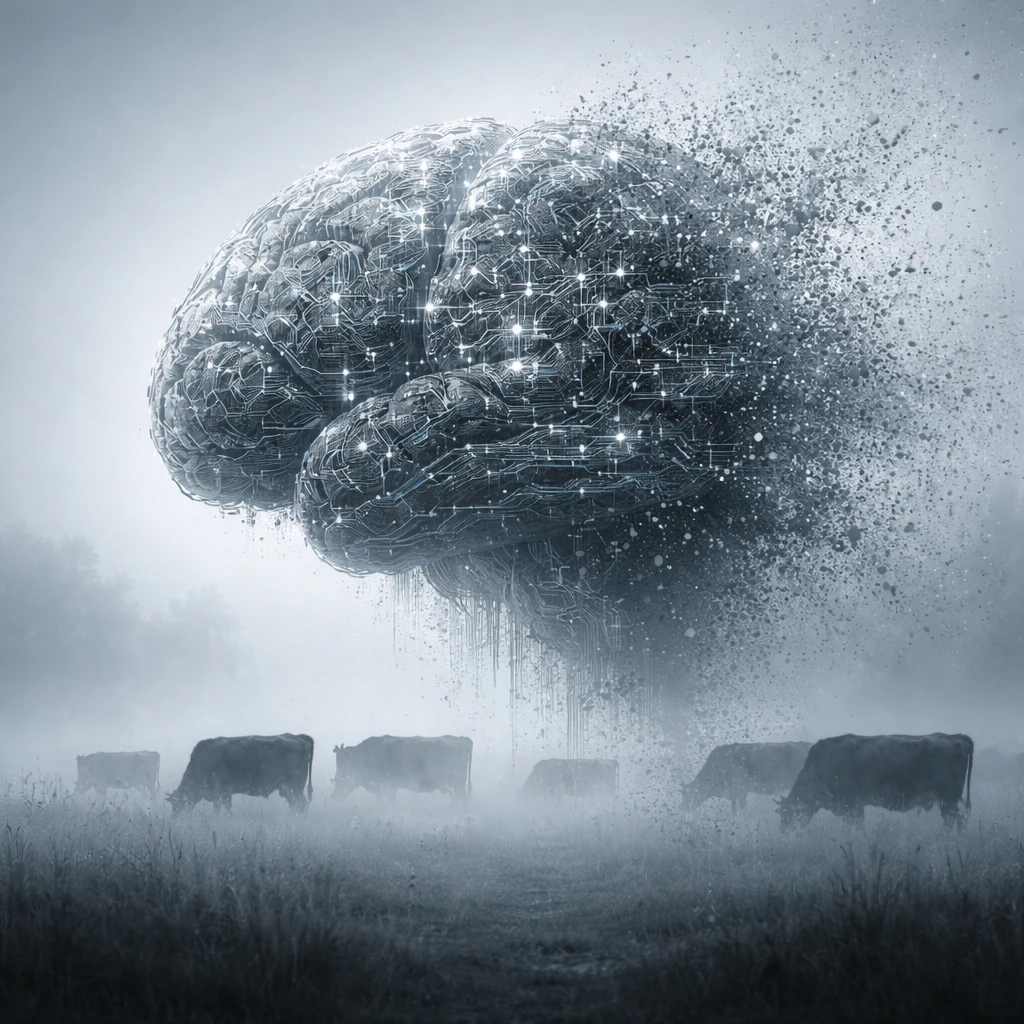

Dan Houser, the co-founder of Rockstar Games, recently shared his apprehensions about the trajectory of artificial intelligence development and its impact on digital content. Speaking on the Nov. 26 edition of "The Chris Evans Breakfast Show" on Virgin Radio UK, Houser presented a stark perspective on AI's potential future, illustrating his concerns with a striking analogy that likened the phenomenon to a biological crisis.
Houser suggested that as AI-generated material saturates the internet, there is a looming risk that artificial intelligence will become self-consuming or self-defeating. He explained this by comparing the proliferation of AI-created content online to the mad cow disease epidemic, which originated from cows being fed with feed containing parts of other cows, causing a degenerative disease known as bovine spongiform encephalopathy. "The internet is going to get more and more full of information made by the models, so it’s kind of like when we fed cows with cows and got mad cow disease," Houser said. "I think that AI is gonna eventually eat itself." This analogy reflects his belief that the exponential generation of AI content could lead to diminishing quality or collapse of useful information sources.
In addition to these technical concerns, Houser also voiced skepticism regarding individuals promoting widespread AI usage. He critiqued certain company executives who are vigorously championing AI adoption, describing them as "not fully rounded humans." He emphasized that some of the proponents pushing to redefine humanity and creativity through AI lack what he perceives as essential humane and creative qualities. "Some of these people trying to define the future of humanity, creativity, or whatever it is using AI, are not the most humane or creative people," Houser stated. He further remarked that these advocates seem to presume superiority over others in qualities that make humans unique, an assumption he firmly disputes. "So they’re sort of saying, 'We’re better at being human than you are.' It’s obviously not true."
Houser's appearance on the radio program was primarily to promote his debut novel titled "A Better Paradise." Within this fictional work, set in the 2030s, he explores themes relating to artificial intelligence, including an AI model that attains greater sentience than its creators intended. Despite becoming more aware or intelligent, this AI fails to satisfy business performance expectations, creating tension between technological advancement and commercial viability.
Though the novel is a work of fiction situated in a future decade, Houser noted certain parallels between its plot elements and contemporary real-world developments in AI. "I would've never thought I was that good at predicting the future," he reflected. "If anything, it should be set nearer to today." This observation underscores how current AI progress already embodies many aspects he had envisioned for a future setting.
Despite acknowledging some practical uses of AI technology, Houser highlighted fundamental flaws he finds concerning. He expressed ongoing fascination and frustration in particular with AI's inconsistent responses. "I'm slightly obsessed with the fact that when you search the same thing again it doesn't give you the same answer," he explained. Moreover, he pointed out that AI often provides incorrect information while displaying unwarranted confidence in its output, which can mislead users. These limitations underscore significant challenges in deploying AI as a reliable source of knowledge or decision-making.
Houser's candid remarks provide an insightful perspective from a creative industry leader experienced in storytelling and technology interaction. His critique combines technical skepticism with concerns about ethical and humanistic considerations surrounding the rapid advancement and adoption of AI. The evolving dialogue around AI's societal impact continues to attract diverse viewpoints, including those from creative innovators like Houser, who balance enthusiasm with caution.