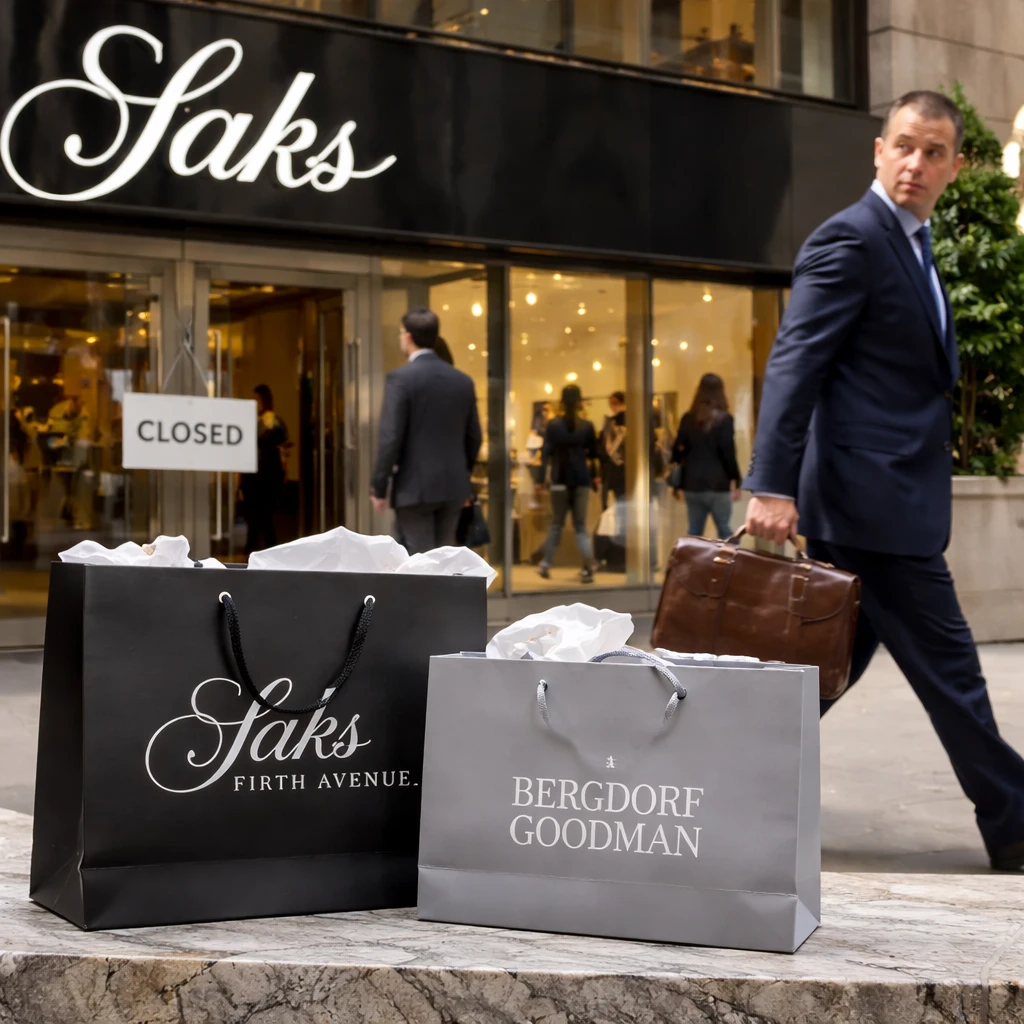
In a significant development for the luxury retail sector, Saks Global, which runs Saks Fifth Avenue and Bergdorf Goodman among other brands, has filed for Chapter 11 bankruptcy protection in the Southern District of Texas. The company disclosed that it had secured approximately $1.75 billion in financing as part of its filing. Saks Global emphasized that its retail locations will remain operational throughout the restructuring process and assured that customer programs would continue as planned. Additionally, it confirmed that suppliers and employees would be compensated during this period.
The retailer manages roughly 33 Saks stores, 36 Neiman Marcus outlets, two Bergdorf Goodman shops, and close to 70 Saks Off 5th discount stores. New leadership took charge amid these developments, with Geoffroy van Raemdonck succeeding Richard Baker as CEO and Executive Chairman this week. Baker previously stepped in following the departure of former CEO Marc Metrick earlier this month.
In mid-2024, Saks Global acquired Neiman Marcus for $2.65 billion, seeking to consolidate a fragmented luxury market. However, this purchase further escalated the company’s already substantial debt at a time when luxury sales were softening. Before the acquisition, Saks struggled with timely supplier payments, stretching out payment terms and creating friction with brand partners.
Industry analysts, like Neil Saunders, managing director of GlobalData Retail, noted the bankruptcy filing was an anticipated consequence of the leveraged acquisition, though he expressed surprise at how quickly events unfolded. Saunders described the acquisition as involving intricate financial maneuvers that ultimately hindered the group’s ability to realize its strategic goals.
The broader retail environment remains challenging even for financially stable entrants. A recent Bain & Company consultancy study projected a contraction in global luxury goods sales for the second consecutive year amid consumer caution prompted by economic concerns.
Several established retailers have already faced significant upheavals: Hudson’s Bay initiated widespread store liquidations in early 2025; Neiman Marcus previously filed for bankruptcy for approximately four months in 2020; Lord & Taylor sought bankruptcy protection in August 2020 and pivoted to a digital-only presence. Similarly, Nordstrom agreed to a $6.25 billion privatization deal last year.
While Macy’s has seen sales improvements under new leadership, the company’s turnaround involved closing underperforming stores.
The bankruptcy filing has heightened concerns among vendors about Saks Global’s future. Gary Wassner, CEO of Hilldun Corp., which provides insurance ensuring suppliers receive payment for shipped merchandise, stated suppliers were anxious about pending spring deliveries already manufactured. Wassner noted Saks accounted for between 40% and 50% of sales for some clients. Owing to uncertainties, he advised his clients to halt shipments as of the previous month. Although there are around $130 million of spring orders awaiting delivery, suppliers are demanding payment guarantees before fulfilling them.
According to documents from the bankruptcy filing, Saks Global has financing commitments amounting to $1.5 billion from some creditors, along with an additional $240 million in incremental liquidity from lenders. The company listed assets and liabilities in a broad range between $1 billion and $10 billion. Chanel ranks as the largest unsecured creditor with an approximate claim of $136 million, followed by Kering — owner of Gucci, Saint Laurent, and Balenciaga — holding a $59.9 million claim.
Prolonged inflationary pressures in the U.S. have pushed a wide array of retailers into bankruptcy proceedings. Recent filings include established names like Claire's and Joann, marking a rising trend in filings across multiple sectors noted by S&P Global Market Intelligence. Retailers accounted for the second-largest proportion of these bankruptcy declarations last year, which totaled 785, the highest tally since 2010.
The retailer manages roughly 33 Saks stores, 36 Neiman Marcus outlets, two Bergdorf Goodman shops, and close to 70 Saks Off 5th discount stores. New leadership took charge amid these developments, with Geoffroy van Raemdonck succeeding Richard Baker as CEO and Executive Chairman this week. Baker previously stepped in following the departure of former CEO Marc Metrick earlier this month.
In mid-2024, Saks Global acquired Neiman Marcus for $2.65 billion, seeking to consolidate a fragmented luxury market. However, this purchase further escalated the company’s already substantial debt at a time when luxury sales were softening. Before the acquisition, Saks struggled with timely supplier payments, stretching out payment terms and creating friction with brand partners.
Industry analysts, like Neil Saunders, managing director of GlobalData Retail, noted the bankruptcy filing was an anticipated consequence of the leveraged acquisition, though he expressed surprise at how quickly events unfolded. Saunders described the acquisition as involving intricate financial maneuvers that ultimately hindered the group’s ability to realize its strategic goals.
The broader retail environment remains challenging even for financially stable entrants. A recent Bain & Company consultancy study projected a contraction in global luxury goods sales for the second consecutive year amid consumer caution prompted by economic concerns.
Several established retailers have already faced significant upheavals: Hudson’s Bay initiated widespread store liquidations in early 2025; Neiman Marcus previously filed for bankruptcy for approximately four months in 2020; Lord & Taylor sought bankruptcy protection in August 2020 and pivoted to a digital-only presence. Similarly, Nordstrom agreed to a $6.25 billion privatization deal last year.
While Macy’s has seen sales improvements under new leadership, the company’s turnaround involved closing underperforming stores.
The bankruptcy filing has heightened concerns among vendors about Saks Global’s future. Gary Wassner, CEO of Hilldun Corp., which provides insurance ensuring suppliers receive payment for shipped merchandise, stated suppliers were anxious about pending spring deliveries already manufactured. Wassner noted Saks accounted for between 40% and 50% of sales for some clients. Owing to uncertainties, he advised his clients to halt shipments as of the previous month. Although there are around $130 million of spring orders awaiting delivery, suppliers are demanding payment guarantees before fulfilling them.
According to documents from the bankruptcy filing, Saks Global has financing commitments amounting to $1.5 billion from some creditors, along with an additional $240 million in incremental liquidity from lenders. The company listed assets and liabilities in a broad range between $1 billion and $10 billion. Chanel ranks as the largest unsecured creditor with an approximate claim of $136 million, followed by Kering — owner of Gucci, Saint Laurent, and Balenciaga — holding a $59.9 million claim.
Prolonged inflationary pressures in the U.S. have pushed a wide array of retailers into bankruptcy proceedings. Recent filings include established names like Claire's and Joann, marking a rising trend in filings across multiple sectors noted by S&P Global Market Intelligence. Retailers accounted for the second-largest proportion of these bankruptcy declarations last year, which totaled 785, the highest tally since 2010.