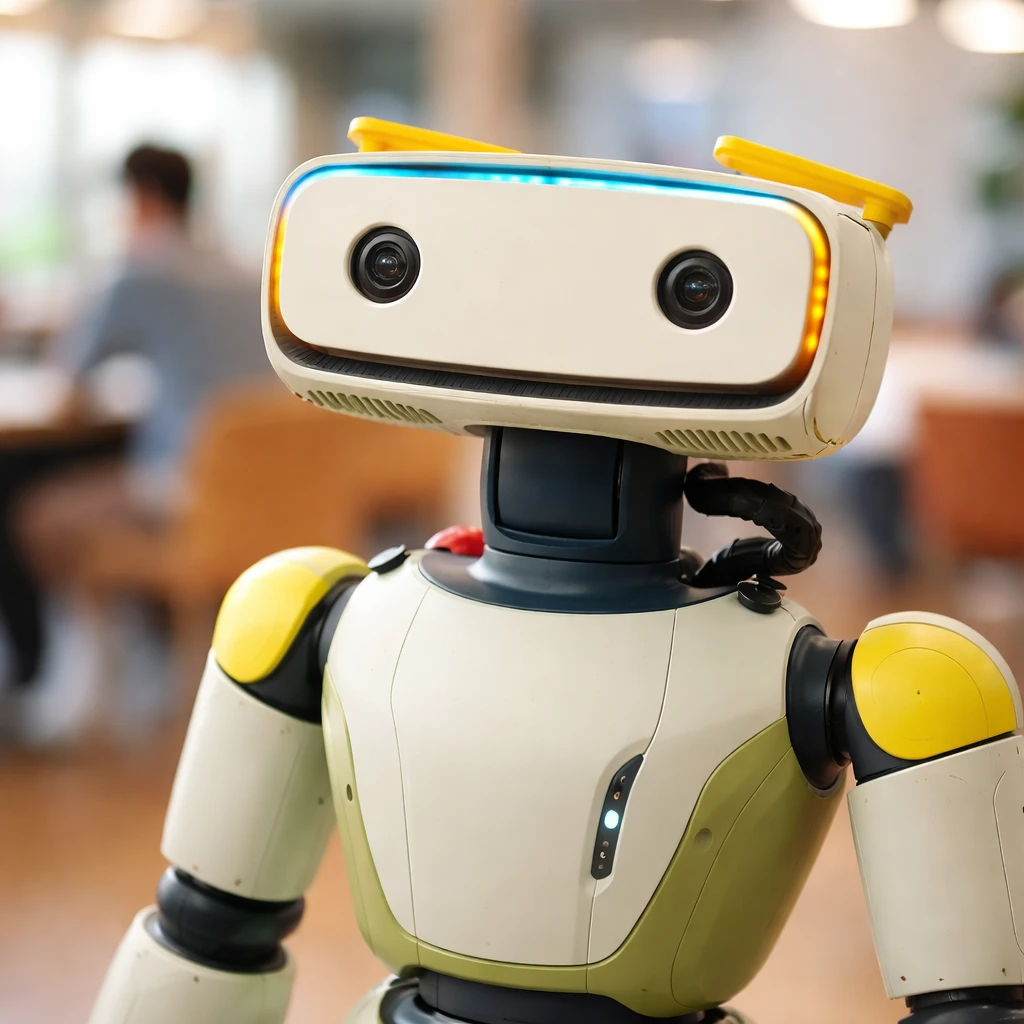

In a Manhattan office, a newly revealed robot named Sprout engages by nodding its rectangular head, echoing human-like gestures with windshield wiper-style "eyebrows," and extending grippers in a greeting handshake. This design markedly contrasts with the sleek, imposing humanoids produced by major companies such as Tesla.
Standing approximately 3.5 feet (1 meter) tall, Sprout wears a padded exterior made of sage-green foam, creating an inviting presence suitable for interaction at the eye level of a 5-year-old child. Developed over two years in secrecy by Fauna Robotics, a stealth startup, its public launch is aimed at catalyzing a novel robotics industry centered on "approachable" robots tailored for personal and communal settings like homes and schools.
Sprout represents a pioneering product in the U.S. market focused on social and domestic robot applications. Its design includes features reminiscent of affectionate and expressive droids from science fiction, drawing inspiration from characters such as WALL-E, Baymax, and Rosie Jetson, as noted by Fauna Robotics’ co-founder and CEO Rob Cochran, who contrasts their approach with more dystopian sci-fi influences like "Westworld" and "Terminator."
Exploring a Distinct Commercial Approach for Humanoid Robots
Most current commercial prototypes of humanoid robots aim at employment in warehouse or factory roles before transitioning to personal use. Notably, Tesla's Optimus and Boston Dynamics' Atlas are intended for industrial tasks such as automotive manufacturing.
In contrast, Fauna Robotics targets a different audience: software developers and robotics enthusiasts. Sprout functions as a complex and versatile developer platform, retailing at $50,000. This price aligns with offerings like China's Unitree humanoid robots, which have found adoption in academic and technology entrepreneurship circles but are sometimes bypassed due to concerns over tariffs and security.
Cochran emphasizes that Fauna is potentially the first American entity actively shipping humanoid robots designed specifically for developer platforms, personally delivering initial units to clients including Disney and Boston Dynamics.
Boston Dynamics’ Chief Strategy Officer Marc Theermann remarked on Sprout's readiness for immediate deployment and its potential acceptance in domestic environments, noting the robot’s user-friendly and anticipatory design.
Capabilities and Interactions within Fauna Robotics’ Testing Facility
Sprout is not engineered to lift heavy items but can perform expressive movements such as the Twist or Floss dance. It can manipulate objects, including toy blocks and stuffed animals, and independently move from a seated to standing position to navigate the office space of Fauna Robotics’ Flatiron District headquarters in New York City.
During demonstrations conducted in January prior to its launch, researchers and a journalist operated Sprout using varied controls, such as a video game controller, a smartphone application, and a virtual reality headset. The robot also possesses spatial awareness sufficient to execute assigned tasks like inventory checks within a break room refrigerator.
It maneuvers steadily over uneven surfaces, with only occasional near-tripping incidents, such as when it circumvented a person but struck a low-lying table wheel. Built with perturbation handling capabilities, Sprout promptly regained stability similar to a clumsy human.
Research scientist Ana Pervan highlighted the robot’s responsiveness, noting that Sprout plan its path to avoid collisions with humans. Pervan expressed enthusiasm for the accompanying, non-threatening design, which avoids the uncanny valley effect and fosters a sense of companionship rather than impersonation.
Rationale behind Fauna Robotics’ Timing and Design Philosophy
Launching a robotics company with a personal robot focus presents numerous challenges. Even successful entities in the space, such as iRobot, recently faced financial difficulties, and others like Anki and Jibo have ceased operations after brief lifespans.
Cochran believes that technological advancements have now reached a tipping point enabling the creation of robots that are simultaneously engaging companions and capable of nuanced mobility within human environments. Fauna’s co-founder and Chief Technology Officer Josh Merel, an expert in robot locomotion with a background at Google DeepMind, has contributed research integrating AI learning methods in simulated environments, a foundation for Sprout’s capabilities.
Both founders have previous collaboration experience and have drawn upon evolving technologies in AI, motors, and battery performance to develop this model.
They intentionally eschewed the dominant "industrial automotive machismo" aesthetic characterized by bulky, heavy, and potentially hazardous robots. Instead, the inclusion of Anthony Moschella, who has designed fitness equipment and appreciates abstract robotic designs from popular culture, helped realize a form factor that humans find approachable and desirable to share space with.
Moschella noted the importance of cultural context in robot design, which his robotics company peers often overlook.
The trajectory of Sprout's future innovations depends heavily on developer engagement and experimentation with the platform. Early feedback from a personal perspective is already positive, with Cochran sharing footage of his own young children enjoying interaction with Sprout.