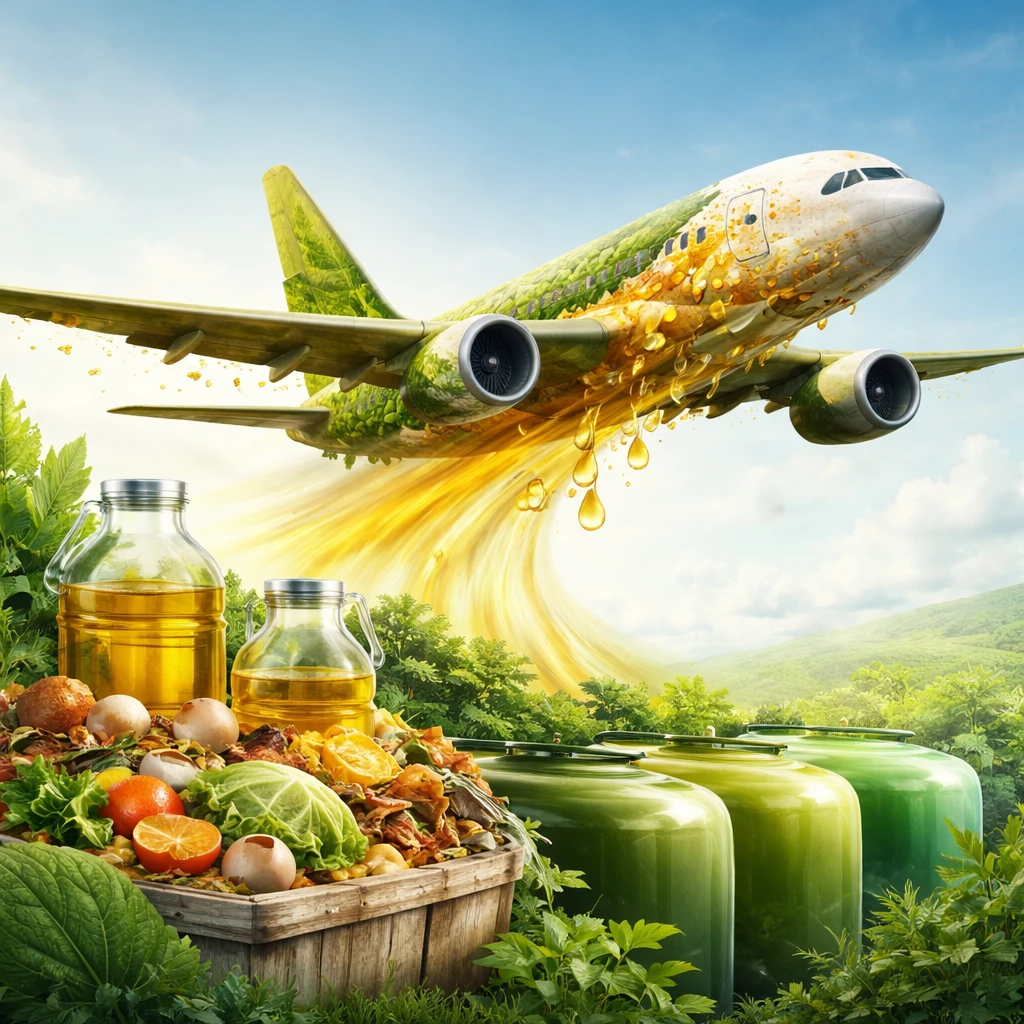
The Future of Air Travel: Sustainable Aviation Fuel from Food Waste
January 5, 2026
Business News

The Future of Air Travel: Sustainable Aviation Fuel from Food Waste

Transforming Culinary Byproducts into Green Energy for Flight

Summary

The aviation industry is exploring sustainable alternatives to traditional jet fuel, with innovations now enabling the creation of sustainable aviation fuel (SAF) derived from waste materials such as used cooking oil. This approach aims to reduce carbon emissions significantly and contribute toward the industry's goal of net-zero emissions by 2050. By repurposing food waste, including cooking oils typically discarded from street food vendors, the sector could revolutionize how airplanes are powered, making air travel more environmentally responsible.

Key Points

Sustainable aviation fuel (SAF) can be produced from waste materials like used cooking oil typically discarded by food vendors.
Utilizing SAF made from food waste helps reduce greenhouse gas emissions compared to traditional fossil-based jet fuel.
The aviation industry aims to achieve net-zero carbon emissions by 2050, with SAF playing a pivotal role in that goal.
Transforming waste into fuel supports circular economy principles by repurposing byproducts that would otherwise contribute to environmental waste.

Amid growing concerns over climate change and the environmental impact of air travel, the aviation sector is advancing efforts to adopt sustainable aviation fuel (SAF) derived from unconventional sources such as used cooking oil and other food waste. This alternative fuel source represents a promising pathway for reducing the aviation industry's carbon footprint while leveraging waste materials that would otherwise contribute to pollution and landfill pressures.

SAF made from waste cooking oils, often sourced from commercial kitchens and street food vendors, embodies the concept of transforming discarded resources into valuable energy. By converting these oils into jet fuel, airlines can significantly cut greenhouse gas emissions compared to fossil-based jet fuels, giving the industry a viable solution to meet stringent environmental targets.

Industry stakeholders, including fuel producers and airline operators, view this innovation as a critical component in the strategy to achieve net-zero carbon emissions by the year 2050. Sustainable aviation fuels produced from waste materials substitute traditional petrochemical fuels, thereby lowering the overall carbon footprint of flights without compromising engine performance or safety standards.

The production process for SAF involves collecting used cooking oils, ensuring they meet quality standards, and processing them to create a fuel that complies with aviation industry specifications. This practice not only offers environmental benefits but also provides a productive use for materials that would typically be considered waste.

Furthermore, sustainable aviation fuel derived from waste aligns with circular economy principles, promoting resource efficiency by repurposing leftovers from the food industry. As the sector advances, collaborations between fuel suppliers, regulatory bodies, and airlines are expected to expand, bolstering the availability and adoption of sustainable fuel options worldwide.

While the use of used cooking oil as a feedstock for SAF is gaining traction, it forms part of a broader landscape of potential waste sources. By tapping into street food waste and other similar byproducts, the industry aims to create scalable solutions to balance demand with environmental responsibility.

Overall, integrating sustainable aviation fuels sourced from food waste into regular airline operations presents a promising advancement toward cleaner air travel. The aviation world’s embrace of these fuels could mark a landmark shift in reducing aviation-related emissions substantially over the next few decades.

Risks
  • Availability and supply limitations of quality used cooking oil and other waste feedstocks could constrain SAF production capacity.
  • Scaling SAF production to meet global aviation fuel demand requires extensive industry coordination and infrastructure development.
  • Cost differentials between SAF and conventional jet fuel may impact the rate of adoption across airlines without supportive policies or incentives.
  • Regulatory and certification processes need to evolve alongside SAF technologies to ensure safety and compatibility with aircraft systems.
Disclosure
Education only / not financial advice
Search Articles
Category
Business News

Business News

Related Articles
ArcelorMittal Advances Green Steel Production with Major Dunkirk Investment

ArcelorMittal's recent announcement of a €1.3 billion investment in an electric arc furnace (EAF) ...

Using Fireplace Ashes in Your Garden: Benefits and Considerations

Amidst a notably cold winter leading to increased fireplace use, many homeowners are seeking sustain...

Why Florida Emerges as a Leading Retirement Destination in 2026

Florida ranks highest among states for retirees in 2026 according to a comprehensive evaluation base...

US Declines to Record Low in Global Public Sector Corruption Rankings

The United States has descended to its lowest ranking ever in Transparency International's Corruptio...

Maximizing Your 401(k): Understanding the Power of Employer Matching

Overestimating investment returns can jeopardize retirement savings. While it's prudent to plan cons...

Commerce Secretary Lutnick Clarifies Epstein Island Lunch Amid Scrutiny Over Relationship

Commerce Secretary Howard Lutnick acknowledged having a family lunch with convicted sex offender Jef...