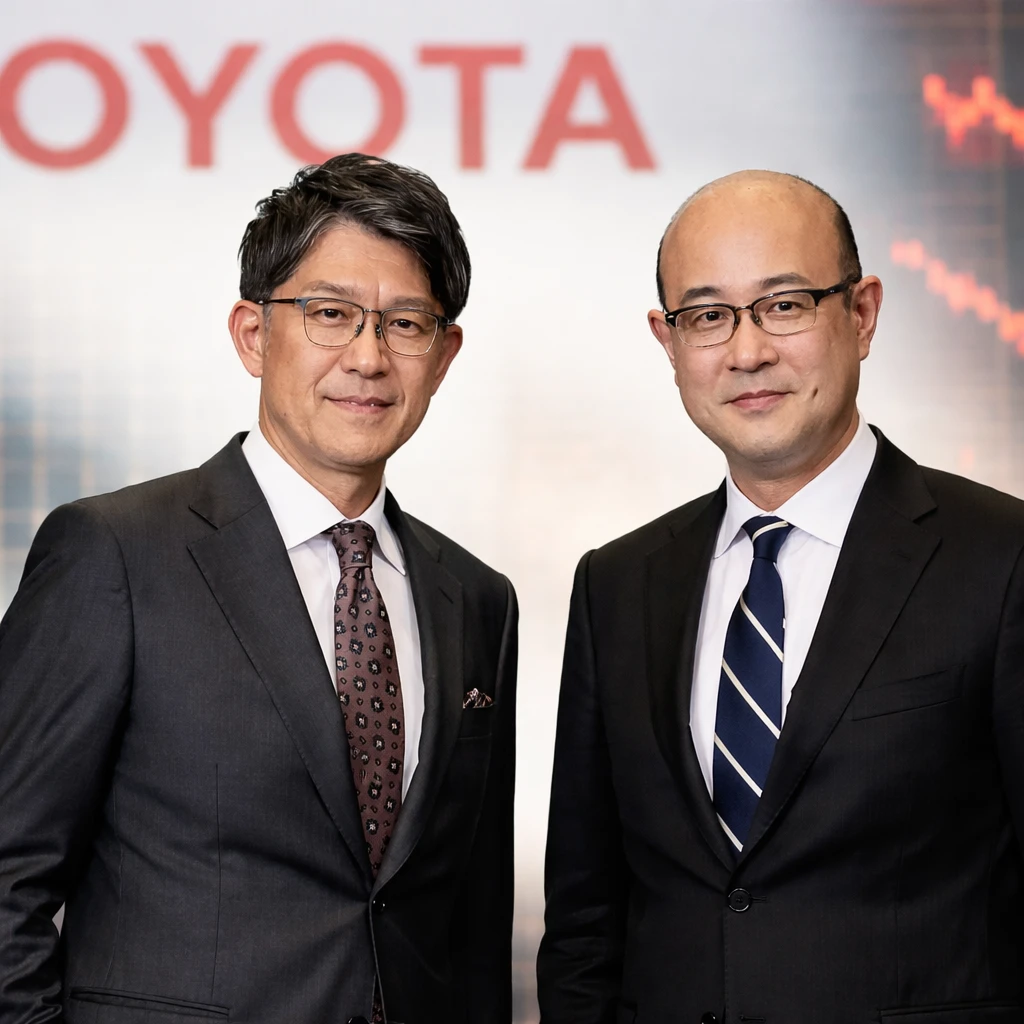

Toyota Motor Corporation reported a 43% decrease in its quarterly profits on Friday, signaling the turbulence the automaker is navigating amidst elevated production costs and external trade pressures. Concurrently, the company announced that its current Chief Financial Officer, Kenta Kon, will assume the role of Chief Executive Officer and President, succeeding Koji Sato effective from April, with shareholder approval anticipated in June.
Koji Sato, who has served as Toyota's CEO for the past three years, characterized the leadership modification as a decisive "shift of gears," emphasizing the company's commitment to advancing its transformation efforts with renewed momentum. Despite stepping down as CEO and president, Sato will remain influential within the corporation as a vice chairman. He will further extend his influence in the automotive sector as the president of the Japan Automobile Manufacturers Association (JAMA) and hold a prominent position within Keidanren, Japan's Business Federation.
Kon brings extensive operational expertise to his upcoming role, having considerable experience spanning areas such as automated driving technologies. His close collaboration with Akio Toyoda, the company's president and grandson of Toyota's founder, positions him uniquely to drive initiatives focused on reversing profit declines and enhancing operational efficiencies.
The broader Japanese automotive industry has been facing their own set of hurdles, primarily due to surging raw material costs and the ramifications of U.S. tariffs imposed under President Donald Trump. Toyota estimates these tariffs contributed to a reduction of approximately 1.45 trillion yen (around 9.2 billion dollars) in operating income over the past year.
Focusing on the quarter from October through December, Toyota's group profit was recorded at 1.25 trillion yen (roughly 8 billion dollars), markedly less than the 2.19 trillion yen in the equivalent quarter of the prior fiscal year. For the full calendar year, the automaker's net earnings slid 26% to 3.03 trillion yen (approximately 19 billion dollars) down from 4.1 trillion yen previously, though revenue experienced nearly a 7% uplift to 38 trillion yen (242 billion dollars) compared to 35 trillion yen the year before.
Globally, vehicle sales surpassed 7.3 million units in the first nine months of the fiscal year, growing from about 7 million vehicles. This expansion was propelled by stronger sales in key markets including Japan, North America, and Europe.
According to Toyota officials, Sato's decision to step down from the CEO position was motivated by the urgency of industry transformation and his additional leadership roles across important automotive and business organizations in Japan. The company emphasized that his departure should not be seen as a response to any internal issues, highlighting that the company's financial trajectory remains solid despite external headwinds largely beyond its control.
Kon acknowledged that while Toyota's workforce is dedicated and responsible, organizational agility needs enhancement. He voiced that the company has been traditionally conservative in modifying systems that have historically proven effective but now require adaptation to evolving market realities.
Headquartered in Toyota City, central Japan, the automaker updated its full-year profit forecast to 3.57 trillion yen (about 22.8 billion dollars), reflecting a 25% decline compared to the previous year. Following these announcements, Toyota's shares traded on the Tokyo Stock Exchange experienced a 2% increase on Friday.
Emphasizing future direction, Toyota indicated the necessity of strengthening collaborations within the industry and expanding partnerships beyond traditional automotive circles to successfully evolve into a comprehensive mobility enterprise.