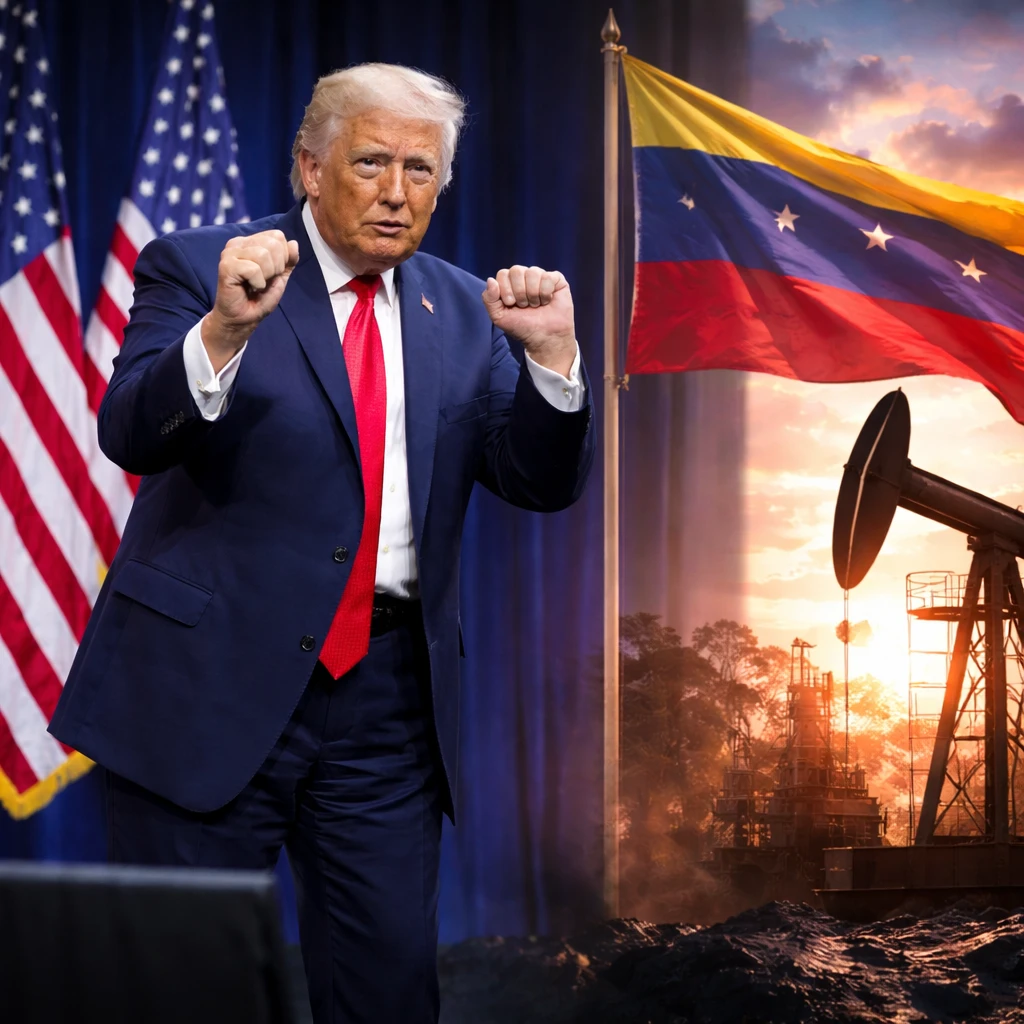
Caracas, Venezuela – In a bold announcement on Tuesday, US President Donald Trump stated that Venezuela is set to provide the United States with between 30 and 50 million barrels of oil, with transactions to be conducted at prevailing market prices. Trump emphasized that proceeds from these oil sales would be directed to benefit citizens of both countries.
The White House is organizing a high-profile meeting scheduled for Friday that will bring together top executives from US oil majors ExxonMobil, Chevron, and ConocoPhillips. The focus of the discussions will be strategies to encourage Venezuela to open its extensive—but currently underperforming—oil industry to greater American investment and technological expertise. A source familiar with the planning, who preferred to remain anonymous, confirmed the participation of these oil companies.
This announcement emerges amid heightened tensions following a nighttime US military operation aimed at capturing Venezuelan President Nicolás Maduro. Officials in Caracas reported that at least 24 Venezuelan security officers were killed during the operation, which also involved Maduro being whisked to the US to face drug trafficking charges. Amid this turmoil, Venezuela's acting president, Delcy Rodriguez, strongly rebuffed Trump's earlier warnings, which had cautioned her about facing outcomes more severe than Maduro’s if she did not implement reforms aligning Venezuela with US interests, including granting access to American energy firms.
Rodriguez addressed agricultural and industrial leaders on Tuesday, asserting, “Personally, to those who threaten me: My destiny is not determined by them, but by God.” Her remarks reflect the government’s resistant stance amid escalating diplomatic pressures.
Venezuela’s Attorney General, Tarek William Saab, indicated that the weekend raid in Caracas resulted in the deaths of “dozens” of officers and civilians, characterizing the attack as a potential “war crime” under investigation. Specific details about the nationalities of the casualties were not provided.
Additionally, Cuba's government confirmed that 32 Cuban military and police personnel serving in Venezuela were killed during the raid. These individuals belonged to Cuba's main security institutions: the Revolutionary Armed Forces and the Ministry of the Interior.
The US Department of Defense reported that seven American service members sustained injuries during the mission. Five have since returned to duty, while two remain recuperating from gunshot and shrapnel wounds, according to an unnamed US official who was not authorized to comment publicly.
An Instagram tribute by the Venezuelan military commemorated the fallen security officers with somber images paired with footage of American aircraft over Caracas and damaged armored vehicles. Streets in Caracas, previously deserted following Maduro’s removal, briefly filled with government supporters waving national flags and celebrating through state-organized patriotic events.
The military’s Instagram statement emphasized that the fallen’s blood demands justice rather than vengeance and reaffirmed a commitment to rescue their legitimate president and eliminate foreign-backed terrorist groups operating within Venezuela.
In the energy realm, with global oil prices hovering around $56 per barrel, the announced oil supply from Venezuela to the US could represent a transaction value up to $2.8 billion. The United States consumes approximately 20 million barrels of oil and related products daily, making Venezuela’s contribution roughly equivalent to two and a half days of US supply, based on data from the US Energy Information Administration.
Despite boasting the world's largest proven crude oil reserves, Venezuela's current production averages roughly one million barrels per day, a figure considerably lower than the United States’ output, which reached nearly 13.9 million barrels per day in October.
Requests for comment to Venezuela’s government media office regarding Trump’s oil transaction announcement were not immediately answered.
Separately, ExxonMobil is actively developing a significant offshore oil deposit near Guyana, Venezuela’s eastern neighbor. This discovery, first made in 2015, prompted Venezuela to reignite a longstanding territorial dispute, claiming about two-thirds of Guyana's landmass, known as Essequibo. The Venezuelan government has recently accused Guyana's leadership and ExxonMobil of activities undermining Venezuelan sovereignty and, in a show of resistance, lawmakers previously contemplated banning Venezuelan operations by oil firms associated with Guyana.
Earlier on Tuesday, Trump responded to Democratic criticisms regarding the recent US military operation in Venezuela by highlighting that former President Joe Biden also supported Maduro’s arrest on drug trafficking charges. Trump lamented the lack of bipartisan acknowledgment for the operation, asserting that although their political philosophies differ, recognition of effectiveness would be commendable.
Maduro was federally indicted in the US in 2020 on charges related to a longstanding conspiracy of narcotics trafficking and narco-terrorism. White House officials emphasized that the Biden administration increased the reward for information leading to Maduro’s arrest following his contentious third-term inauguration, despite evidence suggesting election irregularities. As of August, the reward stands at $50 million.
Public opinion on the capture of Maduro is divided. According to a Washington Post and SSRS poll conducted through text messaging over the weekend, approximately 40% of Americans approved of the US military action, while a similar proportion opposed it. Meanwhile, 20% remained uncertain. Furthermore, nearly 45% of respondents opposed US intervention to govern Venezuela or select new leadership, with nearly 90% asserting that Venezuelans themselves should decide their country's future.
After pleading not guilty to US federal drug trafficking charges on Monday, Maduro and his wife were apprehended early Saturday in a raid surrounded by Cuban security personnel.
Following Maduro’s detention, Trump and administration officials expressed concerns about a potentially more interventionist US foreign policy in the Western Hemisphere. In recent days, Trump renewed calls for the US acquisition of Greenland for security reasons and issued military threats against Colombia, accusing its government of enabling global cocaine sales. Concurrently, the US Department of State declared that Cuba’s communist regime is facing significant challenges.
In diplomatic responses, Colombia’s Foreign Affairs Minister Rosa Villavicencio announced plans to formally address the US Embassy regarding the recent threats against Colombia. She emphasized Colombia's ongoing efforts in combating drug trafficking and expressed a desire for stronger bilateral cooperation.
European leaders from France, Germany, Italy, Poland, Spain, and the United Kingdom, alongside Danish Prime Minister Mette Frederiksen, affirmed Greenland’s sovereignty, underscoring that decisions regarding Greenland rest exclusively with Denmark and Greenland themselves, highlighting its status as a self-governing territory within NATO.