
The World Economic Forum in Davos, Switzerland, concluded after a week marked by a contrast in thematic focus among participants. On one side, global industry executives displayed enthusiasm for leveraging artificial intelligence (AI) to enhance productivity and profitability, alongside an increasing investment surge in renewable energy spearheaded by China.
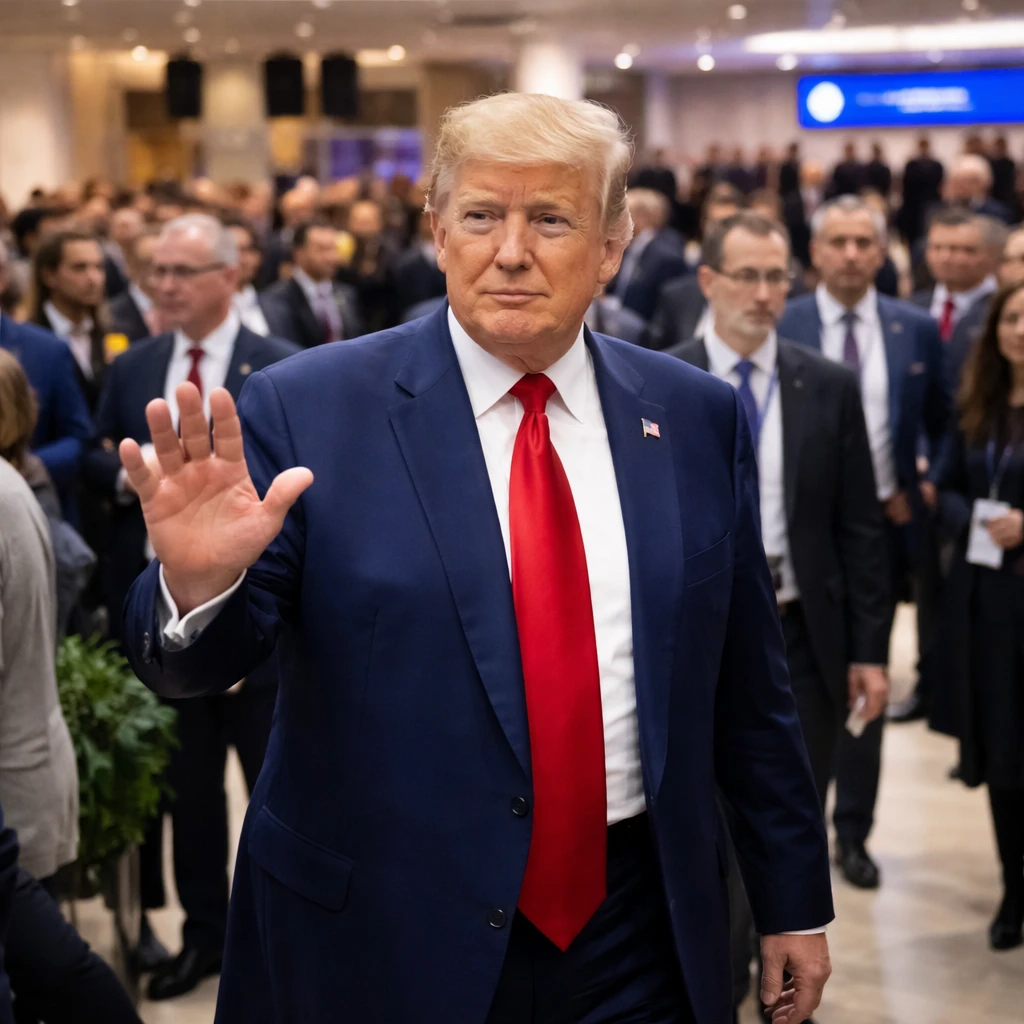
Contrasting with these discussions, the political arena was notably influenced by former U.S. President Donald Trump's appearance, which drew considerable attention and debate. Political observers noted that the forum seemed divided into two concurrent narratives: a forward-looking industrial sector conversation and a geopolitical dialogue dominated by Trump.
During his third visit to Davos as a sitting president, Trump participated in a whirlwind 24-hour visit. His address was characterized by a broad scope and included emphatic statements emphasizing America's position on the global stage. However, this delivery was seen by some as meandering and marked by hyperbole, differing in tone from previous visits where Trump engaged amicably with the corporate crowd.
California Governor Gavin Newsom expressed criticism of Trump during media engagements at the Congress Center, highlighting discord between political figures present at the forum.
Conversely, international leaders such as NATO Secretary General Mark Rutte and Ukrainian President Volodymyr Zelenskyy commended Trump’s efforts to end the conflict in Ukraine. They acknowledged his role in enhancing Western defense initiatives and securing commitments that bolster Kyiv’s security.
Despite accolades, a prevailing narrative at Davos focused on the widening rift between the United States under Trump and its Western partners. Canadian Prime Minister Mark Carney described the division as an irreparable "rupture," underscoring concerns over transatlantic relations.
Leading up to his Davos appearance, Trump stirred tensions by proposing tariffs on eight European nations in response to their opposition to his Greenland acquisition plan. Greenland, a semiautonomous territory affiliated with NATO member Denmark, was the subject of a controversial takeover bid. This proposal elicited significant backlash domestically and internationally.
By midweek, Trump retreated from his initial stance in a notable reversal, shortly after assertive claims over the desire for full ownership of the island. On his social media platform, Trump announced an agreement with NATO’s Rutte establishing a framework for future Arctic security cooperation, potentially easing strained relations stemming from the dispute.
In efforts to contribute to peace initiatives, Trump introduced the "Board of Peace," intended to facilitate a ceasefire in the ongoing Israel-Hamas conflict and support the reconstruction and planning of Gaza’s future. The initiative gained endorsements from diverse nations including Belarus, Kosovo, Indonesia, and Argentina.
Nonetheless, long-term U.S. allies in Europe expressed reservations about the proposal, disputing Trump’s assertion that the Board might one day rival the United Nations. Critics criticized the lack of operational details and suggested reinforcing existing U.N. mechanisms as a preferable approach.
Agnes Callamard, Amnesty International’s Secretary-General, commented that the initiative appeared to attempt an outdated replication of international peace structures without offering substantive progress compared to historical efforts in the 1940s.
Aside from geopolitics, AI featured prominently as a potent topic. High-profile figures such as billionaire entrepreneur Elon Musk and Nvidia CEO Jensen Huang attended Davos for the first time. Musk, who previously labeled the event as "boring," arrived with limited notice to discuss the implications of robotics, AI’s energy consumption, and to subtly critique the Trump administration’s tariffs on Chinese solar panel imports.
Huang addressed job displacement concerns linked to the AI revolution, arguing that the technology boom would stimulate employment opportunities in sectors responsible for developing AI infrastructure, such as electrical work, construction, steel production, and network maintenance.
The intensifying U.S.-China rivalry was echoed by Anthropic CEO Dario Amodei, who likened a U.S. government decision to permit sales of advanced Nvidia chips as analogous to distributing nuclear weapons to North Korea, revealing the complex and sensitive geopolitical dimensions of AI technology dissemination.
Despite these challenges, the sentiment among technologists and business leaders was predominantly optimistic, aligning with the forum’s guiding principle of fostering dialogue to improve global conditions rather than succumbing to pessimism.
Davos co-chair Larry Fink, who chairs BlackRock, highlighted this mood at the event’s closing ceremony by quoting Elon Musk: "It’s better to be an optimist and wrong than be a pessimist who’s right," encapsulating the hopeful outlook prevalent among the gathering.