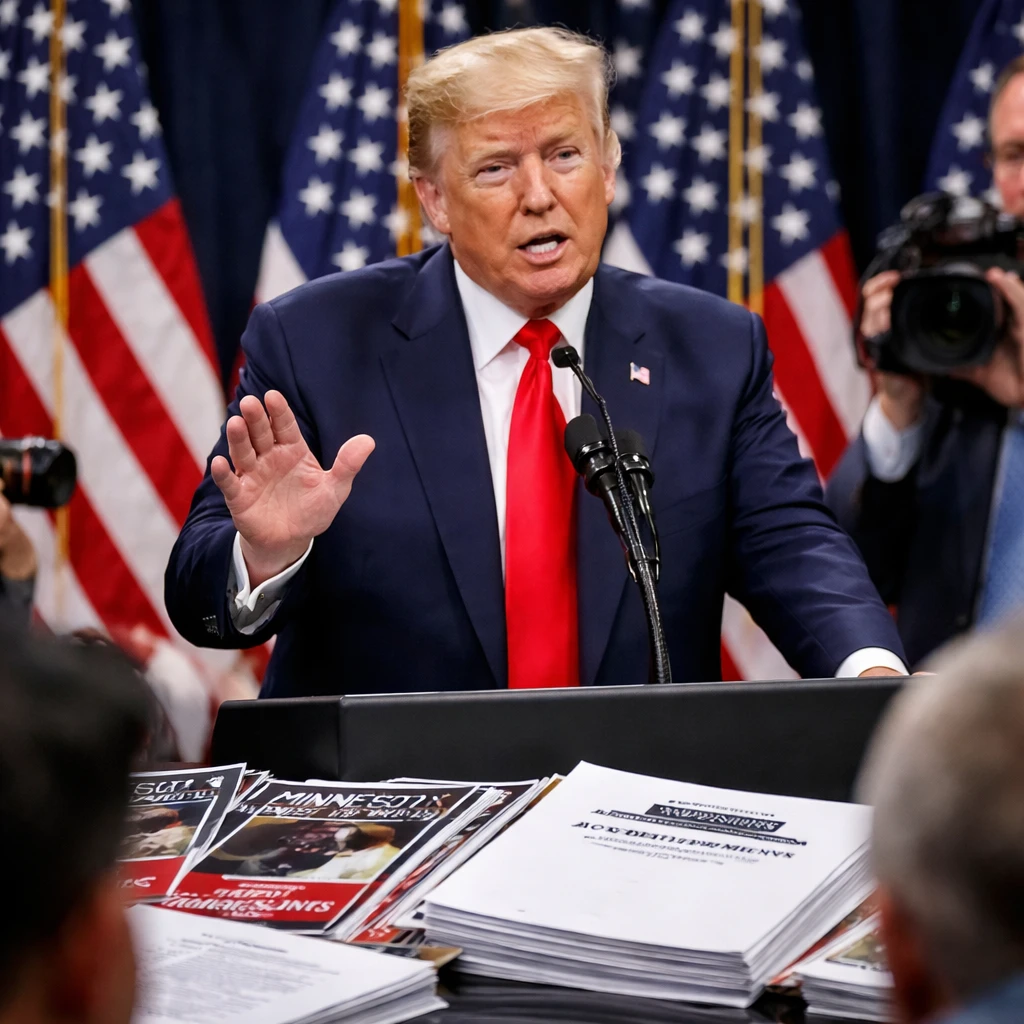

President Donald Trump commemorated his first year back in the White House with a lengthy press conference lasting almost two hours, during which he recapitulated his administration's purported achievements. A significant portion of the session was characterized by reiterations of prior unsubstantiated claims distributed throughout 2025, spanning critical issues such as the legitimacy of the 2020 election, diplomatic accomplishments, economic conditions, and energy sector developments.
Assertions on the 2020 Presidential Election
In addressing former President Joe Biden, Trump asserted, "... a man that didn’t win the election, by the way, it’s a rigged election. Everybody knows that now." This statement, however, contradicts verified electoral outcomes.
Verification: The claim that the 2020 election was stolen lacks support and has been repeatedly debunked. Joe Biden secured 306 electoral votes against Trump’s 232, alongside a popular vote margin exceeding seven million ballots. Moreover, Biden’s Electoral College victory margin closely mirrors Trump’s own 2016 win over Hillary Clinton, where Trump claimed 306 votes to Clinton’s 232 (adjusted to 227 after elector defections). Key battleground states including Pennsylvania, Michigan, Wisconsin, Arizona, and Georgia favored Biden in that election.
Despite these facts, Trump has consistently maintained the assertion of his victory in 2020, extending this narrative even after his reelection in 2024 and as the 2026 midterm elections approach.
These allegations of widespread voting fraud have been refuted by numerous judicial rulings, authoritative state election officers, and even the Department of Homeland Security under Trump’s own administration. Notably, then-Attorney General William Barr affirmed in 2020 that no substantial evidence exists to support allegations of fraud capable of altering the election’s outcome.
International Conflict Resolutions: Realities vs. Claims
Trump claimed credit for mediating and resolving eight wars, listing conflicts involving Israel, Hamas, Iran, Egypt, Ethiopia, India, Pakistan, Serbia, Kosovo, Rwanda, Congo, Armenia, Azerbaijan, Cambodia, and Thailand.
Analysis: While Trump has engaged in diplomatic efforts and some agreements, the portrayal of completely settling these conflicts is overly optimistic and lacks nuance. For example:
- The conflict between Israel and Hamas remains unsettled, with ongoing tensions and violence.
- Trump’s influence in ending the 12-day Israel-Iran confrontation is regarded by some as a temporary cooling rather than a definitive resolution.
- Recent hostilities have reignited in regions such as Cambodia-Thailand and within the Congo-Rwanda dynamic.
- A peace agreement between Armenia and Azerbaijan was signed but awaits parliamentary endorsement and formal treaty ratification.
- The ceasefire between India and Pakistan, following heightened conflict near Kashmir, saw disputed claims regarding the U.S. role in brokering calm, with Pakistan expressing gratitude and India denying such involvement.
- Tensions between Egypt and Ethiopia over the Grand Ethiopian Renaissance Dam persist without crossing into open warfare.
- Serbia-Kosovo relations have remained stable without reported conflicts during Trump’s recent tenure, and no significant advances attributed to him are observable.
Overall, these facts underscore the complexity of international disputes and the gap between singular diplomatic achievements and enduring peace.
Economic Condition and Inflation Commentary
Addressing inflation, Trump remarked, "We inherited, remember this — inflation was at a historic high. We had never had inflation like that. They say 48 years. But whether it’s 48 years or ever, we had the highest inflation, in my opinion, that we’ve ever had."
Contextual Facts: The inflation surge peaking at 9.1% in June 2022 under Biden’s administration was influenced by disrupted supply chains, extensive government relief programs, and the economic impact of the Russia-Ukraine conflict. Despite its severity, this peak is not unprecedented:
- Higher inflation rates above 13% were recorded during 1980's economic period marked by prolonged price increases.
- Estimates suggest inflation neared 20% during World War I.
During Trump's current term, inflation initially depressed but subsequently increased after tariffs were implemented in April, with rates reported at 2.7% as of December 2025.
Energy Policy Assertions: The Case of Coal
On coal, Trump stated, "I say clean, beautiful coal. I never say the word coal, it has to be preceded by the words clean, beautiful coal."
Scientific Observations: Although coal production now features reduced emissions compared to historical levels, it remains environmentally detrimental. According to the U.S. Energy Information Administration (EIA), while carbon dioxide emissions from coal have declined over the past three decades, coal combustion still releases significant pollutants such as sulfur dioxide and nitrogen oxides, contributing to acid rain, smog, and respiratory health problems.
Globally, United Nations-supported research advocates for substantial reductions in coal use to mitigate climate change. In the U.S., coal's share of electricity generation has decreased from over 50% in earlier decades to approximately 15% today, reflecting an energy landscape shift toward cleaner sources.
California Wildfires and Water Supply Controversies
Commenting on the aftermath of the 2025 Los Angeles wildfires and reconstruction efforts, Trump claimed the destruction of over 20,000 homes was linked to water shortages stemming from policies protecting endangered species, particularly citing the diversion of water to the Pacific Ocean to protect a "tiny little fish," a reference to the Delta smelt.
Fact Check: Emergency officials contest that fire hydrant dry-outs during the wildfires resulted not from state water policies but from infrastructural limitations—municipal water systems were ill-equipped for catastrophic fire conditions. Furthermore, water released from dams in California’s Central Valley was directed to an arid lake basin far from Los Angeles, not supplying the city as implied by Trump.
California's water originates primarily from northern mountain snowmelt, funneled via rivers into the Sacramento-San Joaquin River Delta and then conveyed southward through complex federal and state-managed canal systems to serve agricultural and urban needs. Importantly, there is no water pipeline connecting the Pacific Northwest directly to California's supply network, countering the narrative presented.
In conclusion, President Trump's recounting of his 2025 year in office encompasses recurring inaccuracies on pivotal subjects including election legitimacy, peace diplomacy, economic inflation, energy utilization, and environmental resource management. These claims warrant critical examination to ensure public discourse is informed by accurate and contextualized information.