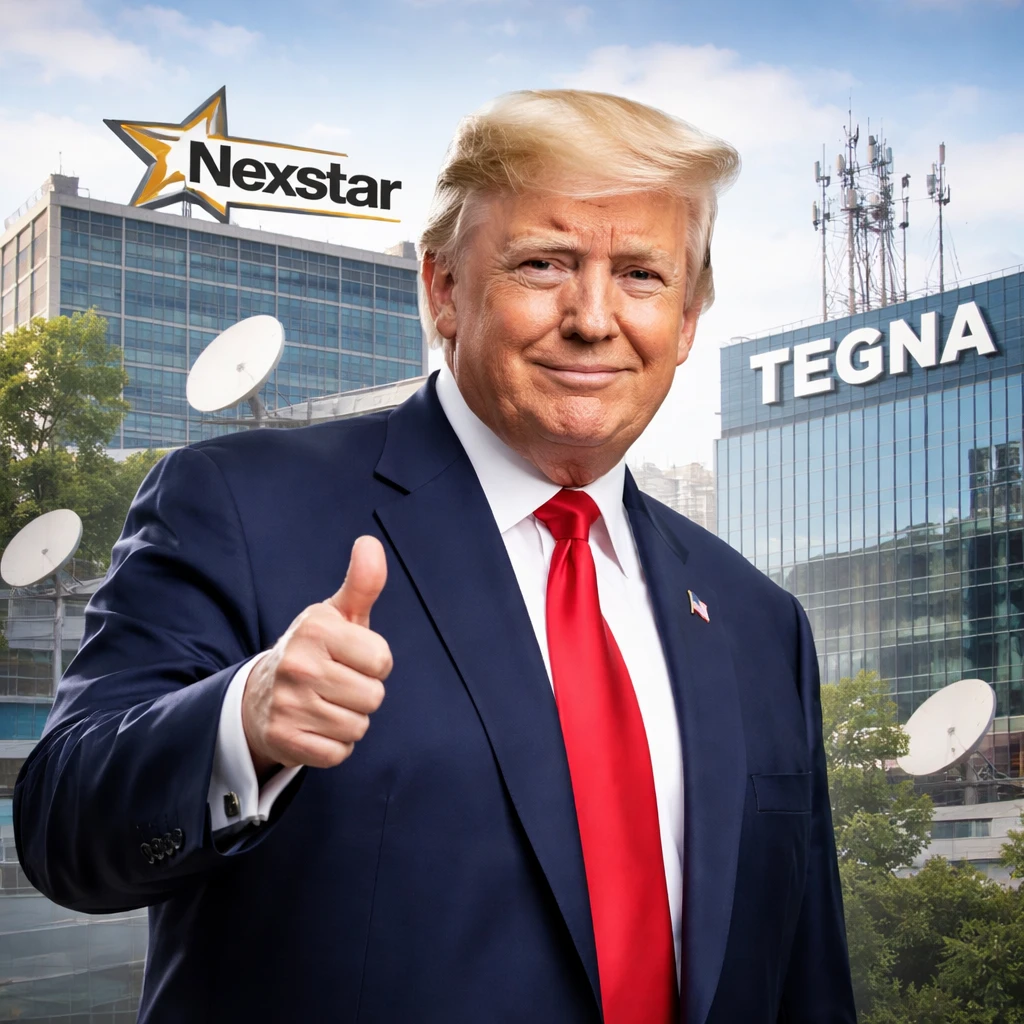

Trump Shifts Stance to Support Nexstar’s $6.2 Billion Acquisition of Tegna
February 7, 2026
News & Politics

Trump Shifts Stance to Support Nexstar’s $6.2 Billion Acquisition of Tegna

President endorses broadcast media consolidation amid regulatory changes

Summary

President Donald Trump has publicly reversed his position on Nexstar Media Group's proposed $6.2 billion acquisition of broadcast firm Tegna, emphasizing the benefits of increased competition in local television markets. The deal, which still awaits regulatory clearance, would combine two major players in regional media, with Nexstar managing over 200 stations and Tegna owning 64 stations. This move aligns with the Trump administration’s deregulatory agenda concerning broadcast ownership rules.

Key Points

President Trump publicly supports Nexstar’s $6.2 billion acquisition of Tegna, reversing previous criticisms.
The merger would create a combined entity controlling over 260 local broadcast stations across more than 100 markets.
The acquisition aligns with the Trump administration’s deregulatory policies and FCC efforts to relax local TV ownership rules, aiming to enhance competitiveness against large tech and media companies.

In a notable development on Saturday, President Donald Trump voiced support for Nexstar Media Group's $6.2 billion deal to acquire Tegna, a fellow broadcaster. This marks a reversal from his earlier reservations expressed in November, signaling a shift towards endorsing the consolidation.

Trump’s endorsement came through social media, where he highlighted the deal's potential to increase competition against what he refers to as "THE ENEMY," a term he uses for mainstream national TV news networks. He asserted that allowing transactions like the Nexstar-Tegna merger would promote competition and help curb the influence of what he describes as "Fake News." His message included a call to finalize the agreement: "GET THAT DEAL DONE."

The announced acquisition, publicized by Nexstar in August, is currently pending regulatory approval. If completed, it would integrate Nexstar's extensive portfolio of over 200 owned and partner television stations across 116 markets nationwide, and its operation of networks such as The CW and NewsNation, with Tegna's ownership of 64 news stations in 51 markets.

Earlier in November, Trump had expressed concerns that the acquisition might enable the expansion of "Radical Left Networks," indicating potential displeasure with the deal at that time. However, the companies involved operate independently from the major broadcast networks like ABC and NBC, which are typically associated with national programming.

Moreover, in September, Nexstar, alongside Sinclair Broadcast Group—a network known for its right-leaning editorial slant—implemented a temporary suspension of Jimmy Kimmel's ABC late-night talk show. This decision followed Kimmel’s commentary on the assassination of conservative activist Charlie Kirk, underscoring Nexstar’s distinct operational stance within the broadcast ecosystem.

Concurrently, the Federal Communications Commission (FCC) is pursuing rule reforms targeting the ownership limitations on local television stations. Several court rulings have also invalidated prior regulations that restricted the number of top-rated stations a single company can control within a market, potentially facilitating larger media consolidations.

In framing the purchase of Tegna, Nexstar has positioned its strategy to resonate with the deregulatory initiatives of the current administration. Perry Sook, Nexstar’s CEO, stated at the deal’s announcement that these governmental efforts "offer local broadcasters the opportunity to expand reach, level the playing field, and compete more effectively with the Big Tech and legacy Big Media companies that have unchecked reach and vast financial resources." This statement situates the merger within the broader challenge local broadcasters face in competing with dominant digital and traditional media giants.

Risks
  • Regulatory approval remains pending for the Nexstar-Tegna transaction, introducing uncertainty to the deal’s completion.
  • Potential political and public backlash could arise from concerns over media consolidation and its impact on market diversity.
  • Changes in FCC regulations and court rulings create a shifting legal landscape that could alter market dynamics and ownership limits.
Disclosure
This article is an independent analysis and does not comprise investment advice. Readers should consider the regulatory environment and market factors impacting broadcast media consolidation.
Search Articles
Category
News & Politics

News & Politics

Related Articles
FDA Initiates Review of BHA Food Additive Safety

The U.S. Food and Drug Administration (FDA) has announced plans to conduct a comprehensive reassessm...

Partisan Divide Deepens as White House Excludes Democratic Governors from NGA Meeting

The longstanding bipartisan forum of the National Governors Association (NGA) is facing disruption a...

Paramount Enhances Hostile Proposition to Thwart Netflix-Warner Bros. Discovery Merger

Paramount Pictures has escalated its aggressive pursuit to acquire Warner Bros. Discovery by introdu...

Treasury Secretary Highlights Urgency for Crypto Regulatory Clarity Amidst Coinbase Opposition

In light of recent fluctuations in cryptocurrency markets, U.S. Treasury Secretary Scott Bessent emp...

U.S. Risks Losing Edge in AI Innovation Due to Fragmented Regulation, Warns White House AI Coordinator

David Sacks, the White House AI and crypto coordinator, cautioned that the United States might fall ...

Commerce Secretary Lutnick Clarifies Epstein Island Lunch Amid Scrutiny Over Relationship

Commerce Secretary Howard Lutnick acknowledged having a family lunch with convicted sex offender Jef...