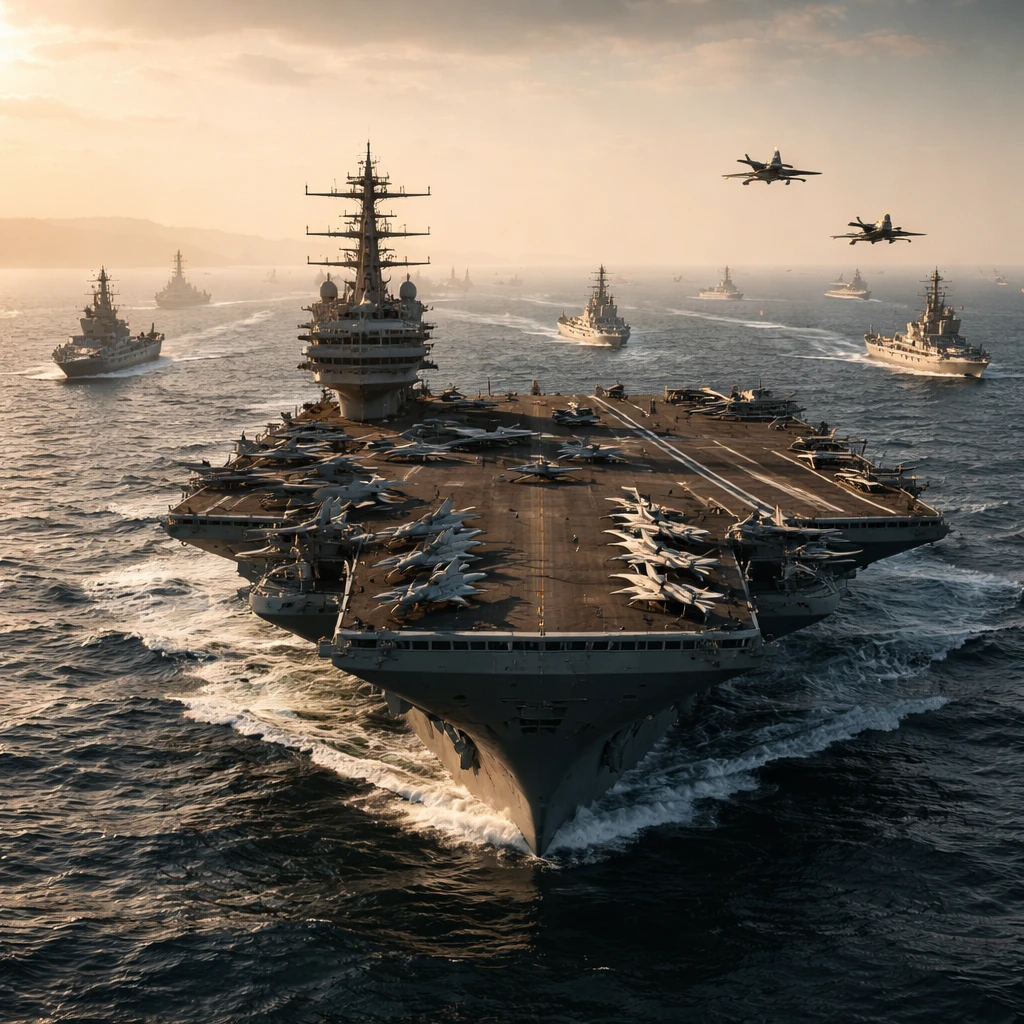

In a notable escalation of military positioning near the Islamic Republic of Iran, the United States has dispatched a substantial naval force, reflecting strategic maneuvers reminiscent of prior operations in the Caribbean. Central to this latest deployment is the arrival of the USS Abraham Lincoln aircraft carrier strike group, which, along with added destroyers, strengthens the operational capabilities of the U.S. Central Command (Centcom) responsible for the Middle East region.
This continued military buildup incorporates not only a significant naval presence but also a sizable complement of personnel, with approximately 15,000 service members stationed throughout the region. Complementary to ground forces, the U.S. has augmented its air power by deploying additional fighter jets, advanced air defense systems, and unmanned aerial vehicles (drones), enhancing its readiness for both defensive posturing and potential offensive operations.
The strategy deployed near Iran draws parallels with an earlier approach executed in the Caribbean region earlier this year. In that context, a coordinated effort involving multiple warships and Special Forces led to the capture of Venezuelan leader Nicolás Maduro. Observers note the similarities in force composition and positioning, suggesting a comparable intent to apply pressure on Iran through a demonstration of military strength.
U.S. President Donald Trump has articulated clear demands directed at Iran, including calls to cease uranium enrichment activities, to limit the scope of its ballistic missile development, and to sever connections with proxy groups characterized as terrorist organizations. However, Iranian authorities have yet to acquiesce to these stipulations, maintaining their existing programs and associations.
Beyond naval deployments, the U.S. maintains a considerable military footprint across various Middle Eastern countries. Troops are actively stationed in locations including Syria, Iraq, Kuwait, Bahrain, Qatar, Jordan, and Israel. This broad deployment underlines the strategic depth and complexity of U.S. operations in the region, affording multiple points of access and control that can support a range of military initiatives.
Military analysts highlight that this extensive positioning gives U.S. forces numerous assets and redundancies, enabling a variety of offensive options. Should President Trump authorize an attack against Iranian targets, the focus could encompass a range of strategic sites, including those safeguarding air defense systems, ballistic missile facilities so vital for Iran’s second-strike capability, drone production centers critical to unmanned reconnaissance and attack, deployments of the Islamic Revolutionary Guard Corps ground forces, and potentially high-profile leadership nodes.
Despite the substantial military escalation, diplomatic complexities persist within the U.S. alliance structure in the region. Notably, strategic partners such as the United Arab Emirates and Saudi Arabia have publicly distanced themselves from supporting any direct U.S. military action against Iran. This reticence adds layers of geopolitical complexity and raises the logistical challenge of accessing Iranian targets.
To conduct potential strikes within Iranian territory, U.S. forces would likely require overflight permissions and operational access through the airspace of countries like Syria, Iraq, and Jordan. Securing such access is a nontrivial aspect of campaign planning and could affect the timing and scope of any potential offensive.
The military buildup around Iran represents a tangible change in U.S. foreign policy strategy, moving from posture and deterrence toward a more probable readiness for active engagement. Drawing on a strategy previously demonstrated during operations in the Caribbean, the Trump administration appears to be signaling a willingness to escalate pressure to enforce demands on Iran’s nuclear and military programs.
This approach carries significant implications for regional stability across the Middle East and bears weight on global markets, particularly in sectors sensitive to conflict-induced disruptions such as global oil supplies. The lack of unanimous regional support and the inherent risks involved contribute to an environment of heightened uncertainty regarding the future trajectory of U.S.-Iran relations and the prospects for peace or conflict escalation.