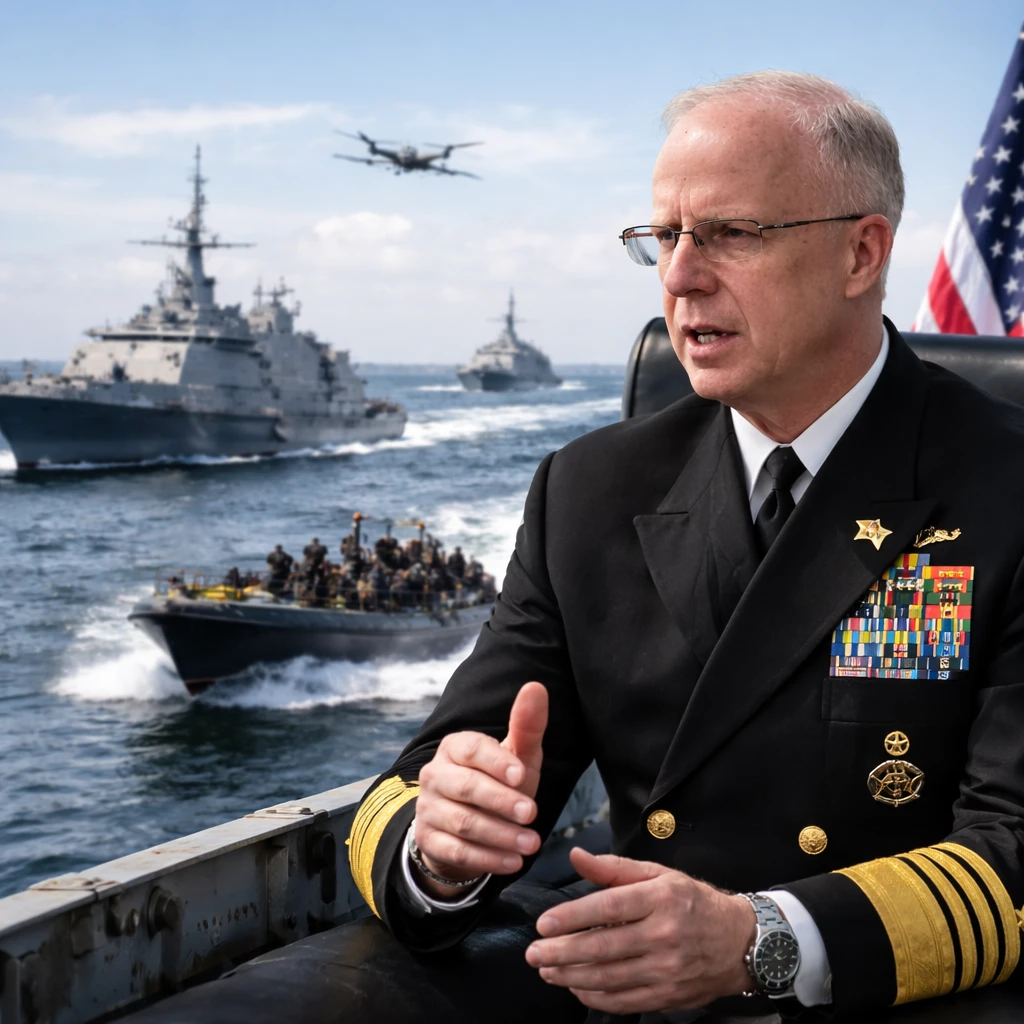

In Washington, the U.S. Navy’s highest-ranking uniformed officer, Admiral Daryl Caudle, outlined a groundbreaking strategic shift away from the traditional dependence on large aircraft carriers for responding to military crises. This initiative is aimed at presenting a more agile and adaptable naval force.
Admiral Caudle referred to his framework as the “Fighting Instructions,” which promotes the deployment of smaller, more specialized groups of ships and assets. He emphasized that this approach would enable the Navy to tailor its presence according to specific regional demands rather than repeatedly relying on the sizable carrier strike groups common in recent military postures, such as those observed during the latest American military actions near Venezuela and Iran.
This revised doctrine arises in the context of the Trump administration's recent decisions to dispatch aircraft carriers and other naval vessels globally to address emergent security challenges. Such redeployments have disrupted planned naval rotations and imposed significant strains on naval resources and maintenance schedules.
One prominent example includes the USS Gerald R. Ford, the world’s largest aircraft carrier, which was redirected late last year from the Mediterranean to the Caribbean. Its crew played a role in a notable operation involving the capture of former Venezuelan President Nicolás Maduro. Similarly, the USS Abraham Lincoln was rapidly moved from the South China Sea to the Middle East in response to increasing tensions with Iran.
Admiral Caudle revealed that his strategy is in consultation with regional commanders, specifically the head of U.S. Southern Command responsible for the Caribbean and Venezuela. They are collaborating to define precise challenges and develop matching naval packages that leverage smaller ships and focused resources, enhancing responsiveness without overextending heavier assets.
Discussing operations in the Caribbean, Caudle envisages a mission emphasizing interdiction and continuous surveillance of commercial vessels. The U.S. has seized numerous tankers operating under suspicious or false flags linked to Venezuela, which are part of a broader network aiding states in circumventing sanctions. According to Caudle, such tasks can be effectively accomplished without deploying carrier strike groups, instead using littoral combat ships, naval helicopters, and close cooperation with the Coast Guard.
Presently, an unusually large contingent of 11 Navy ships, including the USS Gerald R. Ford and several amphibious assault vessels carrying Marines, are deployed in South American waters. This marks a significant departure from past norms where only one or two smaller vessels would patrol these regions. Caudle points out that frequent operations by numerous destroyers mainly to monitor shipping traffic are inefficient for the mission's nature, highlighting a mismatch between asset size and operational needs.
In parallel with scaling down physical naval platforms for such missions, Caudle advocates for enhanced utilization of drones and robotic systems to offer commanders equivalent operational capabilities with decreased reliance on large ships. He recognizes the challenge in adapting military command structures and educating personnel to request and integrate these new technologies effectively, underlining a need for extensive training and procedural evolution.
The naval strategy contrasts with the preceding administration's preference for conspicuous shows of force, including extensive use of aircraft carrier groups and proposals for a new class of heavily armed battleships featuring advanced weaponry like hypersonic and nuclear missiles, railguns, and high-powered lasers. However, these ambitious shipbuilding plans have encountered significant technical and budgetary hurdles.
Admiral Caudle offered a hypothetical scenario to illustrate his model: if the USS Abraham Lincoln is redeployed from a particular area, he would coordinate an alternative three-ship group to cover its responsibilities, maintaining operational continuity with a more nimble and efficient force structure.
He highlighted that his tailored force package concept has been effectively applied in Europe and North America over recent years and suggested its suitability for intensifying strategic interests in other areas like the Arctic, where competition among the U.S., Russia, and China is increasing. Caudle also mentioned the need to provide commanders in such regions with more viable options for maritime security and presence, asserting that his approach offers practical solutions to emerging challenges.