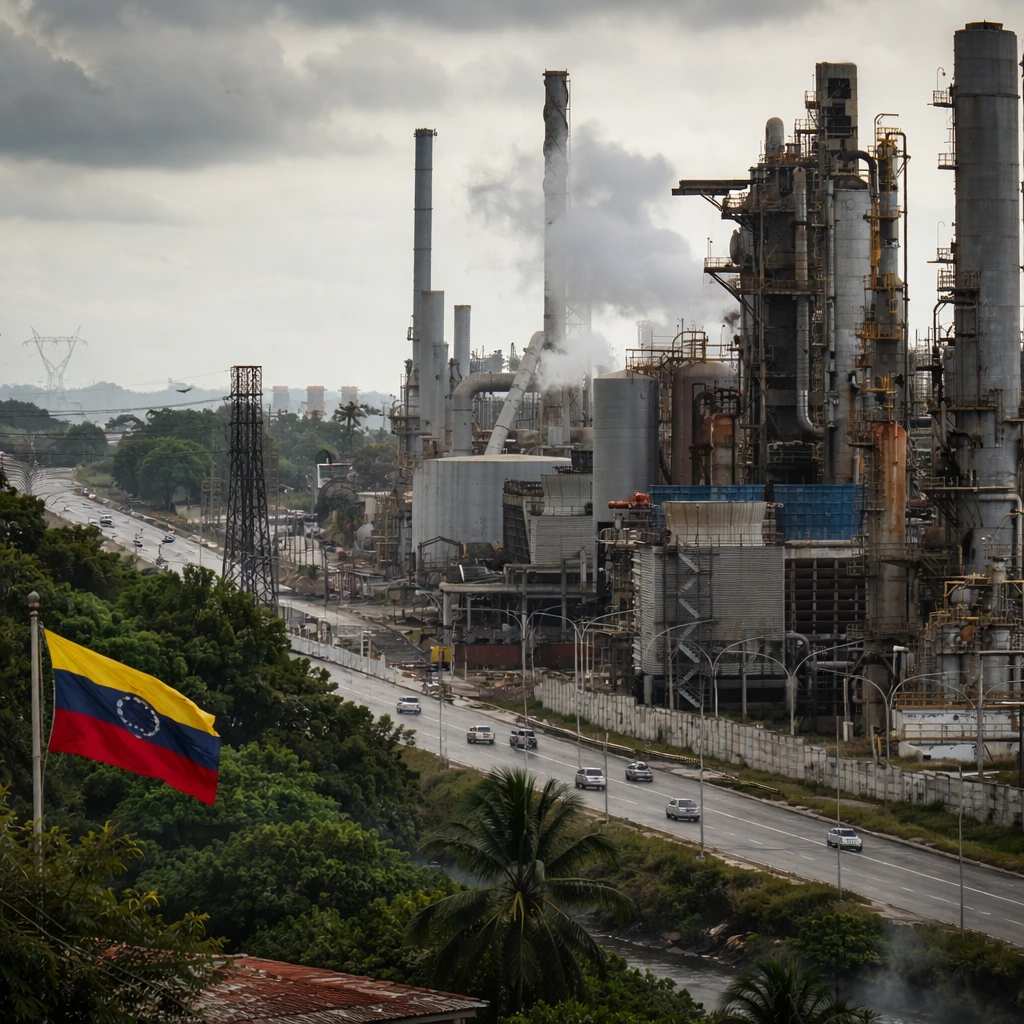

The recent declaration by President Donald Trump regarding American control over Venezuela's oil industry and the proposal to have US companies rehabilitate the sector following the capture of President Nicolás Maduro is unlikely to trigger immediate changes in global oil prices. Venezuela's petroleum infrastructure has suffered severe deterioration due to prolonged neglect and international sanctions, suggesting a protracted period of restoration and substantial capital expenditure will be necessary before production levels can significantly rise.
Some industry experts remain hopeful that Venezuela could quickly double or triple its current output, which stands at roughly 1.1 million barrels per day, to historic production levels achieved in the past. Patrick De Haan, lead petroleum analyst at GasBuddy, emphasized that while recent US military actions did not physically damage Venezuela’s oil infrastructure, years of decay mean rebuilding efforts will not be swift.
Investors from American oil firms are expected to require assurances of political stability before committing significant funds. The political landscape remains unsettled, as illustrated by conflicting claims: President Trump stated US control over the country, whereas Venezuela’s vice president contested that Maduro should regain power, a position later endorsed by Venezuela’s high court mandating her to serve as interim president.
"If the US appears to maintain control over the next 24 hours, optimism would grow that US energy companies could promptly revitalize Venezuela's oil sector," commented Phil Flynn, senior market analyst at Price Futures Group.
If Venezuela successfully escalates oil production, Flynn argued it could result in sustained lower oil prices and exert increased pressure on Russian oil markets. Oil trading does not occur during weekends, so market prices remained unaffected immediately, and substantial price shifts are not anticipated upon market reopening. Venezuela’s existing OPEC membership means its production figures are incorporated in current quotas, while a global oil surplus persists.
Venezuela holds the world’s largest estimated proven crude oil reserves at approximately 303 billion barrels, representing about 17% of global reserves, according to the US Energy Information Administration. This resource base maintains international oil companies’ interest. Major firms including Exxon Mobil and Chevron have not immediately commented, while ConocoPhillips indicated it is monitoring the situation. Chevron maintains considerable operations in Venezuela, producing about 250,000 barrels daily via joint ventures with the state-owned Petroleos de Venezuela S.A. (PDVSA).
Despite abundant reserves, Venezuela’s current crude output constitutes less than 1% of global supply. Declining production trends stem from corruption, mismanagement, and US sanctions, with output shrinking from 3.5 million barrels per day in 1999 to present levels.
The primary challenge is not oil availability but rather the political environment that governs contract reliability for foreign companies. Since Hugo Chávez nationalized the oil sector in 2007, many major international operators including ExxonMobil and ConocoPhillips were expelled.
Francisco Monaldi, director of the Latin American energy program at Rice University, highlighted that beyond infrastructure degradation, foreign firms require a firm sense of political stability and contractual certainty before investments occur. He estimated that increasing production from one million to four million barrels per day could demand approximately $100 billion in investment over a decade.
Venezuela’s heavy crude oil, essential for diesel, asphalt, and heavy equipment fuels, remains in strong demand globally. Diesel shortages are exacerbated by sanctions on Venezuelan and Russian oil, as American light crude is not a direct substitute. Historically, Gulf Coast refineries optimized for Venezuelan heavy crude experienced decreased access as US production rose, and they view restored Venezuelan supply as beneficial both operationally and economically.
Increased Venezuelan output could also strategically reduce dependence on Russian diesel and heavy oil in Europe and elsewhere. Flynn noted Venezuela’s oil industry decline has indirectly served Russian interests, reducing competition in global markets.
Legally, the US seizing control of Venezuela’s oil resources introduces complexities. Matthew Waxman, Columbia University law professor and former national security official, explained that international law prohibits an occupying power from enriching itself through another nation's resources. The US government may assert that the Maduro regime never legitimately owned the oil assets, but prior administration remarks suggest little regard for international legal norms concerning Venezuela.
In summary, the prospects for immediate revitalization of Venezuela’s oil production under US control appear limited by infrastructural needs, investment requirements, legal challenges, and enduring political ambiguity. While Venezuela’s vast reserves offer substantial long-term potential, substantial effort and time will be needed before these resources may significantly impact the global oil market.